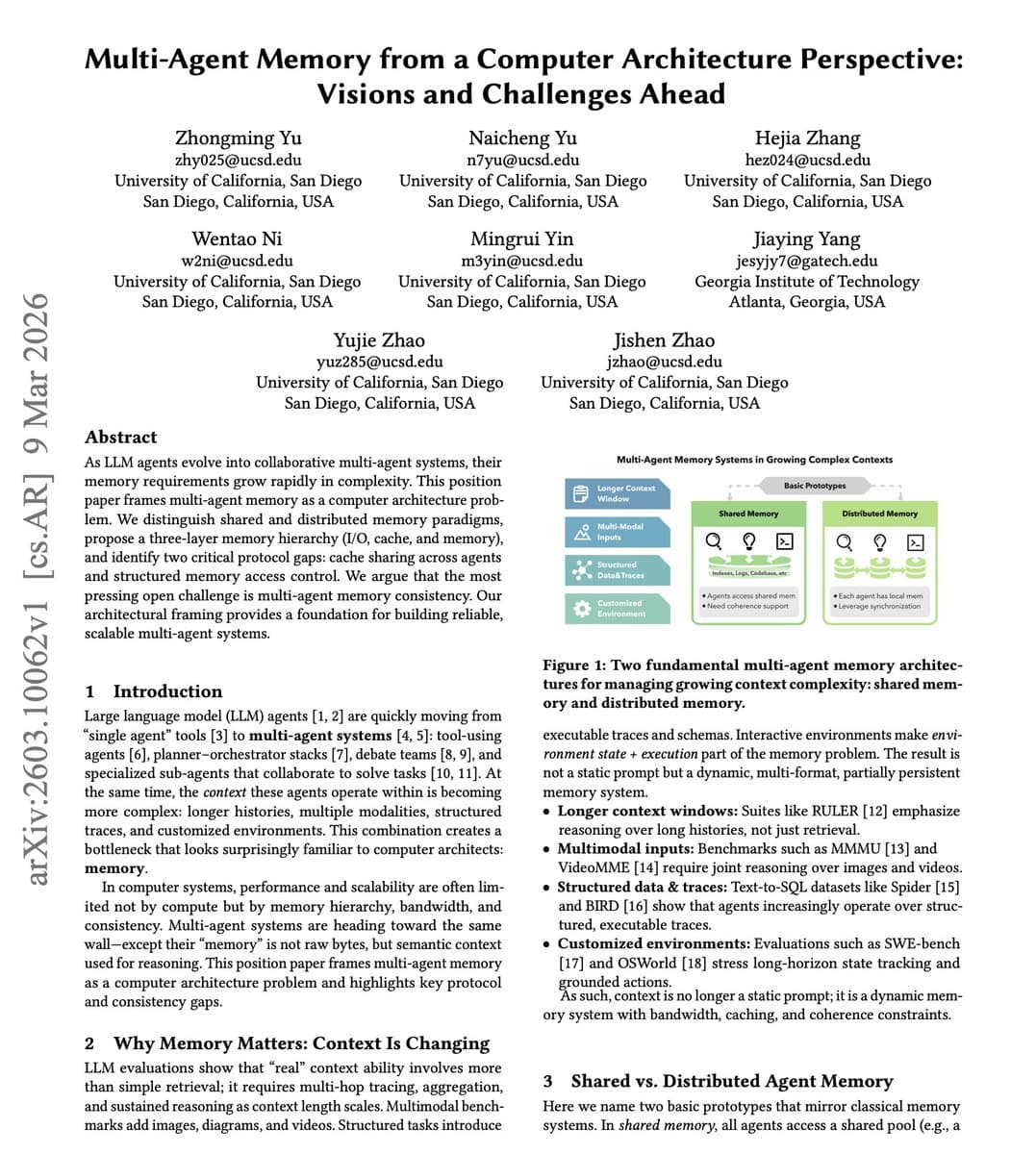
A groundbreaking new approach to AI agent memory is emerging that could fundamentally change how artificial intelligence systems learn, reason, and collaborate. Rather than treating memory as an afterthought, researchers are now proposing to view multi-agent memory systems through the lens of computer architecture—complete with hierarchies, caching mechanisms, and coherence protocols.
This shift comes at a critical moment in AI development. As Omar Sar, an AI researcher and developer, recently noted: "Memory is truly a game-changer for AI agents. Once I had memory set up correctly for my proactive agents, reasoning, skills, and tool usage improved significantly." Sar uses a combination of semantic search and keyword search with Obsidian vaults to create effective memory systems for his agents.
The Computer Architecture Approach to AI Memory
The core insight of the new framework is that agent memory systems today resemble human memory in their informality, redundancy, and difficulty to control. As agents evolve into collaborative multi-agent systems, their memory requirements grow rapidly in complexity. Context is no longer a static prompt but a dynamic memory system with bandwidth, caching, and coherence constraints.
The paper distinguishes between two fundamental memory paradigms: shared memory (where agents access a common memory space) and distributed memory (where each agent maintains its own memory). This distinction mirrors traditional computer architecture concepts and provides a structured way to think about how AI agents should store and retrieve information.
The Three-Layer Memory Hierarchy
At the heart of the proposed framework is a three-layer memory hierarchy:
- I/O Layer: The interface between agents and their environment, handling input/output operations
- Cache Layer: Fast-access memory for frequently used information
- Memory Layer: Long-term storage for comprehensive knowledge and experiences
This hierarchical approach allows for more efficient information retrieval and processing, similar to how computer processors use L1, L2, and L3 caches to optimize performance.
Critical Protocol Gaps Identified
The research identifies two significant protocol gaps in current AI memory systems:
Cache Sharing Across Agents: Currently, most AI agents maintain separate caches, leading to redundancy and inefficiency. The paper proposes mechanisms for agents to share cached information, potentially dramatically improving system performance.
Structured Memory Access Control: As multiple agents read from and write to shared memory concurrently, classical challenges of visibility, ordering, and conflict resolution emerge. The framework suggests implementing structured access protocols to manage these interactions.
The Multi-Agent Memory Consistency Challenge
The largest open challenge identified in the paper is multi-agent memory consistency. When multiple AI agents operate simultaneously, reading and writing to shared memory spaces, maintaining consistency becomes increasingly difficult. This problem mirrors similar challenges in distributed computing systems but with the added complexity of semantic understanding.
As the paper notes: "Multiple agents reading from and writing to shared memory concurrently raises classical challenges of visibility, ordering, and conflict resolution." Solving this consistency problem is crucial for creating truly collaborative AI systems that can work together effectively without conflicting or duplicating efforts.
From Raw Bytes to Semantic Context
Perhaps the most significant shift in perspective proposed by the framework is viewing memory not as raw bytes but as semantic context used for reasoning. This semantic approach to memory could enable AI agents to make more sophisticated connections between pieces of information and apply knowledge more effectively to new situations.
Implications for AI Development
This architectural approach to AI memory has several important implications:
Standardization: By treating memory as an architecture problem, the field could develop standardized approaches that make different AI systems more interoperable.
Performance Optimization: The hierarchical model provides clear pathways for optimizing memory access and improving agent performance.
Scalability: Structured memory systems should scale more effectively as AI systems grow in complexity and number of agents.
Collaboration: Better memory sharing protocols could enable more sophisticated multi-agent collaboration on complex tasks.
As AI systems become increasingly sophisticated and collaborative, their memory systems will need to evolve from simple storage mechanisms to complex, hierarchical architectures. This new framework provides a roadmap for that evolution, potentially unlocking new capabilities in reasoning, problem-solving, and collaborative intelligence.
The paper referenced in this discussion is available for those interested in the technical details of this approach to AI agent memory systems.