In the rapidly evolving field of artificial intelligence, there's a prevailing assumption that more complex systems yield better results. From multi-layered neural networks to intricate agent architectures, the trend has been toward increasing sophistication. However, groundbreaking research highlighted by AI researcher Omar Sar (omarsar0) challenges this assumption, demonstrating that sometimes less truly is more.
The Complexity Conundrum in Automated Theorem Proving
Automated theorem proving represents one of the most challenging frontiers in AI research. The task involves using computational methods to prove mathematical theorems automatically—a capability that requires sophisticated logical reasoning, pattern recognition, and symbolic manipulation. For decades, the prevailing approach has involved building complex, multi-component systems with significant computational overhead.
These traditional systems typically incorporate numerous specialized modules: parsers, proof assistants, search algorithms, heuristic evaluators, and verification components. While effective, this complexity creates several problems. First, it makes systems difficult to reproduce and validate. Second, it increases computational costs, limiting accessibility. Third, it creates maintenance challenges as systems grow increasingly convoluted.
A Radical Alternative: The Minimalist Agent
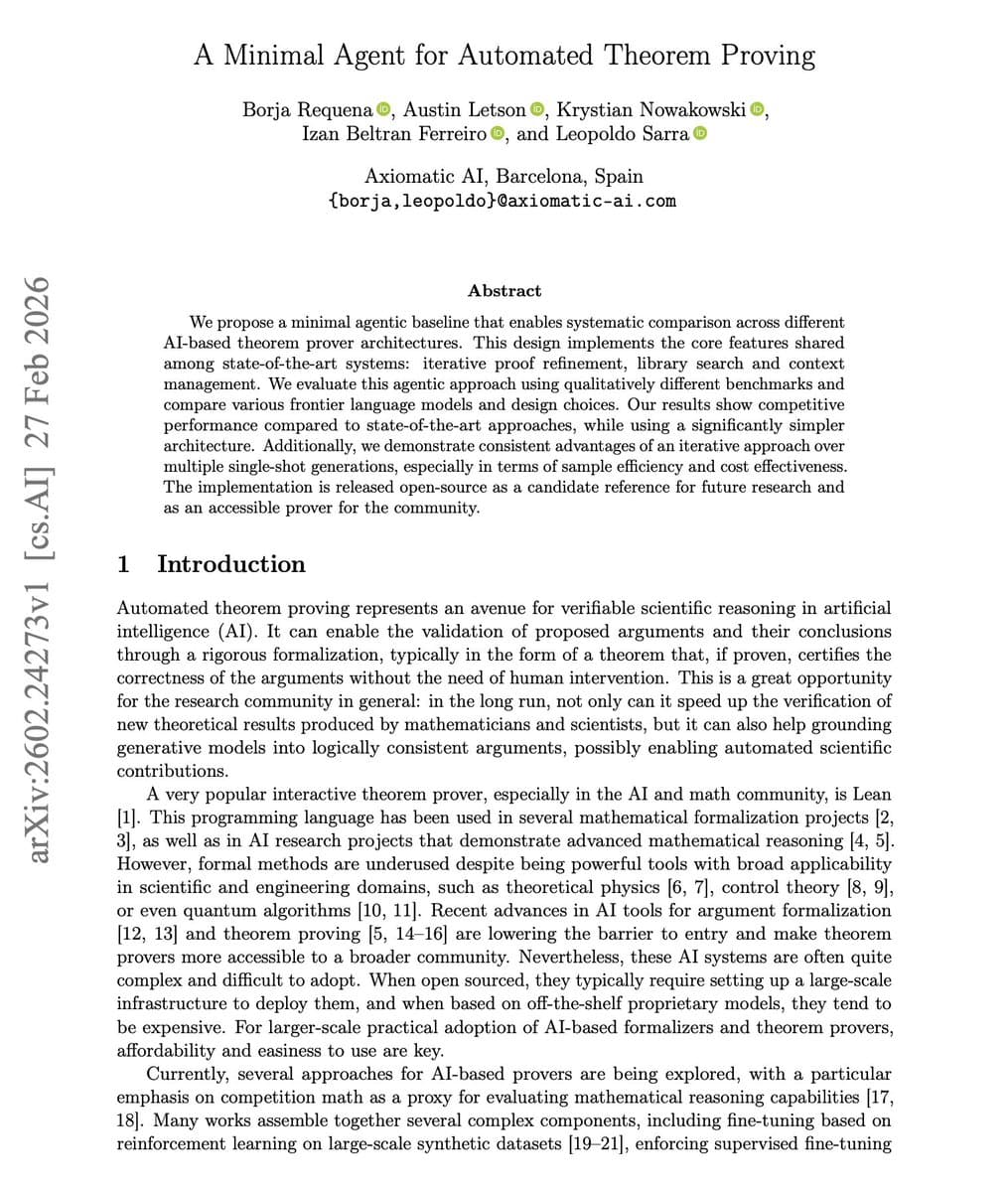
The research introduced by Sar presents a deliberately minimal agent architecture for formal theorem proving that interfaces with Lean, a popular proof assistant and programming language. This minimalist approach strips away unnecessary components while maintaining competitive performance on proof generation benchmarks.
What makes this approach revolutionary isn't just its simplicity, but its effectiveness. The agent demonstrates that sophisticated results don't necessarily require sophisticated infrastructure. By focusing on core functionality and eliminating redundant components, researchers have created a system that's not only capable but also more transparent, reproducible, and efficient.
Technical Architecture and Implementation
The minimalist agent operates on several key principles. First, it maintains a focused interface with Lean, avoiding the overhead of multiple proof assistant integrations. Second, it employs streamlined reasoning processes that prioritize essential operations over exhaustive search strategies. Third, it incorporates efficient memory management that reduces computational overhead without sacrificing capability.
This architecture contrasts sharply with traditional approaches that often incorporate multiple proof assistants, complex search algorithms with numerous heuristics, and elaborate verification pipelines. The minimalist agent proves that many of these components, while individually useful, may not be collectively necessary for achieving competitive performance.
Performance and Benchmark Results
Perhaps most surprisingly, this minimalist approach doesn't come at the cost of performance. The research demonstrates competitive results on established theorem proving benchmarks, challenging the assumption that complexity correlates directly with capability. The agent successfully handles a range of mathematical problems, from basic algebraic proofs to more complex logical theorems.
This performance achievement is particularly significant because it suggests that previous approaches may have been over-engineered. The research indicates that many theorem proving tasks can be accomplished with far simpler architectures than previously believed, opening new possibilities for efficient AI systems in mathematical reasoning.
Implications for AI Research and Development
The implications of this research extend far beyond automated theorem proving. They challenge fundamental assumptions about how we build AI systems across multiple domains:
Reproducibility Crisis: Complex AI systems are notoriously difficult to reproduce, contributing to what some researchers call a "reproducibility crisis" in AI. Minimalist architectures offer a path toward more transparent, reproducible research.
Computational Efficiency: As AI models grow increasingly large and computationally expensive, minimalist approaches could provide a counterbalance, enabling sophisticated capabilities with reduced resource requirements.
Accessibility: Simplified architectures lower barriers to entry, allowing more researchers and developers to work with advanced AI systems without requiring massive computational resources.
Maintainability: Simpler systems are easier to debug, maintain, and extend over time, potentially accelerating innovation cycles.
Broader Applications Beyond Theorem Proving
While this research focuses specifically on automated theorem proving, its principles could apply to numerous AI domains. Natural language processing, computer vision, robotics, and other fields that have trended toward increasing complexity might benefit from similar minimalist reevaluations.
The key insight is that complexity should be justified by measurable benefits rather than assumed to be necessary. This research provides a framework for questioning architectural assumptions and systematically evaluating whether each component truly contributes to system performance.
Future Research Directions
This work opens several promising research directions. First, researchers might explore how minimalist principles apply to other AI domains. Second, there's opportunity to develop methodologies for systematically identifying and eliminating unnecessary complexity in existing systems. Third, this approach could inform the design of next-generation AI systems that prioritize efficiency alongside capability.
Additionally, the research raises questions about optimal complexity levels for different tasks. While some problems undoubtedly require sophisticated approaches, this work suggests we may have overestimated how many fall into this category.
Conclusion: Embracing Simplicity as a Design Principle
The minimalist agent for automated theorem proving represents more than just a technical achievement—it embodies a philosophical shift in how we approach AI system design. By demonstrating that simplicity can be a feature rather than a limitation, this research challenges the field to reconsider its relationship with complexity.
As AI researcher Omar Sar emphasizes in his commentary, "Sophisticated results don't require sophisticated infrastructure." This insight could prove transformative as the field grapples with issues of computational cost, environmental impact, accessibility, and reproducibility.
The path forward may involve balancing necessary complexity with intentional simplicity—creating systems that are as simple as possible but no simpler. In an era of increasingly complex AI, this minimalist approach offers a refreshing and potentially revolutionary alternative.
Source: Research highlighted by Omar Sar (@omarsar0) demonstrating minimalist agent architecture for automated theorem proving with Lean.