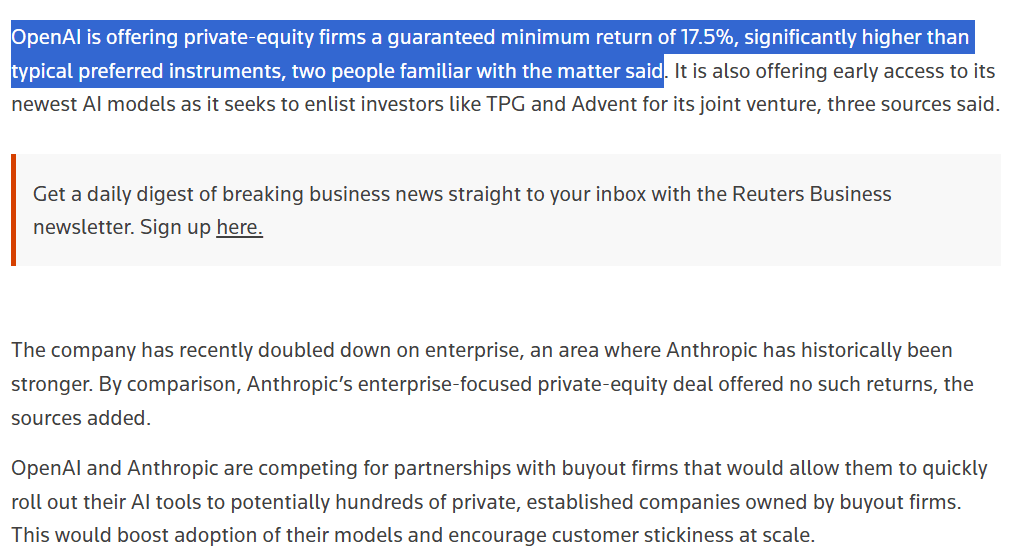
OpenAI is deploying an unusually aggressive financial incentive to capture the enterprise AI market, according to a report from independent researcher @kimmonismus. The company is offering private equity firms a 17.5% guaranteed return on investments tied to OpenAI usage, coupled with early access to new AI models, in a bid to secure long-term, large-scale enterprise partnerships.
The Deal Structure
The reported offer is a multi-pronged strategy designed to create immediate, high-value enterprise adoption. The core components are:
- A 17.5% Guaranteed Return: OpenAI is reportedly guaranteeing private equity (PE) firms a 17.5% return on capital directed toward investments or portfolio companies that commit to using OpenAI's technology stack. This is a direct financial incentive to choose OpenAI over competitors.
- Early Access to New Models: Partnering PE firms and their portfolio companies would receive priority access to new, unreleased AI models from OpenAI. This provides a potential competitive edge in product development and internal operations.
- Objective: Enterprise Lock-In: The strategy is explicitly designed to create high switching costs. By embedding OpenAI's models deeply into a PE firm's portfolio of companies—through long-term contracts and integrated workflows—OpenAI aims to secure a durable, defensible market position.
Strategic Context and Market Pressure
This move occurs against a backdrop of fierce competition in the enterprise AI space, primarily with Anthropic and its Claude models, but also with growing offerings from Google, Meta, and open-source providers. Enterprise contracts are particularly valuable as they represent stable, high-volume revenue and serve as validation for broader market adoption.
Offering a guaranteed return is highly unusual for a technology company and more akin to a financial instrument. It suggests OpenAI is willing to use its significant war chest—bolstered by investments from Microsoft and others—to buy market share and accelerate its distribution network through PE portfolios, which can dictate technology choices across dozens or hundreds of companies.
As noted in the analysis, this is less a sign of panic and more a "high-confidence land grab with expensive incentives." It indicates OpenAI's belief that securing dominant enterprise distribution now is critical to long-term market leadership, and that the cost of these incentives is justified by the future revenue and ecosystem control they would secure.
Unanswered Questions and Implications
The report leaves several key details unclear, which will be critical for assessing the full impact:
- Specific Terms: The exact structure of the guaranteed return (e.g., over what timeframe, on what specific capital commitments) is not detailed.
- Scale and Recipients: It is unknown how many PE firms have been offered this deal or which ones have accepted.
- Competitive Response: How Anthropic, Google, and others will respond to this aggressive tactic remains to be seen. A bidding war for enterprise channels through financial guarantees could emerge.
For enterprise technology leaders, this development signals that AI vendors may begin competing on partnership economics beyond just model capabilities and price-per-token. The ability to influence procurement decisions at the private equity ownership level adds a new, complex layer to enterprise AI strategy.
gentic.news Analysis
This is a fascinating and potentially disruptive escalation in the enterprise AI wars. OpenAI is effectively leveraging its capital position to circumvent traditional sales cycles and procurement hurdles. The 17.5% guarantee isn't a product discount; it's a financial derivative attached to AI adoption, transforming a technology sale into an investment vehicle. This tactic is rarely seen outside of massive infrastructure projects or telecoms, and its use here underscores the perceived winner-take-all dynamics in foundational model deployment.
Technically, the "early model access" perk is equally significant. For data-driven enterprises, being even a few weeks ahead on a new GPT-4.5 or GPT-5 class model can translate into material advantages in product features or operational efficiency. By offering this through PE channels, OpenAI is creating a two-tiered access model where strategic partners get a time-based advantage, further cementing their reliance on the OpenAI ecosystem.
The major risk for OpenAI is the financial liability. Guaranteeing returns is a capital-intensive strategy that bets heavily on rapid, widespread adoption generating enough revenue to cover the guarantees. It also invites scrutiny on whether such incentives could distort fair competition. If this proves successful, expect well-funded rivals to explore similar structures, potentially turning the enterprise LLM market into a contest of balance sheets as much as one of research breakthroughs.
Frequently Asked Questions
What is OpenAI offering private equity firms?
OpenAI is reportedly offering private equity firms a two-part incentive: a 17.5% guaranteed return on investments linked to adopting OpenAI technology, and early access to new, unreleased AI models for their portfolio companies.
Why is OpenAI offering a guaranteed return?
This is a strategic move to rapidly secure large-scale enterprise adoption through private equity portfolios. By offering a financial guarantee, OpenAI aims to lock in long-term contracts and create high switching costs, ensuring its models become deeply embedded across many companies at once in a highly competitive market.
How does this affect the enterprise AI competitive landscape?
It significantly raises the stakes. Competing primarily on model performance and price is now joined by competition on partnership economics and financial engineering. Rivals like Anthropic may feel pressure to respond with similar high-value incentives to protect their enterprise sales pipelines.
What are the risks of this strategy for OpenAI?
The primary risk is financial. Guaranteeing returns requires significant capital and assumes the adopted AI services will generate enough revenue to cover those guarantees. There is also execution risk in onboarding potentially hundreds of portfolio companies simultaneously and the regulatory risk of such aggressive incentives attracting scrutiny.