According to a report from The Information cited by AI researcher Rohan Paul, OpenAI is preparing to launch GPT-5.4 with a revolutionary 1 million token context window. This development places OpenAI's flagship model directly alongside competitors like Google's Gemini and Anthropic's Claude in the race for long-context AI capabilities. But the implications extend far beyond mere competitive positioning—this advancement could fundamentally reshape how we interact with artificial intelligence.
The Context Window Arms Race
For years, context length has been one of the most significant limitations in large language models. Early versions of GPT-3 struggled with just a few thousand tokens, while GPT-4 increased this to 8,000 and later 32,000 tokens through various iterations. The jump to 1 million tokens represents more than a 30-fold increase over GPT-4's standard context window and marks a critical threshold where models can process entire books, lengthy legal documents, or extensive codebases in a single interaction.
This development comes as no surprise in the competitive landscape. Anthropic's Claude 3 already offers a 200,000 token context window, while Google's Gemini 1.5 Pro famously demonstrated a 1 million token capability earlier this year. OpenAI's move to match this capacity suggests that long-context processing has become table stakes for leading AI models, with each major player recognizing that memory and processing breadth are as important as reasoning quality.
Beyond Length: The Extreme Reasoning Mode
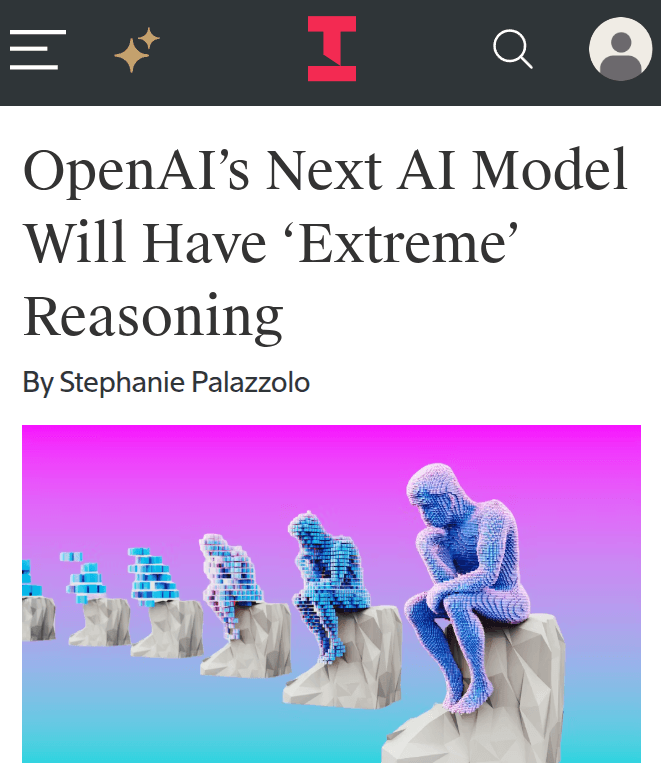
Perhaps more intriguing than the expanded context window is GPT-5.4's new "Extreme reasoning mode," which reportedly allows for deeper processing by utilizing additional computational resources. This feature appears designed specifically for complex, multi-step problems that require sustained analytical thinking—the kind of tasks where current models often stumble or produce inconsistent results.
The technical implementation likely involves some form of chain-of-thought optimization or enhanced reasoning loops that allow the model to spend more "thinking time" on difficult problems. This approach mirrors human problem-solving, where we often need to pause, reconsider, and approach challenges from multiple angles before arriving at a solution.
OpenAI's documentation suggests this mode results in "much more reliable performance for complex tasks" and shows "lower error rates across the board." If these claims hold true, GPT-5.4 could represent a significant leap in reliable AI reasoning, moving beyond impressive demos to genuinely trustworthy problem-solving in professional contexts.
Practical Applications: From AI Agents to Scientific Discovery
The combination of extended context and enhanced reasoning opens doors to previously impractical applications. According to the report, GPT-5.4 can "manage long-horizon tasks that run for hours," making it "ideal for agents and scientific research."
For autonomous AI agents, this capability is transformative. Current agent systems often struggle with maintaining coherence over extended operations, losing track of objectives or context as tasks progress. With a 1 million token window, agents could maintain detailed memory of their actions, environmental states, and evolving goals across hours of operation. This could enable truly persistent digital assistants, research collaborators, or workflow automation systems that don't require constant human supervision.
In scientific research, the implications are equally profound. Researchers could upload entire datasets, literature reviews, or experimental protocols and ask the model to identify patterns, suggest methodologies, or even generate hypotheses. The extended context would allow the AI to maintain awareness of all relevant information simultaneously, potentially accelerating discovery across fields from genomics to materials science.
The Strategic Shift: Monthly Updates and Rapid Iteration
Perhaps the most telling aspect of this announcement is what it reveals about OpenAI's evolving strategy. The company is reportedly "shifting their strategy to release monthly model updates to keep things moving fast." This represents a significant departure from the previous approach of major releases separated by months or even years.
This accelerated release cadence suggests several strategic realities:
- Intensified competition in the AI space is forcing faster innovation cycles
- Modular architecture allows for more frequent, incremental improvements
- Customer expectations have shifted toward continuous improvement rather than occasional breakthroughs
- Technical infrastructure now supports more rapid deployment and testing
For developers and enterprises building on OpenAI's platform, this shift presents both opportunities and challenges. More frequent updates mean access to cutting-edge capabilities sooner, but also require more adaptable integration strategies and potentially more testing overhead.
Technical Challenges and Considerations
While a 1 million token context window sounds impressive, it's important to understand the practical limitations and trade-offs involved. Processing such extensive contexts requires significant computational resources, which translates to higher costs for both OpenAI and its users. The "Extreme reasoning mode" likely exacerbates this cost equation, trading efficiency for accuracy.
There are also architectural challenges to consider. Simply scaling existing attention mechanisms to handle 1 million tokens would be computationally prohibitive. OpenAI has likely implemented more efficient attention variants, possibly similar to the mixture-of-experts approach used in other large models or specialized memory management systems.
Another consideration is retrieval accuracy—the ability to find and utilize relevant information within that massive context. As context windows expand, the challenge shifts from having enough memory to effectively accessing the right memories at the right time. OpenAI will need to demonstrate that GPT-5.4 can not only store vast amounts of information but also retrieve and apply it intelligently.
The Competitive Landscape Reshaped
With this announcement, the competitive dynamics in the AI space become clearer. We're seeing convergence around several key capabilities:
- Extended context (approaching or reaching 1 million tokens)
- Multimodal understanding (text, images, audio, video)
- Reasoning reliability for complex tasks
- Cost-effective scaling for enterprise deployment
OpenAI's move suggests they believe they can compete effectively on all these fronts simultaneously. The monthly update strategy indicates confidence in their technical pipeline and their ability to maintain pace with—or exceed—competitors' innovations.
Looking Forward: Implications for Developers and Businesses
For developers, GPT-5.4's capabilities suggest new architectural possibilities. Applications that previously required complex chunking, summarization, and memory management systems might now be achievable with simpler implementations. The extended context could reduce the need for sophisticated retrieval systems in many use cases, though specialized retrieval will still be necessary for truly massive knowledge bases.
Businesses should consider how these advancements might reshape their AI strategies. The ability to process entire document collections, lengthy transaction histories, or extended customer interactions in a single context could enable more sophisticated analytics, personalized experiences, and automated decision-making.
However, organizations must also consider the cost implications of utilizing these advanced capabilities. The "Extreme reasoning mode" in particular may come with premium pricing, requiring careful evaluation of when the additional accuracy justifies the expense.
Conclusion: A New Era of AI Capability
GPT-5.4's 1 million token context window represents more than just a technical specification—it signals a shift in what's possible with artificial intelligence. When combined with enhanced reasoning capabilities and a faster release cadence, this development suggests we're entering an era where AI can tackle increasingly complex, extended, and meaningful tasks.
The true test will come not in demos or benchmarks, but in real-world applications. Can researchers actually accelerate discoveries? Can businesses build more effective automated systems? Can developers create applications that were previously impossible? If GPT-5.4 delivers on its promise, the answers to these questions might reshape our relationship with technology in fundamental ways.
As with all AI advancements, responsible deployment will be crucial. The increased capability brings increased responsibility—for accuracy, for fairness, and for appropriate use. But if managed thoughtfully, GPT-5.4 could represent a significant step toward AI systems that genuinely augment human intelligence rather than merely mimicking it.
Source: The Information report cited by Rohan Paul on X/Twitter