In a significant move that challenges the dominance of proprietary embedding APIs, Perplexity has unveiled pplx-embed, a collection of multilingual embedding models optimized for large-scale retrieval tasks. This release comes at a critical juncture in AI development, following recent discoveries about LLM limitations and capabilities, including the 'double-tap effect' where repeating prompts dramatically improves accuracy from 21% to 97%.
The Architecture Revolution: From Causal to Bidirectional
Most Large Language Models (LLMs) utilize causal, decoder-only architectures designed primarily for text generation. However, for embedding tasks—where the goal is to create dense vector representations of text for similarity matching and retrieval—this architecture presents fundamental limitations. Perplexity's innovation lies in implementing bidirectional attention mechanisms within their Qwen3-based models, allowing the system to consider context from both directions when creating embeddings.
This architectural shift represents more than just a technical tweak; it fundamentally changes how AI systems understand and represent textual information for retrieval purposes. While traditional LLMs process text sequentially (left-to-right), bidirectional models can capture richer semantic relationships by considering the full context surrounding each token.
Specialized Models for Different Retrieval Scenarios
Perplexity has released two specialized variants of their embedding model, each optimized for specific retrieval scenarios:
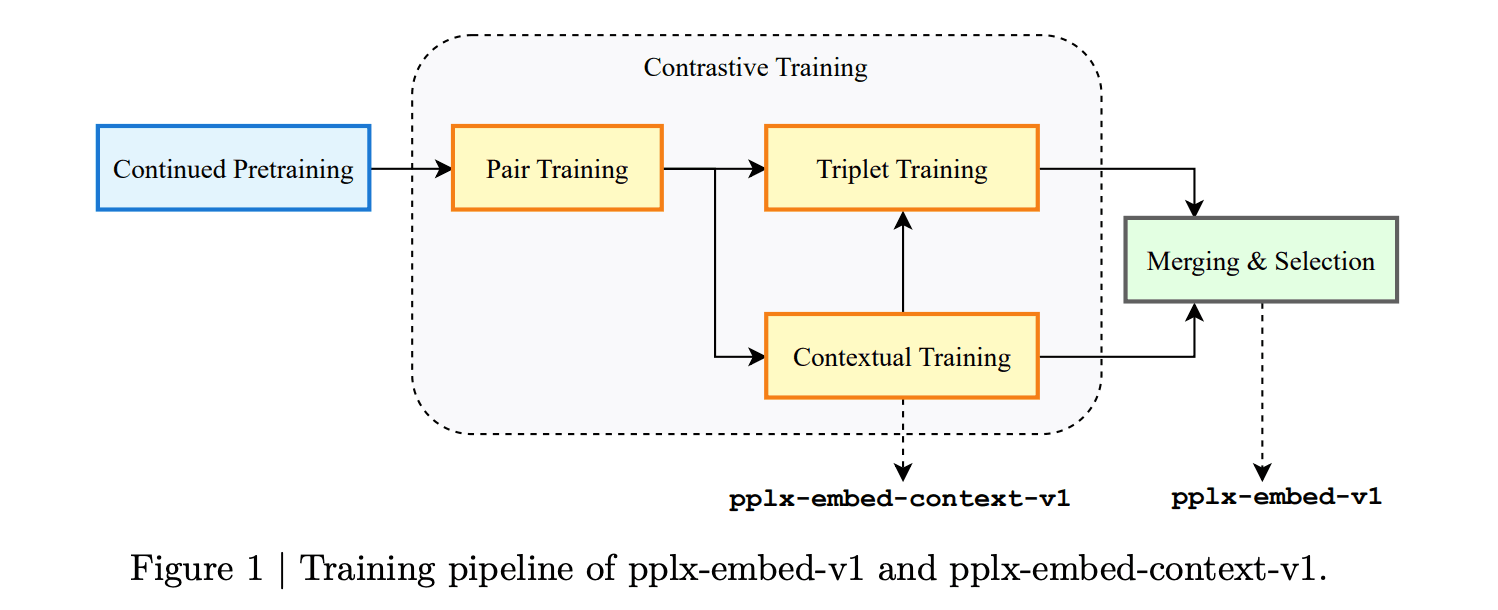
pplx-embed-v1 is tuned for independent queries and standalone text, making it ideal for general search applications and question-answering systems where queries need to be matched against large document collections.
pplx-embed-context-v1 is specifically designed for document chunks, ensuring better alignment in retrieval-augmented generation (RAG) pipelines where context preservation across document boundaries is crucial.
This specialization addresses a common pain point in RAG systems: the mismatch between how queries are embedded versus how document chunks are represented. By optimizing separately for these distinct use cases, Perplexity aims to improve retrieval accuracy and relevance in production systems.
Web-Scale Optimization: Handling Real-World Noise
What sets pplx-embed apart from academic embedding models is its explicit optimization for web-scale data complexity. The internet presents unique challenges for retrieval systems: inconsistent formatting, mixed languages, advertising content, user-generated noise, and varying content quality. Traditional embedding models often struggle with this heterogeneity, leading to degraded performance in real-world applications.
Perplexity's models have been trained and tuned specifically to handle these challenges, making them "production-ready" alternatives to existing solutions. This focus on practical deployment distinguishes pplx-embed from research-oriented models that excel on clean benchmarks but falter in messy, real-world environments.
The Competitive Landscape: Challenging Proprietary APIs
The release positions Perplexity as a serious competitor to proprietary embedding services from major AI providers. By offering state-of-the-art performance with open accessibility, pplx-embed could accelerate the democratization of advanced retrieval capabilities. This development is particularly significant given the growing importance of RAG systems in enterprise AI deployments, where reliable, scalable retrieval forms the foundation for accurate, up-to-date AI responses.
Multilingual Capabilities and Global Accessibility
As a multilingual model family, pplx-embed addresses another critical limitation in current embedding solutions: language bias. Most high-performance embedding models have been optimized primarily for English, creating barriers for global applications. Perplexity's approach suggests a more inclusive design philosophy, potentially opening advanced retrieval capabilities to a wider range of languages and cultural contexts.
Implications for AI Development and Deployment
The timing of this release is noteworthy, coming just days after research revealed critical gaps in LLM responses to technology-facilitated abuse scenarios. This context highlights the growing recognition that foundational AI capabilities—like retrieval—need continuous improvement to handle complex, sensitive real-world applications.
For developers and enterprises, pplx-embed offers several advantages:
- Reduced dependency on proprietary API providers
- Improved performance on noisy, real-world data
- Specialized optimization for different retrieval scenarios
- Multilingual support for global applications
- Production-ready design with web-scale considerations
The Future of Retrieval-Augmented Systems
As AI systems increasingly rely on external knowledge through RAG architectures, the quality of retrieval components becomes paramount. Perplexity's bidirectional approach represents a significant step forward in creating embeddings that better capture semantic meaning in context. This advancement could lead to more accurate, reliable AI systems across applications from customer support to research assistance to enterprise knowledge management.
The specialized nature of the two model variants also points toward a future where retrieval systems become increasingly tailored to specific use cases, moving beyond one-size-fits-all solutions. This specialization trend aligns with broader movements in AI toward more targeted, efficient models rather than monolithic general-purpose systems.
Conclusion: A New Benchmark in AI Retrieval
Perplexity's pplx-embed release marks an important milestone in the evolution of AI retrieval capabilities. By combining bidirectional architecture with web-scale optimization and specialized variants, these models address practical challenges that have limited real-world deployment of advanced RAG systems. As organizations increasingly seek to ground AI responses in accurate, up-to-date information, improvements in retrieval technology become essential infrastructure for the next generation of AI applications.
The success of pplx-embed will ultimately be measured not by benchmark scores but by its impact on production systems—how well it handles the messy reality of web-scale data, how reliably it serves global multilingual applications, and how effectively it enables more accurate, trustworthy AI interactions. Based on its architectural innovations and practical design focus, pplx-embed appears positioned to set a new standard in this critical domain of AI infrastructure.