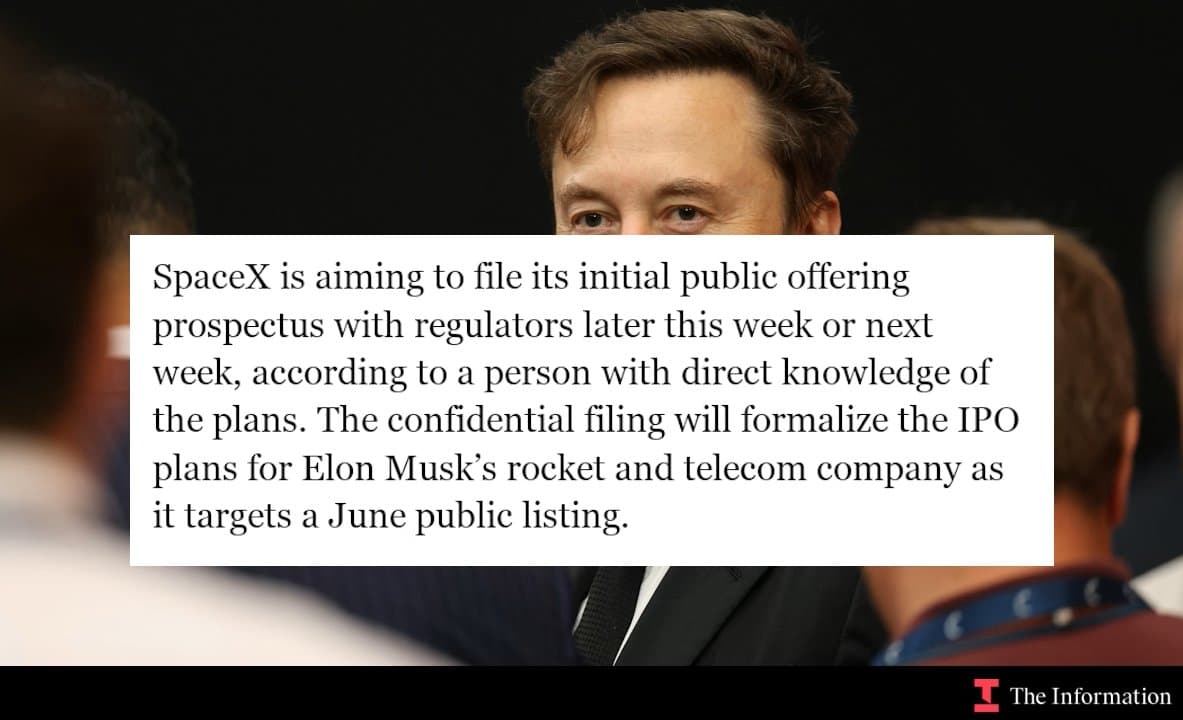
SpaceX is preparing to file its initial public offering (IPO) prospectus with U.S. regulators as early as this week, according to a report from @kimmonismus. The filing would formalize plans for a public market debut in June that is now projected to raise over $75 billion, positioning it to become the largest IPO in U.S. history.
What the Filing Entails
The imminent filing with the Securities and Exchange Commission (SEC) would be the first official, public step in SpaceX's transition from a privately-held company to a publicly-traded entity. This prospectus, known as an S-1 registration statement, will disclose detailed financials, business risks, operational metrics, and the company's capital structure—information that has been closely guarded during its two decades as a private company.
Advisers close to the deal have revised their estimates upward from earlier projections of $50 billion to now predict the offering could raise more than $75 billion. However, the final sizing and valuation won't be formally set until weeks before the actual launch of the IPO, which is currently targeted for June.
Historical Context and Scale
If SpaceX achieves its projected $75+ billion raise, it would shatter the current U.S. IPO record held by Meta Platforms (formerly Facebook), which raised $16 billion in its 2012 debut. The largest global IPO remains Saudi Aramco's $25.6 billion offering in 2019, though that figure is dwarfed by SpaceX's current projections.
The scale reflects SpaceX's transformation from a risky startup that nearly failed in 2008 to a dominant force in space launch services, with its Falcon 9 rocket now responsible for the majority of global orbital launches. The company has also developed the Starship super-heavy launch system and operates the Starlink satellite internet constellation, which has grown to over 2.5 million customers worldwide.
Market Implications
A SpaceX IPO of this magnitude would represent one of the most significant liquidity events in technology history, creating substantial wealth for early investors including Founders Fund, Google, and Fidelity, along with employees who hold equity. It would also provide retail investors their first opportunity to directly invest in a company that has fundamentally reshaped the space industry through reusable rocket technology.
The timing is notable as it follows a period of intense capital investment in SpaceX's Starship development program and rapid expansion of the Starlink constellation, both of which require substantial ongoing funding despite the company's reported profitability in its launch services division.
What Comes Next
Once the S-1 is filed, there will typically be a quiet period followed by an SEC review process, roadshow presentations to institutional investors, and finally pricing and trading commencement. The June target suggests an accelerated timeline compared to typical IPOs, possibly reflecting both market conditions and SpaceX's operational cadence.
gentic.news Analysis
This development represents a watershed moment for both the commercial space industry and the broader technology sector. SpaceX's path to public markets has been unusually long—most technology companies with similar transformative impact (like Google or Amazon) went public much earlier in their growth cycles. Elon Musk has historically been reluctant to take SpaceX public, citing the long-term, capital-intensive nature of space exploration and the quarterly reporting pressures that conflict with multi-decade ambitions like Mars colonization.
The revised $75+ billion estimate, up 50% from earlier projections, suggests extraordinary investor appetite despite recent volatility in technology stocks. This aligns with our coverage of the increasing institutional allocation to "hard tech" and infrastructure companies as investors seek tangible assets beyond software platforms. The IPO would immediately make SpaceX one of the most valuable aerospace companies globally, potentially surpassing established giants like Lockheed Martin ($110B market cap) and Boeing ($100B market cap) within a few years of trading.
Notably, this follows SpaceX's $100 million secondary share sale in late 2023 that valued the company at approximately $180 billion privately. The public valuation will test whether public market investors apply the same premium for growth potential as private investors have. The success or struggle of this offering will significantly impact the entire New Space sector, including competitors like Rocket Lab (already public) and Blue Origin (still private), potentially triggering a wave of space technology IPOs if SpaceX receives a strong reception.
Frequently Asked Questions
When exactly will SpaceX go public?
According to the report, SpaceX is targeting a June public listing, with the IPO prospectus filing expected as early as this week. The exact trading date will depend on SEC review timelines and market conditions, but June appears to be the current target month.
How much will SpaceX be worth after the IPO?
While the exact valuation won't be set until closer to the IPO date, the $75+ billion raise target suggests an enormous market capitalization. For context, if SpaceX were to raise $75 billion while selling 10-15% of the company (a typical IPO percentage), the implied valuation would be between $500 billion and $750 billion, though the actual percentage sold and valuation will be determined during the roadshow process.
Can individual investors buy SpaceX stock in the IPO?
Typically, IPO shares are initially allocated to institutional investors and high-net-worth clients of the underwriting banks. However, once trading begins on the public exchange (likely the NASDAQ), any investor with a brokerage account can purchase shares. Some brokerage platforms also offer limited IPO access to retail investors, though allocations are usually small.
What does this mean for Tesla and Elon Musk's other companies?
Elon Musk is CEO of both SpaceX and Tesla, and the SpaceX IPO could significantly increase his personal liquidity, potentially affecting his ability to fund other ventures like xAI, Neuralink, and The Boring Company. However, Musk has stated he intends to maintain voting control of SpaceX post-IPO, similar to his structure at Tesla, ensuring continued alignment with his long-term vision for the company.