Key Takeaways
- Adopt MCP 2.0 (2026-07-28 spec) for stateless, single-request tool calls.
- Use mcp-explorer to probe servers and datasette-mcp to expose SQL endpoints, cutting complexity and overhead.
What Changed — The 2026-07-28 MCP Specification
The Model Context Protocol just got its biggest update since launch. The new spec, published July 28, 2026, makes MCP stateless. This is a fundamental shift that simplifies everything.
Two headline changes from the changelog:
- Removed protocol-level sessions and the
Mcp-Session-Idheader from the Streamable HTTP transport. - Removed the
initialize/notifications/initializedhandshake. Every request now carries its protocol version and client capabilities in a_metafield.
Before (legacy MCP): Two HTTP requests — first to initialize and get a session ID, second to call the tool.
After (stateless MCP): One HTTP request does it all. Here's the new format:
POST /mcp HTTP/1.1
MCP-Protocol-Version: 2026-07-28
Mcp-Method: tools/call
Mcp-Name: search
Content-Type: application/json

{
  "jsonrpc": "2.0",
  "id": 1,
  "method": "tools/call",
  "params": {
    "name": "search",
    "arguments": {
      "q": "otters"
    },
    "_meta": {
      "io.modelcontextprotocol/clientInfo": {
        "name": "my-app",
        "version": "1.0"
      }
    }
  }
}
This is cleaner from both client and server implementation perspectives. No server-side state to track, no session routing to worry about across backend machines.
What It Means For You — Simpler, Safer Tools
For Claude Code users, this changes the calculus on MCP. Previously, many developers found that giving an agent a shell with curl was more flexible than MCP. But that approach is fraught with risk — it requires a strong model and exposes a lot of attack surface.
MCP tools are easier to audit and control. They're simple enough that smaller models running on a laptop can drive them well. With stateless MCP, building and deploying these tools is dramatically easier.
Simon Willison built three MCP implementations in a week using the new spec:
mcp-explorer— A CLI tool for interactively probing any MCP server. Run it without installing via uvx:uvx mcp-explorer list https://agentic-mermaid.dev/mcpInspect a tool's schema:
uvx mcp-explorer inspect render_svgCall a tool with arguments:
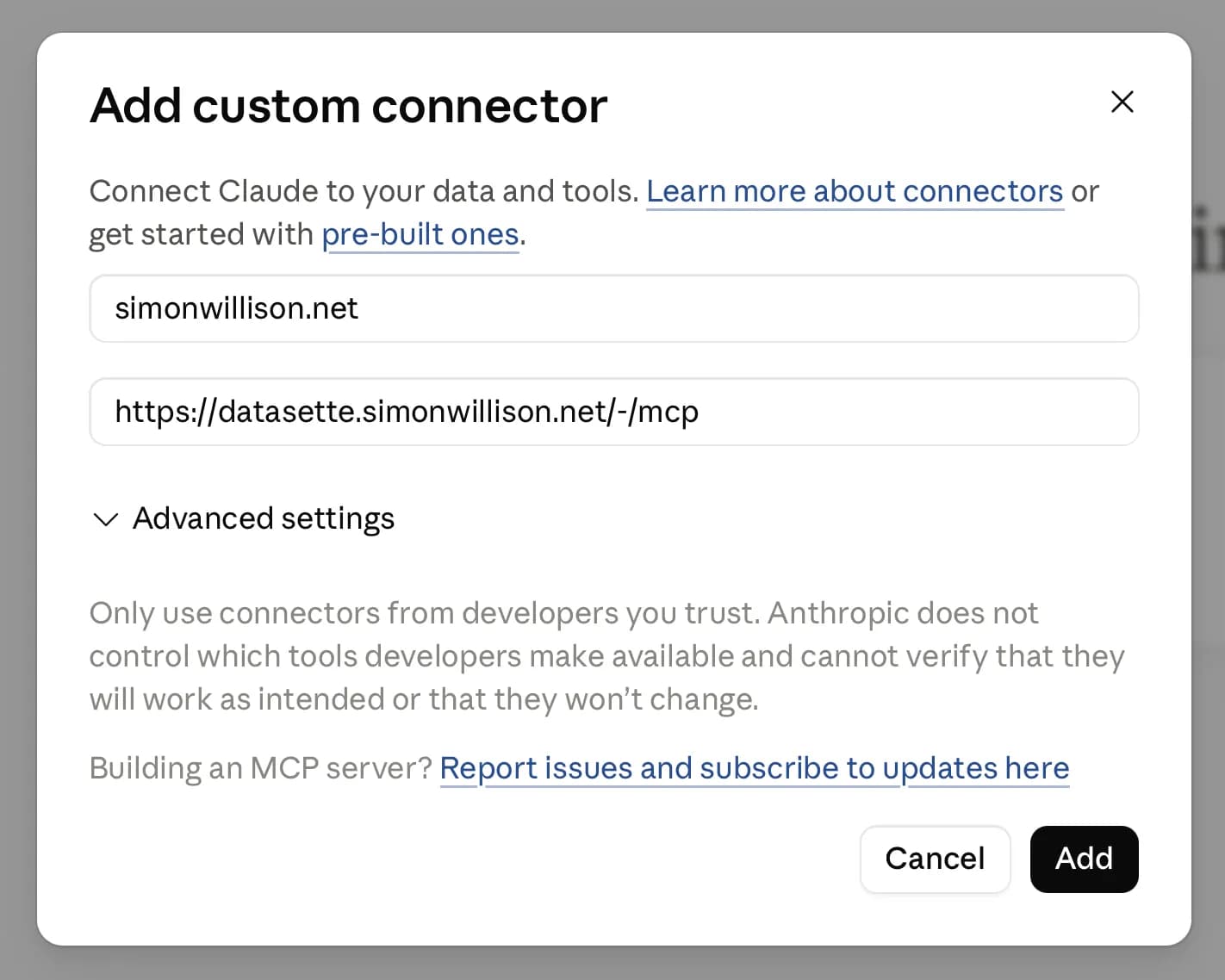
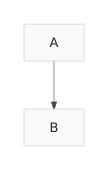
uvx mcp-explorer call https://agentic-mermaid.dev/mcp render_svg -a source 'graph TD; A-->B' -a options '{"padding":24}'datasette-mcp— A Datasette plugin that adds a/-/mcpendpoint to any instance. It exposes three tools:list_databases(),get_database_schema(database_name), andexecute_sql(database_name, sql)(read-only for now). Wire this into Claude, and it can run SQL queries against your hosted data.llm-mcp-client— An alpha plugin for Simon's LLM tool. Usage example:llm install llm-mcp-client llm -T 'MCP("https://datasette.simonwillison.net/-/mcp")' 'count the notes'
Try It Now — Get Started with Stateless MCP
- Probe an existing MCP server. Use
mcp-explorerto see what tools are available and test them without writing any code.
Expose your data. If you run Datasette, install the
datasette-mcpplugin and point Claude Code at your instance. Here's a shared session where Claude ran 7 SQL queries to answer a question about Simon's blog.Build your own server. The stateless spec is simple enough that you can implement a server in an afternoon. Start with a single endpoint that handles
tools/listandtools/call.
Watch out for version mismatches: The RC and final spec renumbered error codes. -32004 (UnsupportedProtocolVersion) became -32022. If you built against the RC, update your error handling. Simon's own test harness shipped with the wrong code, and his tests stayed green because they were wrong in the same direction as the code.
The Bigger Picture
MCP had a huge spike in 2025, then got eclipsed by Skills. But the stateless redesign brings it back as a safer, more auditable alternative to giving agents full shell access. For teams running smaller models or needing tighter control, MCP is now a much more compelling option.
Check the full changelog for the 2026-07-28 spec, including the new extensions framework and RFC 9207 authorization validation requirements.
Source: simonwillison.net
[Updated 03 Aug via simon_willison]
The stateless MCP rollout was dubbed 'Stateless MCP day' on social media, with Ade Oshineye's agentic-mermaid.dev demo server serving as a key testbed. Simon Willison's mcp-explorer tool was built with assistance from Codex, and its tool listing reveals five Mermaid-related functions, including execute for sandboxed JavaScript and render_png for rasterized output. The new spec also formalizes RFC 9207 authorization validation requirements, extending security beyond session removal [per Simon Willison].