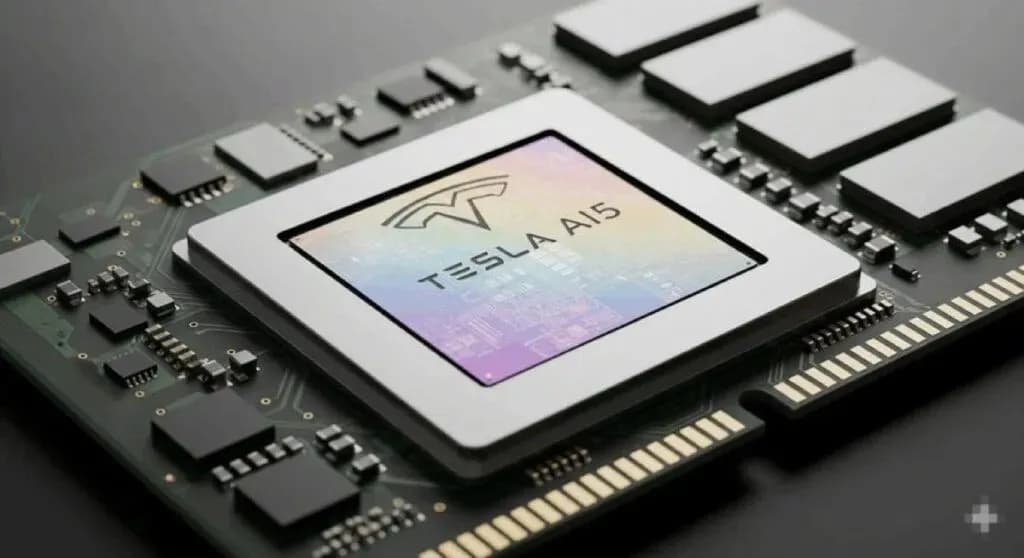
A recent analysis of Terafab's stated manufacturing goals reveals the staggering scale of semiconductor production required to power next-generation AI compute clusters. Based on the company's targets, achieving 1 gigawatt (GW) of AI compute capacity would necessitate approximately 190,000 wafer starts per month (wspm) across logic and memory fabrication.
What the Numbers Show
The breakdown, as highlighted by industry analyst Ben Bajarin, specifies the following monthly wafer capacity requirements per 1GW of compute:
- ~50,000 wspm of logic (presumably advanced nodes for processors)
- ~140,000 wspm of DRAM (for high-bandwidth memory)
This totals roughly 190,000 wafer starts per month dedicated to a single 1GW AI compute deployment. For context, a large, state-of-the-art semiconductor fabrication plant (or "fab") might have a capacity in the range of 50,000 to 100,000 wafer starts per month. Therefore, Terafab's goal for a single cluster would require the equivalent output of 2-4 major fabs running at full capacity.
The Context of Scale
The term "Terafab" itself suggests a focus on terascale or extreme-scale manufacturing. In the AI hardware race, compute is increasingly measured in total power draw (megawatts and gigawatts) as a proxy for performance, given the direct relationship between power consumption and FLOPs (floating-point operations per second). Companies like NVIDIA, AMD, and custom silicon developers (e.g., Google's TPU, Amazon's Trainium) are all pushing for denser, more powerful systems.
A 1GW cluster represents an enormous installation. For comparison, some of the world's largest data centers today have total power capacities measured in the hundreds of megawatts. A 1GW AI cluster would be a facility of unprecedented density, likely requiring direct access to substantial power generation and advanced cooling solutions.
The Manufacturing Challenge
The analysis underscores a critical bottleneck in the AI boom: advanced semiconductor manufacturing capacity. The required ~50,000 wspm for logic chips would almost certainly need to be on the most advanced process nodes (e.g., 3nm, 2nm) to achieve the necessary performance and power efficiency. This capacity is currently concentrated at a handful of companies, primarily TSMC, Samsung, and Intel.
The even larger demand for DRAM (~140,000 wspm) highlights the memory bandwidth wall that AI training and inference face. High-Bandwidth Memory (HBM) stacks are essential for feeding data to massive AI accelerators, but their production is complex and capacity-constrained.
gentic.news Analysis
This analysis of Terafab's goals spotlights the most pressing, physical constraint on AI scaling: the supply chain for advanced semiconductors. It's no longer just a question of chip design or software algorithms; it's a question of how many wafers can be produced per month. This aligns with the broader trend we've covered, where AI progress is becoming gated by hardware manufacturing and energy infrastructure, not just research breakthroughs.
Our previous reporting on NVIDIA's Blackwell platform and its GB200 NVL72 systems highlighted the industry's move toward liquid-cooled, rack-scale systems that already push power and thermal limits. Terafab's projected scale is the logical, extreme extension of this trend. Furthermore, this context connects to the intense competition for TSMC's CoWoS (Chip-on-Wafer-on-Substrate) advanced packaging capacity, a critical bottleneck for assembling the very chips that would go into these wafers. Companies like NVIDIA, AMD, and Intel are all vying for this scarce packaging resource, as we detailed in our coverage of the 2025 chip supply crunch.
The 1GW target also intersects with the energy discourse surrounding AI. As we analyzed in "The Megawatt Era of AI," the industry's power demands are drawing scrutiny from utilities and policymakers. A single 1GW cluster would consume roughly the same amount of power as a mid-sized nuclear reactor unit, framing AI's expansion as a major infrastructure challenge.
Frequently Asked Questions
What is a "wafer start per month" (wspm)?
A wafer start per month is a standard metric in semiconductor manufacturing that counts the number of silicon wafers that begin the fabrication process in a given month. It's a measure of a factory's (fab's) capacity. A typical leading-edge logic fab today might have a capacity of 50,000-100,000 wspm.
How much AI compute is 1 gigawatt (GW)?
One gigawatt of power for an AI data center represents an immense amount of computing capability. As a rough analogy, if the AI accelerators (like GPUs) in the cluster have a power efficiency of 0.5 FLOPs per watt, a 1GW facility would deliver 500 petaFLOPs of sustained compute performance. This is enough to train frontier AI models significantly larger than today's state-of-the-art.
Who or what is Terafab?
Based on the context of the analysis, "Terafab" appears to refer to a project, company, or initiative targeting terascale (extremely large-scale) semiconductor fabrication specifically for AI compute. The name suggests a focus on building the foundational manufacturing capacity required for the next generation of AI infrastructure.
Why is DRAM wafer capacity needed in such high volume compared to logic?
Modern AI accelerators rely on vast amounts of high-bandwidth memory (HBM) to feed data to their compute cores. HBM is a type of DRAM that is vertically stacked. Producing these stacks requires a significant amount of base DRAM wafer production before the complex packaging and stacking process begins. The ~140,000 wspm figure reflects the raw silicon needed to produce the massive quantities of HBM required for a 1GW AI cluster.