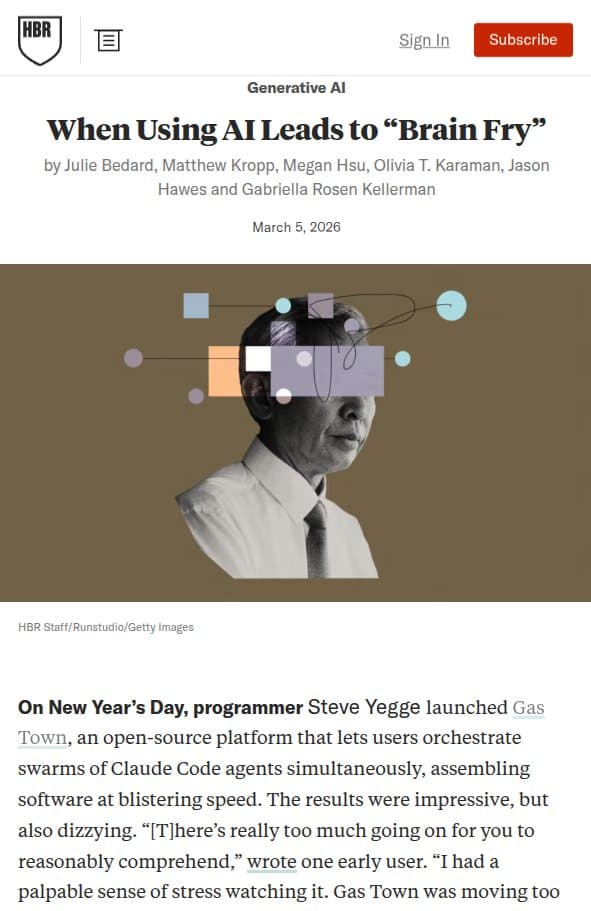
New research published in the Harvard Business Review reveals a troubling paradox in our AI-driven workplace: the very tools designed to enhance productivity and reduce cognitive load are instead creating a specific type of mental exhaustion researchers are calling "AI brain fry." This phenomenon is hitting hardest among high-performing workers who use artificial intelligence to push beyond their normal limits, according to a comprehensive survey of 1,500 workers across multiple industries.
The Cognitive Cost of Constant Oversight
While AI systems are generally marketed as productivity enhancers that should lighten human workloads, the reality appears far more complex. The HBR study found that AI implementation often forces users into relentless task-switching and intense oversight that actually clutters the mind rather than clearing it. This creates what researchers describe as "mental static"—a cognitive burden that emerges not from doing one's core job, but from managing multiple digital agents and constantly verifying their output.
"You aren't just doing your job anymore; you are managing multiple digital agents and double-checking their work," the research explains. This supervisory role adds layers of cognitive processing that traditional work didn't require, creating what amounts to a second job: AI management.
Who's Most Affected and Why
The study reveals that 14% of full-time workers already experience this AI-induced mental fog, with the highest impact concentrated in technical fields including software development, information technology, and finance. These are precisely the domains where AI adoption has been most aggressive and where workers are most likely to use AI tools to extend their capabilities beyond normal human limits.
High oversight emerges as the primary culprit behind this cognitive strain. Supervising multiple AI outputs leads to a measurable 12% increase in mental fatigue and a staggering 33% jump in decision fatigue among affected workers. This decision paralysis represents more than just personal discomfort—it has tangible business consequences.
The Business Impact of AI Exhaustion
This research identifies significant organizational risks associated with AI-induced cognitive overload. Exhausted employees are 10% more likely to quit their positions, creating retention challenges and knowledge loss for companies investing heavily in AI integration. For large corporations, this decision paralysis can translate to millions of dollars in lost value through either poor choices or complete inaction on critical matters.
"For massive firms worth many billions, this decision paralysis can lead to millions of dollars in lost value due to poor choices or total inaction," the study warns. The economic implications extend beyond individual productivity to affect entire organizational decision-making processes.
The Fundamental Mismatch
At its core, the research highlights a fundamental mismatch between how AI tools are designed and how humans actually work with them. Rather than creating seamless assistance, current implementations often require workers to adapt their cognitive processes to machine workflows, creating what researchers describe as "working harder to manage our tools than we are to solve the actual problems they were meant to fix."
This suggests that the problem isn't AI itself, but rather how organizations implement and integrate these technologies into human workflows. The cognitive overhead of constantly switching between human and machine thinking patterns, verifying outputs, and managing multiple AI agents appears to outweigh the efficiency gains in many current implementations.
Looking Forward: Rethinking AI Integration
The HBR research points toward necessary changes in how organizations approach AI adoption. Rather than simply adding AI tools to existing workflows, companies may need to fundamentally redesign processes to minimize cognitive switching costs and oversight burdens. This might involve creating clearer boundaries between human and AI responsibilities, developing better verification systems that require less constant human attention, or implementing usage guidelines that prevent cognitive overload.
As AI becomes increasingly embedded in professional work, understanding and mitigating these cognitive costs will become essential for maintaining both worker wellbeing and organizational effectiveness. The research serves as an important warning that technological advancement must be balanced with human cognitive limitations—a lesson that could determine whether AI truly enhances our capabilities or merely adds new layers of complexity to navigate.
Source: Harvard Business Review research as reported by @rohanpaul_ai