What Happened
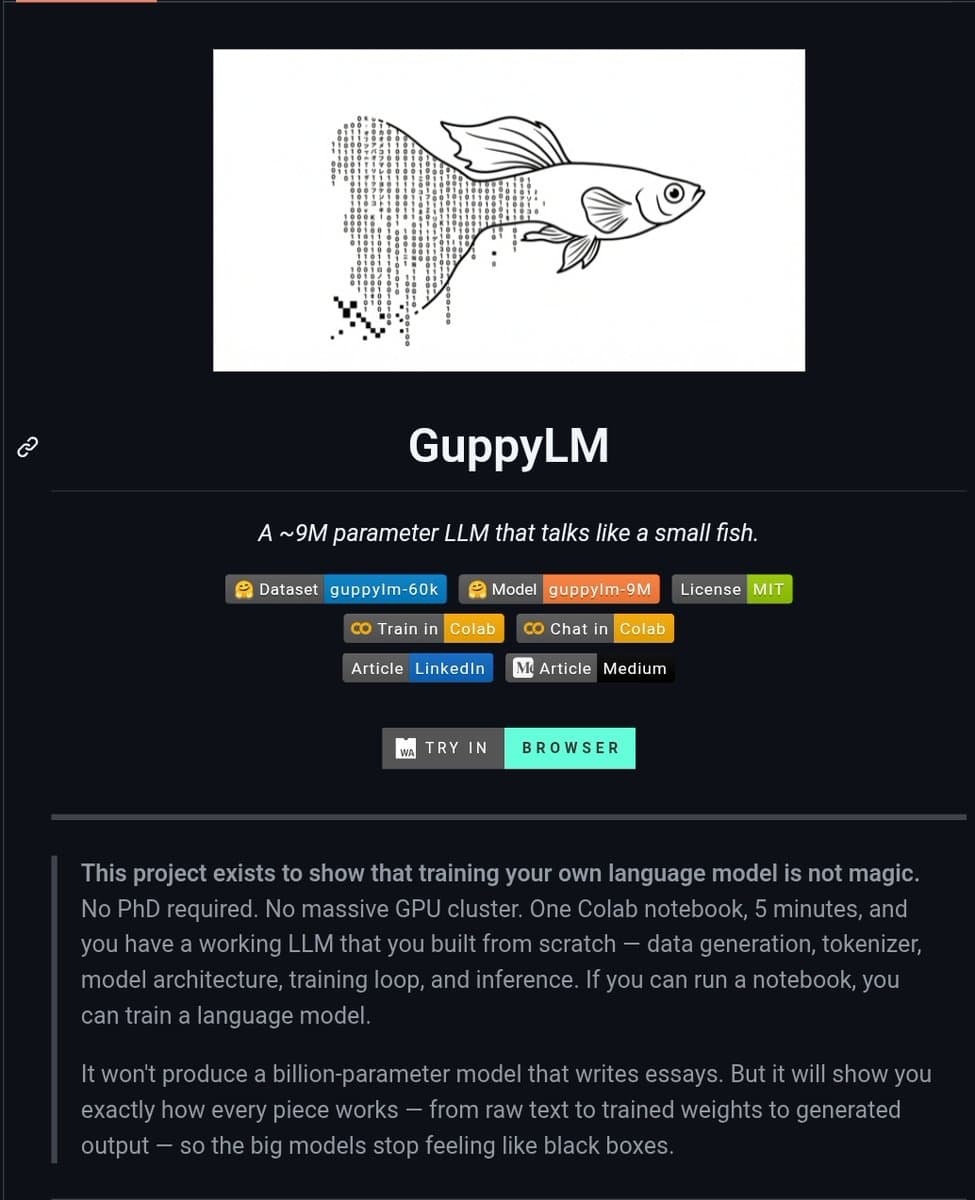
A developer shared a minimalist, educational implementation of a transformer-based language model that can be trained from scratch on readily available hardware. The project, highlighted by the Twitter account @_vmlops, demonstrates a complete pipeline—from building a tokenizer to training the transformer and running inference—using only about 9 million parameters.
The core value proposition is pedagogical: it strips away the complexity of distributed training, proprietary APIs, and massive computational requirements to show the fundamental mechanics of how modern large language models work. The entire codebase is designed to be run on a single GPU, such as those available in Google Colab's free tier, with training completing in a matter of minutes.
Context
This tutorial arrives during a period of intense industry focus on scaling laws, where state-of-the-art performance is often equated with models exceeding hundreds of billions of parameters and requiring clusters of expensive GPUs. While that path drives frontier capabilities, it creates a significant barrier to entry for students, researchers, and engineers seeking to understand the core algorithms.
Educational resources that bridge this gap are valuable. They allow practitioners to experiment with architecture changes, debug training dynamics, and build intuition in a lightweight, controllable environment before engaging with larger, more opaque systems.
The Tutorial's Approach
The linked tutorial provides a "clean, from-scratch implementation" in PyTorch. According to the source, it intentionally avoids shortcuts and external APIs, walking through:
- Tokenizer Implementation: Building a basic tokenizer to process text data.
- Transformer Architecture: Implementing a small-scale transformer model, likely following the encoder-decoder or decoder-only structure common in LLMs.
- Training Loop: Setting up the data loading, loss function (typically cross-entropy), and optimizer to train the model.
- Inference: Writing the code to generate text from the trained model.
By keeping the model size at ~9M parameters, the computational requirements are minimal. This makes the tutorial accessible for anyone with a laptop capable of running Colab, effectively democratizing the hands-on learning process for transformer internals.
gentic.news Analysis
This development is a microcosm of a growing counter-trend in AI: the value of small, interpretable models for education and specific applications. While frontier model development by OpenAI, Anthropic, and Google DeepMind continues its march toward trillion-parameter systems, there's parallel activity in making the fundamentals more accessible. This aligns with other movements we've covered, such as the rise of parameter-efficient fine-tuning (PFT) techniques like LoRA and the popularity of smaller, deployable models from organizations like Mistral AI and Microsoft's Phi series.
The tutorial serves as a necessary foundation. Understanding attention mechanisms, layer normalization, and autoregressive training on a 9M parameter model is directly transferable knowledge when working with a 70B parameter model. It tackles the "black box" problem head-on by providing a transparent, end-to-end blueprint. For engineers, this kind of resource is arguably more valuable for skill development than simply calling a proprietary API. It empowers them to customize, troubleshoot, and innovate rather than just consume.
Furthermore, this reflects a maturation of the ML engineering ecosystem. As the field advances, the community recognizes that alongside building the most powerful models, we must also build the best-understood models. Educational resources like this are critical for sustaining long-term growth and ensuring a broad base of practitioners can contribute to the field's evolution beyond just scaling compute.
Frequently Asked Questions
Can this 9M parameter model perform useful tasks like ChatGPT?
No. A 9M parameter model is several orders of magnitude smaller than production LLMs (which start in the billions of parameters) and is purely for educational purposes. It can learn basic language patterns and generate simple, coherent text over short sequences, but it lacks the knowledge, reasoning capacity, and instruction-following ability of frontier models. Its utility is in teaching how transformers work, not in replacing them for applications.
What do I need to run this tutorial?
You primarily need a Google account to access Google Colab, which provides free GPU resources sufficient for this project. The tutorial is implemented in PyTorch, so a basic understanding of Python and PyTorch tensors is helpful. The entire process—coding, training, and inference—is designed to be contained within a single Colab notebook.
How is this different from using a pre-trained model from Hugging Face?
Using a pre-trained model from Hugging Face involves downloading weights and running inference or fine-tuning, which abstracts away the model's creation. This tutorial is about building the model from the ground up. You write the code for every component. This deepens understanding of why the model works, which is essential for research, advanced debugging, and developing new architectures, rather than just applying existing ones.
Are there other similar educational projects?
Yes, the community has several well-known projects. Andrej Karpathy's nanoGPT is a famous example that provides a clean, minimal implementation for training GPT-style models. minGPT is another. This new tutorial appears to fit squarely in that tradition, offering a complete, self-contained walkthrough ideal for beginners seeking a comprehensive starting point.