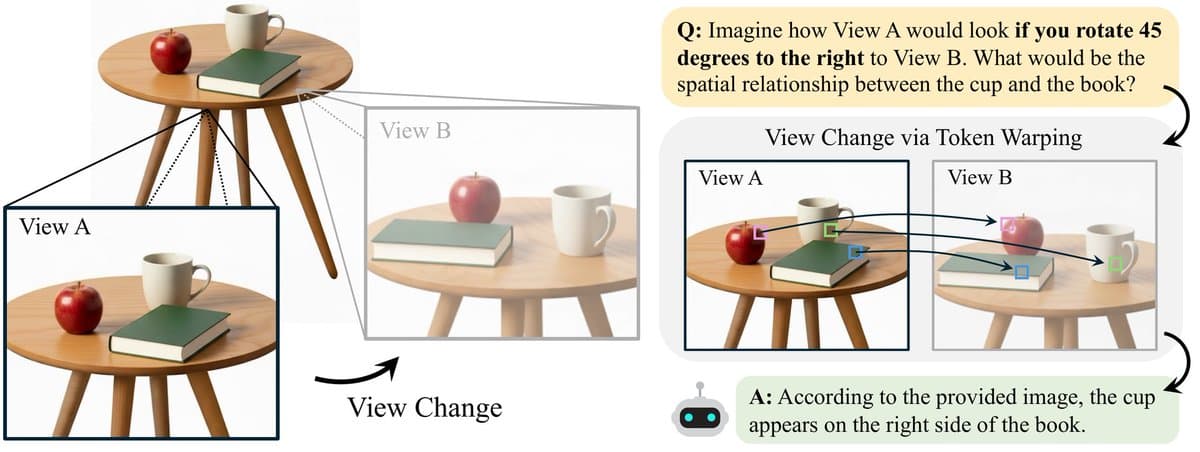
A paper accepted to CVPR 2026 introduces a novel approach for enabling Multimodal Large Language Models (MLLMs) to reason about nearby viewpoints without any additional training. The core innovation, termed "token warping," involves rearranging the visual tokens of an image based on geometric transformations, rather than manipulating raw pixels. This method demonstrates superior performance over traditional pixel-warping techniques and generative baselines while maintaining robustness to inaccuracies in depth estimation.
What the Researchers Built: A Token-Based Warping Module
The research addresses a fundamental challenge in vision-language models: reasoning about how a scene would look from a slightly different perspective. Traditional approaches often warp the input image at the pixel level using depth maps and camera poses—a computationally heavy process sensitive to depth errors. Alternatively, some methods use generative models to "hallucinate" the new view, which can introduce artifacts and inconsistencies.
This work proposes a middle ground. It leverages the fact that modern vision transformers (ViTs) and MLLMs process images not as pixels, but as a sequence of visual tokens. Each token represents a patch of the image. The key insight is that applying a geometric warp (e.g., for a rotation or translation) can be approximated by rearranging the sequence of these tokens before feeding them into the MLLM's language model backbone.
How It Works: Rearranging the Visual Sequence
The process is conceptually straightforward but effective:
- An input image is encoded by a vision encoder (like CLIP's ViT) into a grid of visual tokens.
- Given a target camera pose (e.g., "rotate 30 degrees to the left"), a depth map (which can be estimated or provided), and the original camera parameters, a homography matrix is calculated.
- This matrix defines where each image patch (and thus its corresponding token) should move in the new viewpoint.
- Instead of rendering a new pixel image, the system simply rearranges the 1D sequence of tokens according to this mapping. Tokens that would move out of frame are masked.
- This warped token sequence, which now represents a geometrically plausible novel view, is fed directly into the MLLM for question-answering or reasoning tasks.
This approach is zero-shot; it requires no fine-tuning of the MLLM. The model is asked questions about the warped scene as if it were viewing a new image, and its pre-trained knowledge about object permanence and 3D structure allows it to answer accurately.
Key Results: Beating Pixel and Generative Baselines
The paper evaluates the method on tasks requiring spatial and viewpoint reasoning, such as Visual Question Answering (VQA) on transformed scenes (e.g., "After rotating left, what is now to the right of the cup?").
Token Warping (Proposed) Rearranges ViT tokens High Fast, zero-shot, preserves semantic fidelity Pixel Warping Warps RGB pixel image Low Prone to blurring and distortion from depth errors Generative Baselines Generates novel view image Medium Can hallucinate incorrect details, slowerReported results show token warping consistently outperforms pixel-based warping, especially when depth estimates are noisy. It also surpasses generative baselines in accuracy, as those models sometimes invent plausible but incorrect scene details. The token-based method is also significantly faster than rendering a new image, as it skips the decoding step entirely.
Why It Matters: Efficient 3D Reasoning for Foundational Models
This work is a step toward more efficient and robust 3D geometric reasoning within large foundation models. By operating on the token representation that models already use, it avoids the lossy conversion back to pixels. This aligns with a broader trend in AI research: moving computation to the latent or token space where it is more efficient and often more semantically meaningful.
For practitioners, the method offers a plug-and-play module for enhancing MLLMs on tasks requiring spatial understanding—from robotics ("what would the robot see if it moved here?") to AR/VR and embodied AI—without the cost of collecting new training data or fine-tuning massive models.
gentic.news Analysis
This research fits squarely into the accelerating trend of improving the spatial and geometric reasoning capabilities of large multimodal models. As we covered in our analysis of Google's RT-3, a core limitation for real-world AI agents is understanding how actions change perception. Token warping provides a lightweight, inference-time solution to part of this problem: simulating perception changes.
The choice to warp tokens instead of pixels is particularly astute, reflecting a deeper architectural shift. It treats the vision transformer's token grid as a foundational geometric representation, not just a set of features. This mirrors developments in text-based reasoning where models manipulate knowledge graphs or chain-of-thought tokens internally. The paper's success suggests that for many reasoning tasks, a geometrically warped semantic map (the tokens) is more useful than a photorealistic but potentially misleading pixel image.
Furthermore, the emphasis on robustness to depth noise is critical for real-world deployment. As seen in the challenges faced by companies like Covariant in unstructured environments, sensor data is always imperfect. A method that degrades gracefully with noisy depth inputs, as token warping does, has a much higher chance of integration into practical systems than one requiring perfect depth maps. This work demonstrates that sometimes, the path to more robust AI is not more accurate low-level perception, but smarter abstraction of that perception for higher-level reasoning.
Frequently Asked Questions
What is token warping in AI?
Token warping is a technique for multimodal AI where the visual tokens from a vision transformer (ViT) are rearranged based on a geometric transformation, like a camera rotation. This allows a model to "see" a simulated new viewpoint without generating a new image, enabling better spatial reasoning.
How does token warping differ from image warping?
Traditional image warping manipulates the RGB pixels of an image, which can become blurry or distorted, especially with imperfect depth data. Token warping manipulates the higher-level, semantic tokens that an AI model already uses to understand the image, avoiding visual artifacts and being more robust to errors.
Do models need special training to use token warping?
No, a key advantage of the method is that it is zero-shot. It works with pre-trained Multimodal LLMs (MLLMs) without any additional fine-tuning, acting as a preprocessing step on the visual input tokens.
What are the practical applications of this research?
This technology can enhance AI systems that need to reason about space and perspective, such as robotics navigation, augmented reality (AR) content interaction, autonomous vehicle simulation, and any embodied AI agent that must predict how its actions will change what it sees.