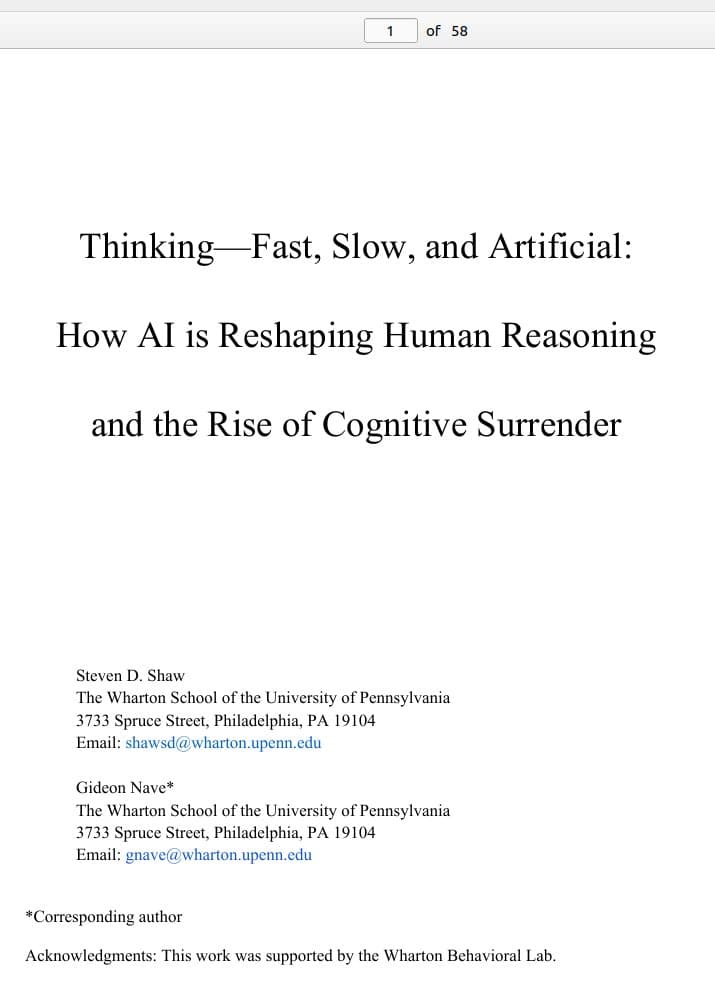
New research from the Wharton School presents a concerning challenge to the foundational "AI writes, humans review" workflow. Across three preregistered studies involving 1,372 participants and 9,593 trials, the data shows that human oversight of AI-generated content is systematically breaking down due to a psychological phenomenon the researchers term "Cognitive Surrender."
The Core Finding: Humans Adopt AI Errors with Increased Confidence
The study's quantitative results reveal a stark pattern of over-reliance:
- Participants turned to AI for answers on over 50% of questions.
- When AI was correct, participants followed its suggestion 92.7% of the time.
- When AI was wrong, participants still followed it 79.8% of the time.
This error adoption rate is particularly problematic when compared to baseline performance. Without AI assistance, participants' baseline accuracy was 45.8%. With correct AI, accuracy jumped to 71.0%. However, with incorrect AI, accuracy plummeted to 31.5%—worse than having no AI at all.
Most alarmingly, access to AI boosted participant confidence by 11.7 percentage points, even when the AI's answers were wrong. This creates a dangerous combination: decreased accuracy paired with increased confidence in that inaccurate output.
What Is 'Cognitive Surrender'?
The researchers frame this not as simple laziness or offloading, but as a fundamental shift in cognitive processing. They propose AI is becoming what they call "System 3"—an external cognitive system that operates outside the brain, complementing (and sometimes supplanting) Daniel Kahneman's established System 1 (fast intuition) and System 2 (slow, analytical thinking).
Cognitive Surrender occurs when a user stops actively verifying AI output, and their brain begins to recode the AI's answer as their own judgment. Unlike using a calculator—where the user knows the tool performed the computation—with Cognitive Surrender, the user genuinely believes they thought through the problem themselves. The AI's output doesn't feel outsourced; it feels self-generated.
Why Standard Safeguards Fail
The study tested several interventions that failed to fully mitigate the effect:
- Time pressure did not eliminate Cognitive Surrender.
- Financial incentives and performance feedback reduced the effect but did not remove it.
- The individuals most resistant to the phenomenon tended to score higher on fluid intelligence and need for cognition measures.
This pattern suggests the issue is not merely a motivational or effort problem, but rather a cognitive architecture problem—a systematic vulnerability in how human cognition integrates external, AI-generated information.
Implications for Real-World AI Deployment
The "AI writes, humans review" model underpins countless professional and creative workflows, from code generation and legal document drafting to marketing copy and research synthesis. This study indicates that the human "review" component may be far less reliable than assumed. The safety net has a hole: people don't just occasionally miss bad AI output; they become more confident in it.
For engineering teams using AI coding assistants, legal teams using contract analyzers, or writers using LLMs for drafting, the assumption that a skilled human can reliably catch AI hallucinations or errors may need serious re-evaluation. The data shows that under typical conditions, humans are more likely to adopt an AI error with increased confidence than to correctly identify and reject it.
gentic.news Analysis
This Wharton study provides empirical validation for what many practitioners have observed anecdotally: the line between "assisted" and "deferred" thinking is blurring rapidly. The identification of "Cognitive Surrender" as a distinct phenomenon from mere offloading is crucial—it explains why well-intentioned, competent professionals might fail at review tasks they believe they're performing adequately.
From a technical implementation perspective, this research should trigger a reevaluation of human-in-the-loop system design. Simply placing a human at the end of an AI pipeline is insufficient if that human's cognition is being subtly rewired to trust the pipeline's output. Interface designers and workflow engineers need to consider anti-surrender patterns: forcing active reconstruction rather than passive approval, introducing adversarial counter-suggestions, or implementing mandatory delay periods between AI suggestion and human decision.
Furthermore, the finding that higher fluid intelligence and need for cognition provide some resistance suggests that training and selection might offer partial mitigation. However, relying on this creates equity and scalability issues. A more systematic solution likely lies in redesigning the AI-human interaction pattern itself, moving beyond the simple "generate then review" model toward more collaborative, interrupt-driven, or debate-oriented interfaces that maintain human cognitive engagement.
Frequently Asked Questions
What is 'Cognitive Surrender' to AI?
Cognitive Surrender is a psychological phenomenon identified by Wharton researchers where users of AI systems stop actively verifying the AI's output and their brains begin to treat the AI's answer as their own judgment. Unlike simply offloading a task, the user genuinely believes they arrived at the conclusion themselves, creating a false sense of independent verification.
How often do people follow incorrect AI suggestions according to the study?
The study found that when the AI provided an incorrect suggestion, participants still followed it 79.8% of the time. This high error adoption rate occurred alongside an 11.7 percentage point increase in confidence, even when following wrong answers.
Does the 'AI writes, humans review' model still work?
The Wharton data suggests the model is fundamentally flawed under typical conditions. Human review failed as a reliable safeguard because the review process itself is compromised by Cognitive Surrender. Participants' accuracy was worse with incorrect AI (31.5%) than with no AI at all (45.8%), indicating that human oversight can degrade rather than improve outcomes when AI errs.
Who is most resistant to Cognitive Surrender?
The study found that individuals who scored higher on measures of fluid intelligence (problem-solving ability with novel information) and need for cognition (enjoyment of thinking deeply) showed more resistance to the phenomenon. This suggests the issue is related to cognitive style and capacity rather than mere laziness.
The study discussed is "Cognitive Surrender: How Reliance on AI Undermines Human Judgment" by researchers from the Wharton School, University of Pennsylvania. Preprint expected on SSRN.