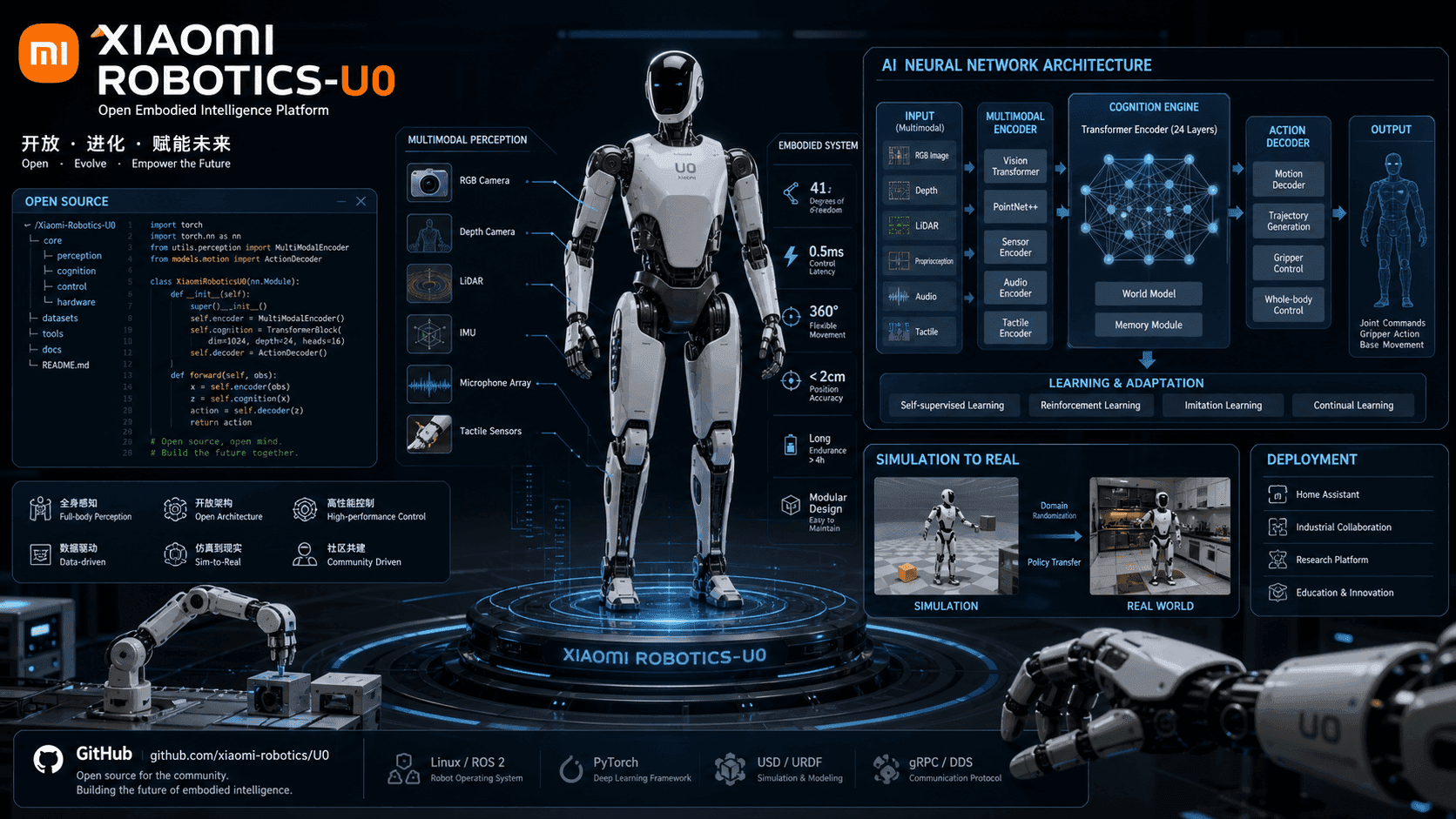
Xiaomi open-sourced Robotics-U0, a 38B-parameter embodied generative model on July 2026. It is the first unified architecture handling scene generation, embodied transfer, video generation, and text-to-image for robotics.
Key facts
- 38 billion parameters in a single transformer architecture.
- Unifies scene generation, embodied transfer, video, text-to-image.
- Open-source release on GitHub in July 2026.
- No benchmark results or training compute disclosed.
- First open-source unified embodied generative model.
Xiaomi has released Robotics-U0, a 38-billion-parameter embodied generative model, as open-source software According to Pandaily. The model claims to be the first to unify four distinct robot-related tasks—scene generation, embodied transfer, video generation, and text-to-image—within a single transformer-based architecture.
Key Takeaways
- Xiaomi open-sourced 38B-parameter Robotics-U0, unifying four embodied tasks in a single model.
- No benchmarks or training data disclosed yet.
Unified Architecture, Single Model

Unlike prior work that required separate models for each task (e.g., RT-2 for robot control, VideoPoet for video generation, or SceneDreamer for scenes), Robotics-U0 uses a single 38B-parameter transformer. The model processes both visual and text inputs and outputs pixel-level predictions for all four tasks. Xiaomi claims this unified approach enables cross-task knowledge transfer, potentially improving performance on each individual task compared to isolated models.
Open-Source Release and Implications
The model is released under an open-source license, with weights and inference code available on GitHub. Xiaomi did not disclose training compute requirements, dataset size, or inference latency [per the announcement]. This contrasts with proprietary embodied models like Google's RT-2 or Meta's Habitat, which remain closed. The open-source release targets the research community and aims to accelerate embodied AI development.
Benchmark Results Not Provided

Xiaomi did not release benchmark results comparing Robotics-U0 against task-specific baselines. Without quantitative evaluations—such as scene generation FID scores, embodied transfer success rates, or video generation FVD—it is difficult to assess whether the unified architecture sacrifices task-specific performance. The company stated that "comprehensive benchmarks will be released in a follow-up technical report," but no timeline was given.
What This Means for Embodied AI
Robotics-U0 enters a landscape where embodied AI models are increasingly large and multimodal. The 38B parameter count places it between Meta's SAM 2 (2.4B) and Google's Gemini Robotics (estimated >50B). By open-sourcing, Xiaomi positions itself as a contributor to the open embodied AI ecosystem, potentially lowering the barrier for robotics labs without massive compute budgets. However, without training data details or benchmark scores, the model's practical utility remains unverified.
What to watch
Watch for Xiaomi's follow-up technical report with benchmark results. If the model achieves competitive FID/FVD scores against task-specific baselines, it could validate the unified approach. Otherwise, the open-source release may be more symbolic than practically useful for production robotics.
Source: pandaily.com