In the rapidly evolving landscape of artificial intelligence, multi-agent systems have emerged as a powerful approach to complex problem-solving. By deploying multiple specialized AI agents that collaborate on tasks, these systems can tackle challenges ranging from mathematical reasoning to code generation. However, this distributed approach comes with a significant vulnerability: error propagation. When one agent in the chain makes a mistake, that error can cascade through subsequent agents, compromising the entire system's output.
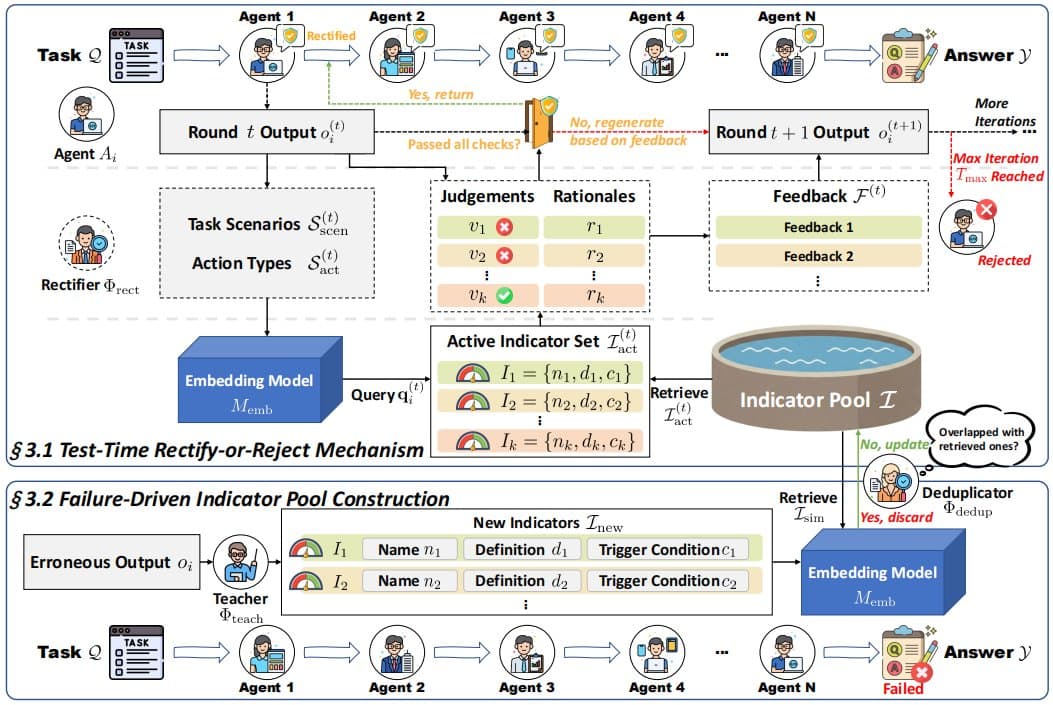
Researchers have now developed a novel solution to this problem called AgentDropoutV2, described as a "test-time firewall for multi-agent systems." This innovative approach intercepts and corrects errors before they can cascade through the system, using a technique called "rectify-or-reject pruning."
How AgentDropoutV2 Works
At its core, AgentDropoutV2 functions as a quality control mechanism that operates during inference (when the model is making predictions) rather than during training. The system monitors the outputs of individual agents within a multi-agent pipeline and makes real-time decisions about whether to:
- Rectify the output by correcting detected errors
- Reject the output and prune that particular agent path
- Allow the output to proceed if it meets quality thresholds
The "rectify-or-reject pruning" mechanism is particularly innovative because it doesn't simply discard problematic outputs—it attempts to fix them first. This approach recognizes that not all errors are equally severe and that many can be corrected with targeted interventions.
Performance Improvements
The most compelling evidence for AgentDropoutV2's effectiveness comes from its performance on mathematical reasoning benchmarks. According to the research, the system boosts accuracy by 6.3 percentage points on standard math benchmarks—a significant improvement in a field where even single-digit gains are noteworthy.
What makes this achievement particularly remarkable is that it's accomplished without retraining the underlying models. Traditional approaches to improving AI system performance typically require extensive retraining with additional data or architectural modifications. AgentDropoutV2 demonstrates that substantial improvements can be achieved through smarter inference-time strategies alone.
Technical Implementation
While the original announcement doesn't provide exhaustive technical details, the concept of a "test-time firewall" suggests several possible implementation approaches:
- Confidence scoring: Each agent's output could be accompanied by a confidence score, with low-confidence outputs triggering the firewall
- Consistency checking: Multiple agents might solve the same subproblem independently, with discrepancies triggering intervention
- Verification agents: Specialized agents could be deployed specifically to verify the outputs of other agents
- Pattern recognition: The firewall might learn to recognize common error patterns and apply targeted corrections
The "dropout" in the name suggests a connection to the well-known dropout regularization technique used in neural network training, but applied here in a novel context during inference rather than training.
Implications for AI Development
AgentDropoutV2 represents a significant shift in how we approach AI reliability and error correction. Traditionally, most error mitigation has focused on the training phase—improving datasets, refining architectures, or implementing training-time regularization. This new approach demonstrates that substantial gains can be achieved by focusing on inference-time strategies.
The implications extend beyond mathematical reasoning systems. Similar approaches could be applied to:
- Code generation systems where error cascades can create security vulnerabilities
- Scientific reasoning systems where incorrect intermediate conclusions can derail entire analyses
- Business decision support systems where early errors in data interpretation can lead to flawed recommendations
- Creative AI systems where inconsistent elements can undermine coherence
Challenges and Limitations
While promising, the AgentDropoutV2 approach likely faces several challenges:
- Computational overhead: The firewall mechanism adds additional computation during inference, potentially slowing down response times
- False positives/negatives: The system must balance being too aggressive (rejecting/correcting valid outputs) versus too permissive (allowing errors through)
- Domain specificity: The effectiveness of error detection and correction may vary across different problem domains
- Integration complexity: Adding such a system to existing multi-agent architectures requires careful engineering
The Future of Multi-Agent Systems
AgentDropoutV2 points toward a future where AI systems are not just evaluated on their raw capabilities but on their robustness and error resilience. As multi-agent systems become more complex and are deployed in higher-stakes applications—from medical diagnosis to autonomous systems—techniques like this will become increasingly essential.
The research also suggests new directions for AI safety research. Rather than focusing exclusively on making individual models more reliable, we might develop specialized "safety agents" or "verification layers" that work alongside primary reasoning systems to ensure output quality.
Conclusion
AgentDropoutV2 represents an important advancement in making multi-agent AI systems more reliable and robust. By implementing a test-time firewall that intercepts and corrects errors before they cascade, researchers have demonstrated that significant accuracy improvements are possible without the computational expense of retraining models.
As AI systems grow more complex and are deployed in increasingly critical applications, techniques like AgentDropoutV2 will play a crucial role in ensuring their reliability and trustworthiness. The approach marks a shift from purely training-focused improvements to inference-time optimization strategies—a direction that may yield substantial benefits across many AI application domains.
Source: HuggingPapers on X (formerly Twitter) - https://x.com/HuggingPapers/status/2027837931063247229