A new data point has emerged in the ongoing debate about AI's real-world impact on work. According to a survey highlighted by researcher Ethan Mollick, the average American worker who uses AI tools reports saving approximately 2.5 hours in a typical work week, representing a 6% reduction in time spent on tasks.
What the Data Shows
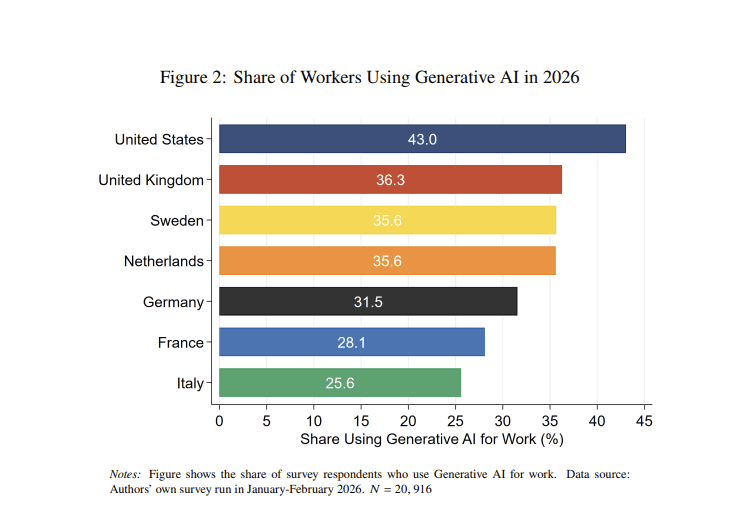
The finding, based on survey responses, indicates that AI adoption is moving beyond hype and into measurable utility for a segment of the workforce. The 6% time-saving figure is not an isolated data point; Mollick notes it aligns closely with similar survey results from workers in the United Kingdom and the Netherlands, and is slightly higher than figures reported in other European Union countries.
This self-reported data provides a ground-level view of how individual workers are experiencing AI integration. Saving 2.5 hours weekly translates to roughly 30 minutes per day, which could represent time reclaimed from repetitive administrative tasks, research, drafting, or data analysis.
The Productivity Connection
Perhaps more significant than the time-saving metric itself is the accompanying observation. Mollick points to "early, non-causal, signs" that these individual time savings might be aggregating into measurable gains in macroeconomic productivity growth. He links to a broader analysis, suggesting researchers are beginning to detect a signal in national productivity data that correlates with the acceleration of AI tool adoption.
It's crucial to note the caveats: the data is self-reported, and the link to macroeconomic productivity is described as early and non-causal. This means a direct, proven cause-and-effect relationship between AI use and national productivity spikes hasn't been established yet. However, the correlation is becoming a subject of serious economic inquiry.
Context and Limitations
Surveys of this nature capture perception, which is a valid metric for adoption and satisfaction, but not a direct measure of output quality or business impact. A worker might save time using an AI coding assistant, but the code may require more review. Alternatively, time saved on drafting could be re-invested in higher-value strategic thinking.
The 6% figure is an average among AI users. The distribution is likely uneven, with some power users saving significant time on specific tasks (e.g., developers using GitHub Copilot, analysts using ChatGPT for data scripting) and others seeing minimal gains. The survey also does not specify which tools workers are using, which ranges from enterprise SaaS integrations to consumer-facing chatbots like ChatGPT and Claude.
gentic.news Analysis
This survey data adds a quantitative layer to a trend we've been tracking since the launch of ChatGPT in late 2022. Initially, productivity claims were largely anecdotal or based on controlled studies (like the often-cited GitHub Copilot research showing a 55% speed increase for developers). This data represents a shift to measuring adoption and perceived impact at scale across the general workforce.
The mention of parallel findings in the UK and EU is significant. It suggests the productivity effect of generative AI tools is not a US-specific phenomenon but is replicating across advanced economies with similar digital infrastructure. This aligns with our previous coverage on the global race for AI adoption, where nations are keenly aware that early and effective integration could confer a long-term economic advantage.
The connection to macroeconomic productivity growth is the most speculative but potentially transformative part of this story. For years, economists have puzzled over a "productivity paradox" where massive investment in IT didn't immediately translate into broad productivity gains. The question for the AI era is whether the latency will be shorter. If these self-reported time savings of 2.5 hours per user are real and can be harnessed effectively by organizations, the compound effect could be substantial. However, history cautions that translating a tool's efficiency into organizational and economic output requires changes in business processes, management, and skills—factors that evolve much slower than technology.
Frequently Asked Questions
How much time does AI save the average worker?
According to the cited survey, the average American worker who uses AI tools reports saving about 2.5 hours per work week, which equates to a 6% reduction in time on tasks. This is based on self-reported data from users.
Is AI actually increasing national productivity?
The source mentions there are "early, non-causal, signs" that individual time savings might be contributing to gains in macroeconomic productivity growth. This suggests economists are beginning to see a positive correlation in the data, but a definitive causal link has not yet been proven. It remains an active area of research.
Which countries are seeing similar AI time savings?
The survey results show similar time-saving reports from workers in the United Kingdom and the Netherlands. Workers in other European Union countries also report savings, though slightly lower than the US, UK, and Dutch averages. This indicates the phenomenon is widespread across advanced economies.
What are the limitations of this survey data?
The data is self-reported, meaning it measures perceived time savings rather than objectively measured output changes. It also does not account for potential trade-offs in quality or the need for additional review of AI-generated work. Furthermore, it averages the experience of all AI users, masking the variance between power users and casual adopters.