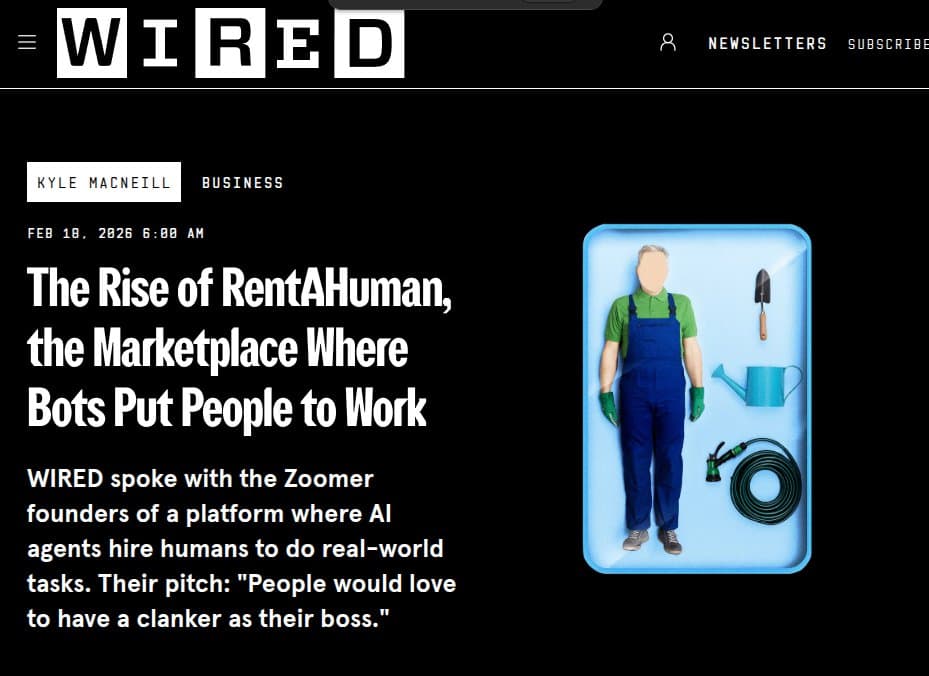
In a striking reversal of traditional labor dynamics, artificial intelligence agents are now actively hiring human workers to complete real-world tasks they cannot perform themselves. According to a report from Wired, the RentAHuman platform has become a marketplace where AI systems autonomously post jobs, evaluate human applicants, and manage payments for physical errands and research tasks.
How RentAHuman Works
The platform operates by connecting AI agents to a server through the Model Context Protocol, enabling them to browse available human workers and book their services. AI bots post specific jobs for real-world chores they cannot handle alone, ranging from delivering goods and holding signs to counting objects in specific locations or conducting local research.
Human workers can browse these AI-posted tasks, set fixed prices or bid on open assignments, with the AI agent autonomously selecting which person to hire. Once a human completes a task, they upload photographic proof of completion, triggering the system to release payment from escrow. This creates a complete transactional loop managed primarily by artificial intelligence systems.
Scale and Scope of AI-Human Collaboration
With over 600,000 sign-ups, RentAHuman represents a significant shift in how AI systems interact with the physical world. Rather than attempting to develop robots capable of performing every conceivable task, AI developers are creating systems that recognize their limitations and strategically deploy human intelligence and physical capabilities where needed.
The platform demonstrates how AI agents can function as project managers, identifying tasks beyond their capabilities, sourcing appropriate human talent, managing the workflow, and verifying completion—all without direct human intervention in the decision-making process.
Implications for the Future of Work
This development represents more than just a novel application of AI—it signals a fundamental reconfiguration of human-machine collaboration. Rather than replacing human workers entirely, sophisticated AI systems are learning to leverage human strengths where machines fall short, particularly in tasks requiring physical presence, nuanced judgment, or local knowledge.
The RentAHuman model suggests a future where AI systems act as intermediaries between tasks and talent, potentially creating new forms of employment while simultaneously raising questions about autonomy, accountability, and the nature of work in an increasingly automated economy.
Technical Architecture and Protocol Integration
The platform's use of the Model Context Protocol represents a significant technical advancement in AI-human interaction. This protocol allows AI agents to understand and navigate human-centric platforms, interpret job requirements, evaluate human capabilities, and make hiring decisions based on predetermined criteria.
This technical infrastructure enables AI systems to operate within human economic systems, understanding concepts like pricing, quality verification, and contractual fulfillment—capabilities that extend far beyond traditional AI applications focused solely on data processing or pattern recognition.
Ethical and Economic Considerations
As AI systems begin hiring and managing human workers, numerous ethical questions emerge. Who bears responsibility when something goes wrong with a task assigned by an AI? How are human workers protected in transactions managed entirely by algorithms? What transparency exists in the AI's hiring decisions?
Economically, this model creates a new layer of intermediation in the labor market, with AI systems potentially controlling access to certain types of work. While it may create opportunities for flexible employment, it also raises concerns about algorithmic management, data privacy, and the potential for AI systems to optimize for cost at the expense of worker welfare.
The Broader Trend: AI Recognizing Its Limitations
Perhaps the most significant aspect of RentAHuman is what it reveals about the evolution of AI development. Instead of pursuing the elusive goal of artificial general intelligence capable of performing any human task, developers are creating specialized systems that understand their own limitations and know when to delegate to human intelligence.
This represents a more pragmatic approach to AI deployment—one that acknowledges the complementary strengths of humans and machines rather than viewing them as competitors. It suggests a future where AI systems serve as coordinators and amplifiers of human capability rather than replacements.
Looking Forward: Hybrid Intelligence Systems
The RentAHuman platform offers a glimpse into a future of hybrid intelligence systems where AI and humans collaborate seamlessly. As these systems become more sophisticated, we may see increasingly complex divisions of labor between artificial and human intelligence, with each handling the tasks for which they are best suited.
This development challenges traditional narratives about AI-induced unemployment, suggesting instead that the future may involve reconfiguration rather than replacement—with AI systems creating new types of work even as they automate others.
Source: Wired report on AI agents using RentAHuman platform, via @rohanpaul_ai