In a groundbreaking demonstration of artificial intelligence's potential to accelerate scientific discovery, researchers have developed a neuro-symbolic AI system that autonomously solved an open problem in theoretical physics. The system successfully derived novel, exact analytical solutions for the power spectrum of gravitational radiation emitted by cosmic strings—a long-standing challenge that had resisted complete analytical treatment.
According to the paper published on arXiv (arXiv:2603.04735), the research team created an AI agent that combines Google's Gemini Deep Think large language model with a systematic Tree Search framework and automated numerical feedback. This hybrid approach represents a significant advancement over previous AI-assisted attempts that only yielded partial asymptotic solutions.
The Physics Problem: Cosmic Strings and Gravitational Waves
Cosmic strings are hypothetical one-dimensional topological defects that may have formed during phase transitions in the early universe. If they exist, these cosmic strings would generate gravitational waves—ripples in spacetime—that could potentially be detected by observatories like LIGO and Virgo. Understanding the precise mathematical description of this radiation has been a persistent challenge for theoretical physicists.
The core mathematical problem involves evaluating the integral $I(N,\alpha)$ for arbitrary loop geometries, which describes how gravitational radiation depends on the properties of cosmic string loops. Previous attempts to solve this problem analytically had been incomplete, leaving physicists to rely on numerical approximations or limited special cases.
The AI Solution: Neuro-Symbolic Architecture
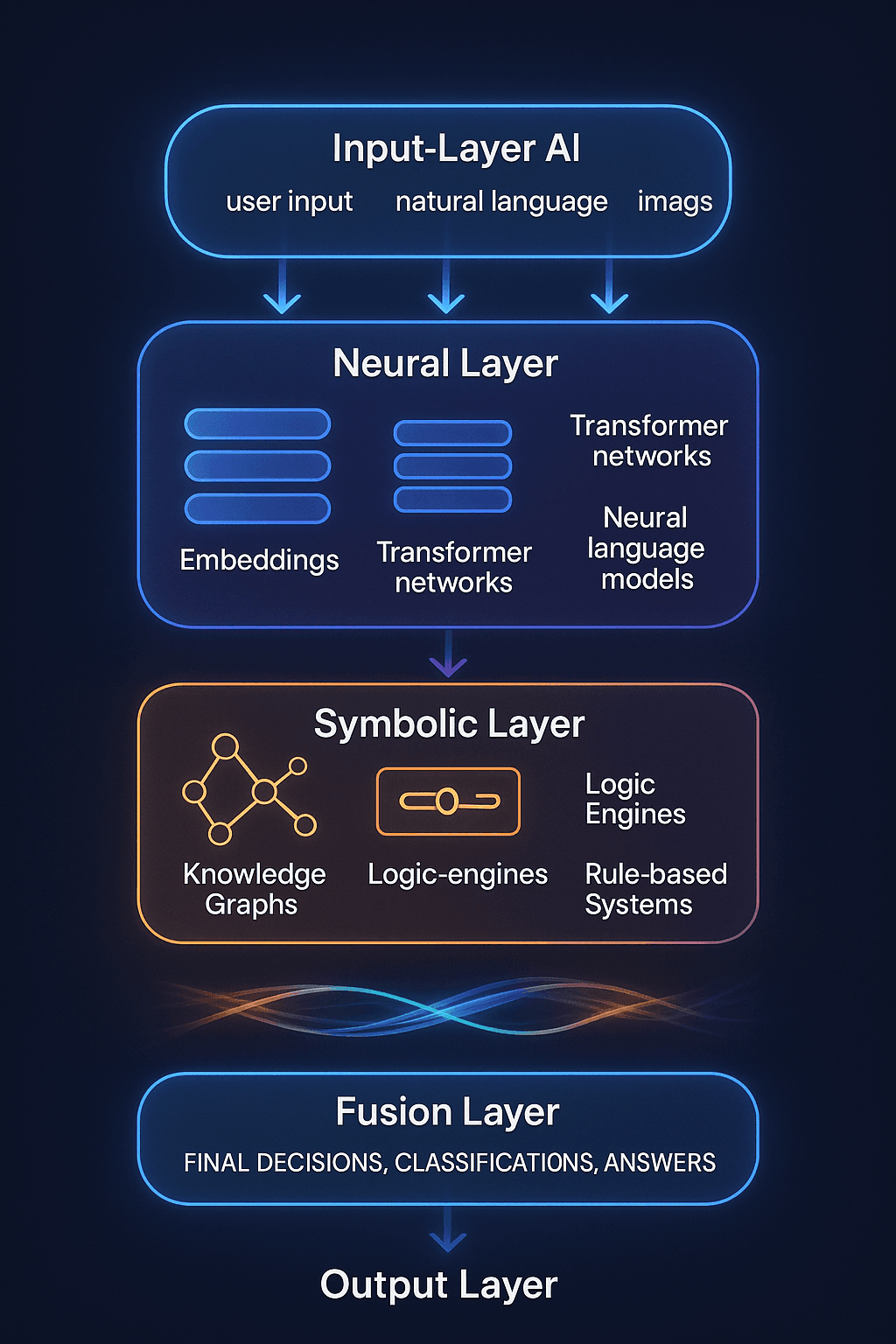
The research team's breakthrough came from designing what they call a "neuro-symbolic system" that marries the pattern recognition capabilities of large language models with the structured reasoning of symbolic mathematics. The system architecture consists of three key components:

- Gemini Deep Think LLM: Provides the mathematical intuition and creative problem-solving approaches
- Systematic Tree Search Framework: Explores different mathematical pathways in an organized manner
- Automated Numerical Feedback: Continuously validates proposed solutions against numerical benchmarks
"The agent identified a suite of 6 different analytical methods," the researchers report in their paper. "The most elegant of which expands the kernel in Gegenbauer polynomials $C_l^{(3/2)}$ to naturally absorb the integrand's singularities."
This mathematical approach proved particularly powerful because Gegenbauer polynomials have properties that naturally handle the singularities present in the cosmic string radiation problem—something that had stumped previous analytical attempts.
Beyond Partial Solutions: From Asymptotic to Exact
What makes this achievement particularly significant is that it moves beyond the partial solutions obtained in previous AI-assisted research (referenced as \cite{BCE+25} in the paper). Where earlier attempts only yielded asymptotic solutions valid in certain limits, the new system derived exact analytical solutions that work across the full parameter space.
"The methods lead to an asymptotic result for $I(N,\alpha)$ at large $N$ that both agrees with numerical results and also connects to the continuous Feynman parameterization of Quantum Field Theory," the authors explain.
This connection to established quantum field theory techniques is particularly noteworthy, as it suggests the AI didn't just find a mathematical trick but discovered a solution that fits naturally within existing theoretical frameworks.
Transparency and Methodology: A Blueprint for AI-Assisted Discovery
Perhaps as important as the physics result itself is the detailed methodology the researchers provide. In an effort to promote transparency and reproducibility in AI-assisted scientific discovery, the paper includes:

- Complete system prompts used to guide the Gemini model
- Search constraints that defined the problem space
- Details of the intermittent feedback loops that kept the AI on track
- Full mathematical derivations of the discovered solutions
This level of methodological detail represents a growing trend in AI research—moving from treating AI systems as black boxes to creating transparent, reproducible frameworks that other researchers can build upon.
Implications for Theoretical Physics and Beyond
The successful application of this neuro-symbolic AI system to a concrete physics problem has several important implications:
- Accelerated Discovery: Problems that might take human researchers years to solve could potentially be addressed in much shorter timeframes
- New Mathematical Techniques: AI systems may discover novel mathematical approaches that human mathematicians haven't considered
- Bridge Between Fields: The system naturally connected techniques from special functions (Gegenbauer polynomials) with quantum field theory methods
- Validation Paradigm: The combination of symbolic derivation with numerical validation creates a robust framework for verifying AI-discovered solutions
The Future of AI in Fundamental Science
This research represents more than just a single solved problem—it demonstrates a viable pathway for integrating AI into the fundamental scientific discovery process. The neuro-symbolic approach appears particularly promising because it combines the strengths of different AI paradigms:
- Neural networks for pattern recognition and creative exploration
- Symbolic systems for rigorous mathematical derivation
- Search algorithms for systematic exploration of solution spaces
- Numerical validation for continuous reality-checking
As the authors note in their conclusion, this work "demonstrates that artificial intelligence can accelerate mathematical discovery by autonomously solving an open problem in theoretical physics." The implications extend far beyond cosmic strings, suggesting that similar approaches could be applied to other challenging problems in theoretical physics, mathematics, and potentially other scientific domains.
The research, while still in preprint form and awaiting peer review, offers a compelling vision of how AI might transform not just applied science but the most fundamental aspects of theoretical research. As AI systems become more sophisticated at mathematical reasoning, we may be entering an era where human and artificial intelligence collaborate to solve problems that have resisted solution for decades or longer.
Source: arXiv:2603.04735v1, "Solving an Open Problem in Theoretical Physics using AI-Assisted Discovery" (Submitted March 5, 2026)