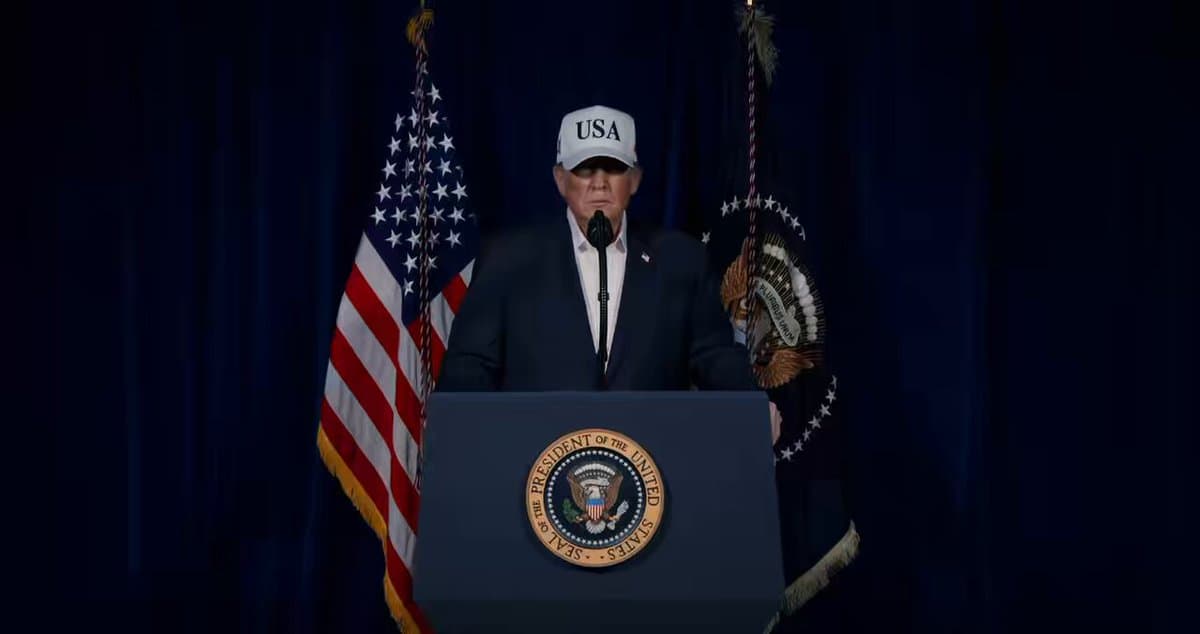
A concerning development in AI-generated disinformation has surfaced with a fabricated statement attributed to former President Donald Trump declaring that "the Iranian war has officially started." The statement, which circulated on social media platform X (formerly Twitter), represents a new frontier in synthetic media manipulation with potentially serious geopolitical implications.
The Incident and Its Spread
The false statement appeared in a tweet from an account claiming to share an official Trump announcement about military conflict with Iran. While the original tweet has been removed or restricted, the incident highlights how easily AI-generated content can mimic official communications. The statement's phrasing and presentation were designed to appear authentic, potentially causing confusion among viewers who might not immediately recognize it as fabricated.
This incident follows a growing trend of AI-generated political content, including deepfake videos, synthetic audio, and fabricated statements attributed to public figures. The technology behind these creations has become increasingly accessible, allowing bad actors to produce convincing disinformation with minimal technical expertise.
Technical Capabilities Behind Synthetic Media
Current AI systems can generate convincing text, images, and video through several approaches:
- Large Language Models (LLMs) like GPT-4 can produce human-like text in various styles, including political statements
- Voice synthesis technology can clone voices with remarkable accuracy using minimal training data
- Video generation tools can create realistic footage of public figures saying things they never actually said
- Image generation models can produce fake photographs of events that never occurred
These technologies combined create a perfect storm for disinformation campaigns, particularly during politically sensitive periods or international crises.
Geopolitical Context and Risks
The choice of Iran as the subject of this fabricated statement is particularly significant given ongoing tensions in the Middle East. AI-generated content targeting geopolitical flashpoints could:
- Escalate tensions between nations by creating false narratives about military actions
- Influence markets through fake announcements about conflicts or diplomatic breakthroughs
- Manipulate public opinion ahead of elections or important policy decisions
- Undermine trust in legitimate official communications during actual crises
Detection and Mitigation Challenges
Identifying AI-generated disinformation presents significant challenges:
- Speed vs. verification: Synthetic content can spread faster than fact-checkers can verify it
- Improving quality: Each generation of AI models produces more convincing outputs
- Platform limitations: Social media platforms struggle to implement effective detection at scale
- Legal gray areas: Current laws often don't adequately address synthetic media creation and distribution
Several organizations are developing detection tools, including:
- Digital watermarking for AI-generated content
- Forensic analysis tools that identify artifacts in synthetic media
- Blockchain-based verification systems for authentic content
Broader Implications for Democracy and Information Integrity
This incident represents more than just a single fake statement—it highlights systemic vulnerabilities in our information ecosystem:
Erosion of Trust: As synthetic media becomes more prevalent, public trust in all digital content may decline, creating a "liar's dividend" where even genuine content faces skepticism.
Political Manipulation: AI-generated disinformation could be weaponized to influence elections, policy debates, and international relations with unprecedented scale and precision.
Journalistic Challenges: News organizations face increasing difficulty verifying content, potentially slowing responsible reporting during fast-moving events.
National Security Concerns: State actors could use synthetic media to create false pretexts for military action or to undermine alliances.
Industry and Policy Responses
Technology companies, governments, and civil society organizations are exploring various approaches to address synthetic media threats:
- Content provenance standards that track the origin and editing history of digital media
- Mandatory labeling requirements for AI-generated content
- Improved detection algorithms integrated into social media platforms
- Public education campaigns about synthetic media risks
- International cooperation on norms and regulations for AI-generated content
The European Union's AI Act and various U.S. legislative proposals attempt to address these issues, but regulatory frameworks struggle to keep pace with technological development.
Future Outlook and Recommendations
As AI capabilities continue advancing, we can expect:
- More sophisticated and targeted disinformation campaigns
- Increased use of synthetic media in geopolitical conflicts
- Growing challenges for election integrity worldwide
- Potential development of "truth infrastructure" to authenticate legitimate content
Recommendations for addressing these challenges include:
- Investment in detection technology through public-private partnerships
- Media literacy education focused on identifying synthetic content
- Clear legal frameworks for malicious use of synthetic media
- International agreements on norms for state behavior regarding AI disinformation
- Transparency requirements for AI model developers regarding capabilities and limitations
The fabricated Trump statement about Iran, while ultimately contained, serves as a warning about what's possible with current technology—and what might come next as AI systems grow more capable.
Source: Analysis based on social media monitoring and AI disinformation research. The original tweet has been removed from X (formerly Twitter).