What Happened
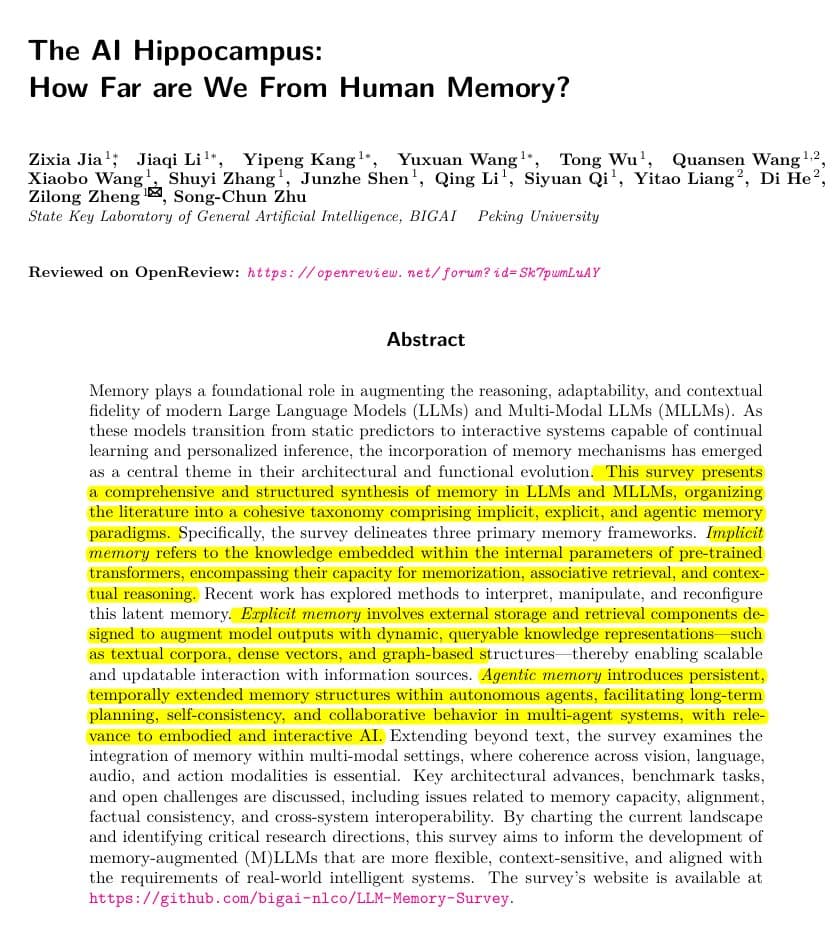
A survey paper titled "The AI Hippocampus: How Far are They From Human Memory?" (arXiv:2601.09113) argues that modern AI systems need three distinct memory systems to approach human-like cognition: parametric memory (weights), retrieval memory (fresh facts), and agent memory (ongoing goals and preferences).
The paper, highlighted by AI researcher Rohan Paul, contends that a model with only parametric memory is "knowledgeable but stale," while one with only retrieval can fetch facts but "lack continuity, judgment, and a stable sense of what matters across time."
Key Claims
- Parametric memory: Slow, durable knowledge stored in model weights (e.g., training data).
- Retrieval memory: Fresh, specific facts fetched on demand (e.g., RAG, vector databases).
- Agent memory: Ongoing goals, preferences, and experience across sessions (e.g., episodic memory).
The real bottleneck, according to the paper, is control: when to retrieve, what to keep, what to forget, and how to update memory without corrupting nearby knowledge.
Unresolved Challenges

The paper is careful to note what remains unsolved:
- Long context is expensive.
- Retrieval can contaminate generation.
- Memory editing can break nearby knowledge.
- Multimodal systems face a brutal scaling problem because video, audio, and action create long, messy histories.
gentic.news Analysis
This survey arrives at a critical inflection point in AI development. The industry has spent years optimizing parametric memory (larger models, more data) and retrieval memory (RAG, vector databases), but agent memory remains the least mature and most fragmented. The paper's framing of memory as a "negotiated truce between permanence, retrieval, and experience" echoes the growing consensus among AI labs that long-running agents require persistent state management.
What's particularly noteworthy is the paper's emphasis on control over storage. This aligns with recent work from Anthropic and Google DeepMind on "memory editing" and "continual learning"—both of which struggle with catastrophic forgetting. The paper's caution about multimodal memory scaling is timely: as AI systems move into video, audio, and embodied contexts (robotics, autonomous driving), the memory requirements explode exponentially.
For practitioners, the takeaway is clear: building effective AI agents will require not just better models or better retrieval, but a unified memory architecture that can decide what to remember, when to recall, and how to update without breaking existing knowledge. This is still an open research problem, and the paper provides a useful taxonomy for thinking about it.
Frequently Asked Questions
What are the three types of AI memory?
The paper proposes parametric memory (model weights for durable knowledge), retrieval memory (fresh facts fetched on demand), and agent memory (ongoing goals, preferences, and experience across sessions).
Why is control considered the bottleneck?
Control refers to the decision-making process of when to retrieve information, what to keep, what to forget, and how to update memory without corrupting nearby knowledge—a much harder problem than storage itself.
How does this compare to human memory?
The paper acknowledges that the distance from human memory is still large, especially for multimodal systems handling video, audio, and action histories. Human memory integrates these systems seamlessly, while AI systems struggle with the scaling and control challenges.
What are the practical implications for AI developers?
Developers building long-running agents should consider implementing separate memory systems for different purposes: weights for core knowledge, retrieval for dynamic facts, and agent memory for session-specific context and preferences.