Key Takeaways
- Plurai introduces 'vibe training,' using adversarial agent swarms to distill a small language model (SLM) for evaluating and guarding production AI agents.
- The SLM outperforms standard LLM-as-a-judge setups with ~8x faster inference and ~50% fewer evaluation errors.
What Happened

Researchers at Plurai have introduced a new method called vibe training that could replace the common 'LLM-as-a-judge' approach for evaluating and guarding production AI agents. Instead of relying on a large, general-purpose language model to score agent outputs, vibe training distills a small, specialized language model (SLM) tailored to a specific agent's domain.
How It Works
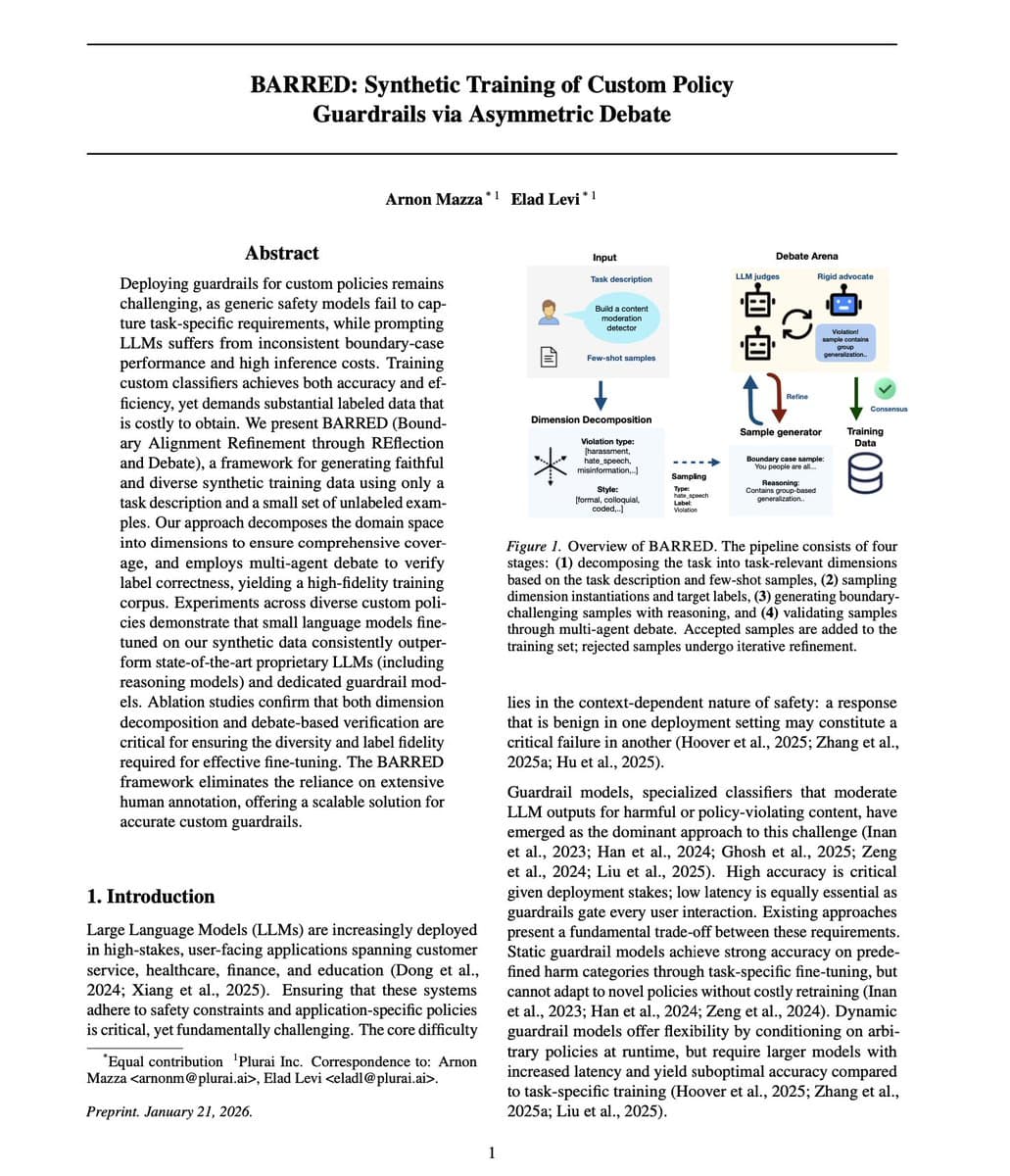
The key insight is that generic LLM judges are slow, expensive, and often miss domain-specific failures. Vibe training flips this by generating synthetic training data through a swarm of adversarial agents that debate and stress-test every use case the target agent is supposed to handle. This interaction data is then used to train a specialized SLM that understands what 'wrong' looks like in that particular domain.
Key Results
According to Plurai, the vibe-trained SLM delivers:
- ~8x faster inference compared to standard LLM-as-a-judge setups
- ~50% fewer evaluation errors
The SLM acts as both evaluator and runtime guardrail, combining two roles into one smaller, faster, more accurate model.
Why It Matters
For teams deploying AI agents in production, the LLM-as-a-judge pattern has become a bottleneck. It's costly to run a large model for every evaluation call, and general-purpose judges frequently fail to catch edge cases specific to a given application (e.g., financial compliance, medical terminology, or legal phrasing). Vibe training offers a concrete path to a specialized, lightweight alternative that can be deployed at scale without sacrificing—or even improving—evaluation quality.
What This Means in Practice

If your team currently uses GPT-4 or Claude as a judge to evaluate agent outputs, vibe training suggests you can replace that with a distilled model that runs 8x faster and makes half as many mistakes—at least for your specific use case. The adversarial data generation step is automated, so you don't need to hand-label thousands of examples. This could make agent evaluation both cheaper and more reliable.
Limitations
The approach depends on the quality of the adversarial swarm's generated data. If the adversarial agents fail to explore the full failure space, the SLM may still miss critical errors. Additionally, the technique requires an initial investment in running the adversarial debate process, which itself may require significant compute. The paper's results are also based on Plurai's own benchmarks; independent third-party validation would strengthen the claims.
Frequently Asked Questions
What is vibe training?
Vibe training is a method developed by Plurai that uses a swarm of adversarial AI agents to generate synthetic training data for distilling a small, specialized language model (SLM) that can evaluate and guard production AI agents more efficiently than a general-purpose LLM judge.
How does vibe training compare to LLM-as-a-judge?
Vibe training replaces a large, general-purpose LLM judge with a small, domain-specific SLM that runs ~8x faster and makes ~50% fewer evaluation errors, according to Plurai's reported results.
Do I need to label training data for vibe training?
No. The training data is generated automatically by a swarm of adversarial agents that debate and stress-test the target agent's use cases. No hand-curated labels are required.
Can vibe training be used for any AI agent?
Yes, in principle. The method is domain-agnostic: you define the use cases your agent must handle, spin up adversarial agents to generate interaction data, and train a specialized SLM. It's most useful for domains where a generic LLM judge consistently misses edge cases.
gentic.news Analysis
This development arrives at a critical inflection point for the agent evaluation ecosystem. Over the past year, we've seen a growing backlash against the 'just use GPT-4 as a judge' approach, with practitioners reporting high costs, latency issues, and brittle evaluation pipelines. Plurai's vibe training directly addresses these pain points by shifting from a one-size-fits-all judge to a specialized, distilled model.
The use of adversarial agent swarms for data generation is particularly clever. It mirrors the 'red-teaming' approach that's become standard in safety evaluation, but applies it to functional correctness rather than just safety. This technique could become a template for other agent evaluation tools.
However, the approach introduces a new dependency: the quality of the adversarial swarm. If the swarm fails to generate diverse enough failure cases, the distilled SLM will inherit blind spots. Teams adopting vibe training will need to carefully design their adversarial agents to cover the full failure surface of their target agent.
From a business perspective, this aligns with a broader trend we've tracked at gentic.news: the shift from monolithic LLMs to specialized, smaller models for specific tasks. We've covered similar moves with distilled models for code generation, customer support, and now agent evaluation. The 'SLM-for-agents' thesis is gaining concrete validation.
The reported 8x speedup and 50% error reduction are impressive, but we'd like to see independent replication. If these numbers hold, vibe training could become a standard component in the agent deployment stack, alongside tools like LangSmith, Weights & Biases, and Arize AI for monitoring.
Key takeaway: If you're running LLM-as-a-judge in production, this paper is worth benchmarking against your own use case. The potential cost and accuracy improvements are too large to ignore.