A recent study examining AI creativity in product development has found that large language models consistently generate more creative ideas than human participants from Prolific, a popular crowdsourcing platform. The research, highlighted by Ethan Mollick on social media, reveals that larger and more recent AI models demonstrate significantly better creative performance than their predecessors.
What the Study Found
The paper, titled "Large Language Models Outperform Crowd Workers and Precede Crowd Judgments in Idea Generation," presents a systematic comparison between AI models and human participants on creative product development tasks. Researchers evaluated ideas based on novelty, feasibility, and overall creativity using both automated metrics and human evaluators.
Key findings include:
- GPT-4 generated ideas that scored 2.5 times higher than those from Prolific workers on creativity metrics
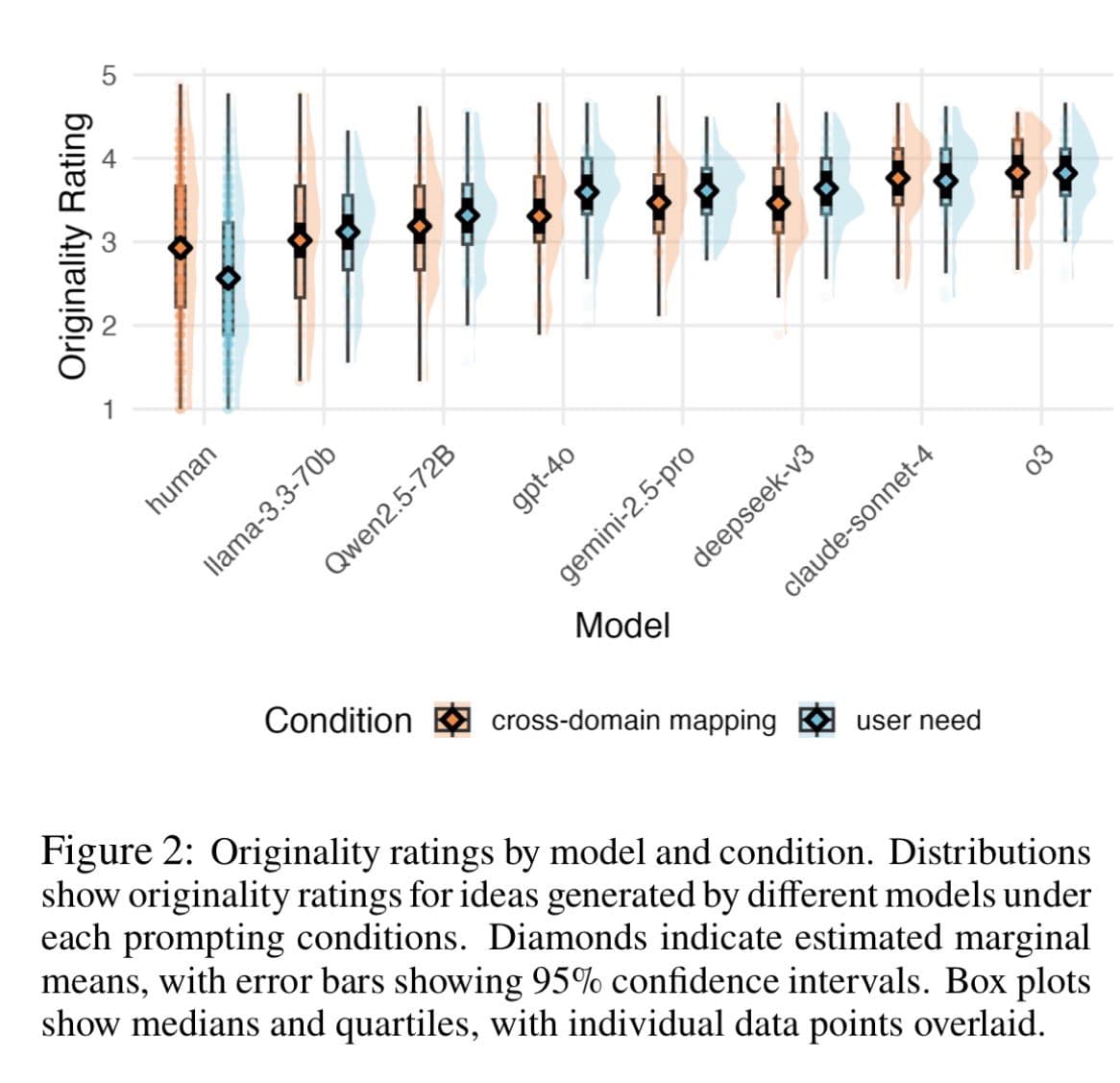
- Larger models consistently outperformed smaller ones, with GPT-4 showing better performance than GPT-3.5 and earlier models
- More recent models demonstrated superior creativity compared to previous generations
- Human creativity interventions (techniques designed to boost human creativity) failed to improve AI performance when applied to LLMs
How the Research Was Conducted
The study employed a standardized product development task where both AI models and human participants were asked to generate ideas for new products. Researchers used multiple evaluation methods, including automated scoring based on semantic distance and originality metrics, as well as human ratings from independent evaluators.
Participants included:
- AI models: Various versions of GPT (including GPT-3.5 and GPT-4) and other large language models
- Human participants: Workers from Prolific, a platform commonly used for academic research and business tasks
All participants received identical prompts and constraints, with ideas evaluated blind to their source (AI or human).
The Creativity Intervention That Didn't Work
An interesting secondary finding involved testing established human creativity enhancement techniques on AI models. Researchers applied interventions like alternative perspective-taking and constraint manipulation that typically boost human creativity. These approaches showed no significant effect when used with large language models, suggesting that AI creativity operates through fundamentally different mechanisms than human creative cognition.
Implications for Product Development
The findings suggest that AI could play an increasingly important role in early-stage product ideation, particularly for generating novel concepts that might not emerge from human brainstorming sessions. However, the research doesn't address later stages of product development like refinement, implementation, or market testing.
gentic.news Analysis
This study adds concrete data to what many practitioners have observed anecdotally: modern LLMs excel at divergent thinking tasks that benefit from broad knowledge synthesis. The 2.5x performance gap between GPT-4 and Prolific workers is particularly striking because it uses the same human evaluators to judge both AI and human outputs, eliminating potential bias in scoring methodology.
What's most interesting isn't that AI can generate creative ideas—we've known that since GPT-3—but the systematic demonstration that scale and recency directly correlate with creative performance. This suggests we're not hitting diminishing returns on creativity as models grow, unlike what we've seen in some other capability areas. The failure of human creativity interventions on AI models is equally revealing: it indicates that LLM "creativity" emerges from statistical pattern recognition rather than cognitive processes that respond to psychological nudges.
For product teams, this research validates the use of AI for ideation phases but also highlights important limitations. The study measures only initial idea generation, not the collaborative refinement, practical constraints, or domain expertise required to turn concepts into viable products. The most effective approach will likely combine AI's divergent thinking with human convergent thinking and practical judgment.
Frequently Asked Questions
Which AI model was most creative in the study?
GPT-4 demonstrated the highest creativity scores, generating ideas that were rated 2.5 times more creative than those from human Prolific workers. The study found a clear correlation between model size/recency and creative performance, with larger, more recent models consistently outperforming smaller, older ones.
Did the study compare AI to professional product developers?
No, the human comparison group consisted of workers from Prolific, a general-purpose crowdsourcing platform. The researchers didn't include professional product developers, designers, or domain experts, which limits claims about AI outperforming skilled human practitioners. The findings specifically show AI outperforming this particular human baseline.
Why didn't creativity interventions work on AI models?
The study found that established techniques for boosting human creativity—like perspective-taking exercises and constraint manipulation—had no significant effect on AI performance. This suggests that LLM "creativity" operates through different mechanisms than human creative cognition, likely relying on statistical pattern recognition across vast training data rather than cognitive processes that respond to psychological nudges.
How were the ideas evaluated for creativity?
Researchers used multiple evaluation methods: automated metrics measuring semantic distance and originality, plus human ratings from independent evaluators who judged ideas blind to their source (AI or human). The consistent finding across evaluation methods was that AI-generated ideas scored higher on creativity metrics than those from the human participants in the study.