GPT-4o Tutor Boosts High School Test Scores by 0.15 Standard Deviations in Randomized Trial
AI ResearchScore: 85

GPT-4o Tutor Boosts High School Test Scores by 0.15 Standard Deviations in Randomized Trial

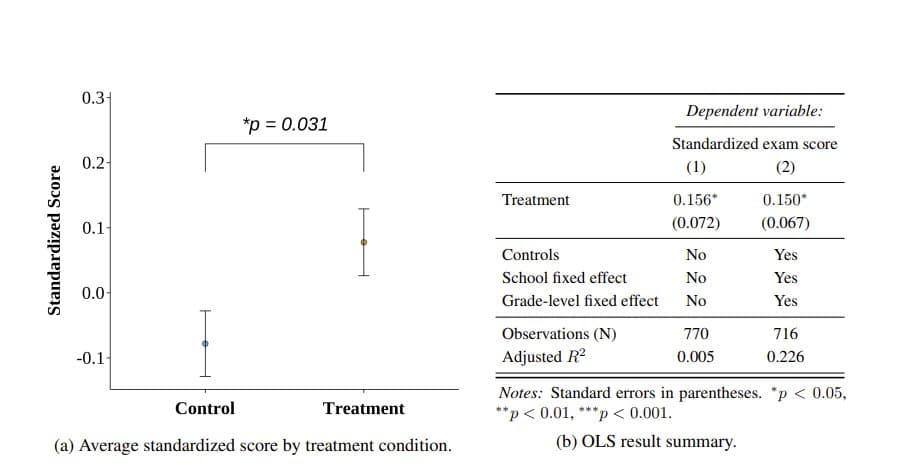
A randomized controlled experiment found a GPT-4o-powered tutor that personalizes problems raised high school students' final test scores by 0.15 standard deviations. Researchers estimate this gain is equivalent to 6-9 months of additional schooling.

4h ago·2 min read·22 views·via @emollick
Share:

What Happened

A randomized controlled trial involving high school students has demonstrated that an AI tutor powered by GPT-4o can significantly improve learning outcomes. The study, highlighted by researcher Ethan Mollick, found that students who used the personalized AI tutor saw their final test scores increase by 0.15 standard deviations (SD) compared to a control group.

According to the researchers, this effect size translates to "equivalent to as much as six to nine months of additional schooling by some estimates." The key intervention was a tutoring system that used GPT-4o to generate and adapt problems specifically for individual students.

Context

This study represents one of the more rigorous attempts to measure the real-world educational impact of large language models (LLMs) in a classroom setting. Randomized controlled trials (RCTs) are considered the gold standard for evaluating educational interventions, as they isolate the effect of the specific tool being tested.

The research adds concrete data to the ongoing debate about AI's role in education. While many schools have experimented with AI tools, robust evidence of their efficacy at scale has been limited. The 0.15 SD improvement is a measurable, medium-sized effect in educational research, suggesting the personalized tutoring approach has substantive value.

The system's use of GPT-4o—OpenAI's latest flagship model known for its multimodal and reasoning capabilities—indicates that model performance is likely a factor in the results. The tutor's ability to dynamically personalize problems appears to be a critical component of its effectiveness.

AI Analysis

The 0.15 standard deviation improvement is a meaningful result in educational intervention research. For context, effect sizes in education typically range from 0.0 to 0.4 SD, with 0.10 considered small but not negligible, and 0.20 considered medium. A 0.15 SD gain places this AI tutor in the lower range of a medium effect, which is notable for a scalable, software-based intervention. The comparison to 6-9 months of additional schooling, while an estimate, frames the impact in practical terms educators understand. Technically, the study suggests that GPT-4o's capability to generate and tailor problems in real-time is a key differentiator from static digital worksheets or pre-programmed tutoring systems. The 'personalization' likely involves adjusting problem difficulty, format, or subject focus based on student responses—a task well-suited to LLMs. Practitioners should note that the tutor wasn't just an AI chatbot; it was a structured system built *around* GPT-4o to deliver a specific pedagogical intervention. The major unanswered question is the long-term retention of gains and the system's effectiveness across different subjects, student demographics, and educational contexts. Furthermore, the study doesn't detail the exact prompting, scaffolding, or guardrails used to ensure educational accuracy and safety, which are critical for real-world deployment. Future research should compare this approach to other AI tutoring methods and human tutoring to better understand its relative cost-effectiveness.
Original sourcex.com

Trending Now

More in AI Research

View all