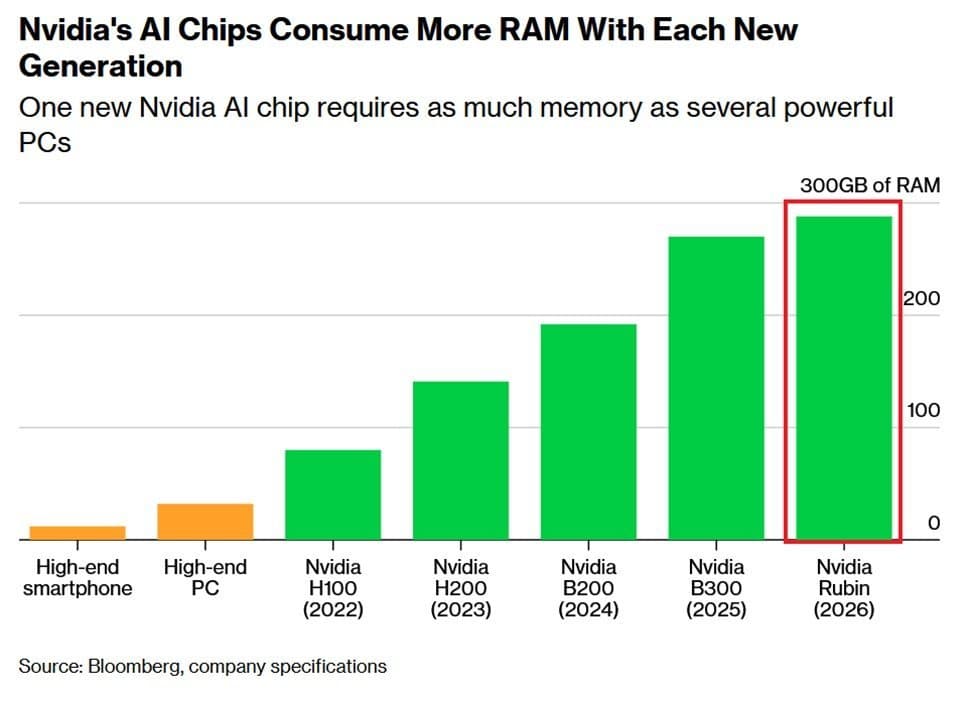
A quiet revolution in hardware requirements is unfolding behind the scenes of the artificial intelligence boom, and its implications are reverberating through global supply chains. According to recent reports, Nvidia's upcoming Rubin AI chip will require a staggering 288GB of RAM just to operate—a figure that represents an exponential leap in memory requirements for computational hardware.
Putting 288GB in Perspective
To understand the scale of this demand, consider comparative benchmarks: The Rubin chip's memory requirement is 800% more than what's found in a top-tier desktop computer today. When compared to high-end smartphones, the disparity becomes even more dramatic—2300% more memory than current premium mobile devices contain. This isn't incremental growth; it's a quantum leap in hardware requirements driven by increasingly complex AI models that demand unprecedented memory bandwidth and capacity.
The Supply Chain Domino Effect
The surge in memory requirements has triggered a cascade of consequences throughout the global electronics ecosystem. Large-scale purchases by AI giants OpenAI and Alphabet have reportedly depleted available memory supplies, creating what analysts describe as a "massive global memory shortage." The impact on pricing has been immediate and severe: 16GB DDR4 memory modules have seen prices skyrocket by 2352% to approximately $76.90 per unit.
According to the source material, "Hardware manufacturers simply cannot make memory chips fast enough to keep up with the demands of these new AI processors." This statement underscores a fundamental mismatch between manufacturing capacity and the explosive growth in AI hardware requirements.
The Rubin Chip: A Glimpse into AI's Hardware Future
Nvidia's Rubin represents more than just another chip iteration—it signals a new paradigm in computational architecture where memory capacity becomes as critical as processing power. The 288GB requirement suggests AI models are growing in complexity at a rate that outstrips traditional Moore's Law predictions for processing improvements alone.
This development raises important questions about the sustainability of current AI advancement trajectories. If each new generation of AI chips requires exponentially more memory, we may be approaching physical and economic constraints that could reshape the pace of AI development.
Global Implications Beyond Technology
The memory shortage extends far beyond the tech sector. As memory chips become scarce and expensive, ripple effects will likely impact:
- Consumer electronics pricing and availability
- Automotive industries increasingly dependent on chips
- Medical devices and diagnostic equipment
- Industrial automation systems
This represents a classic case of emerging technology creating unexpected bottlenecks in seemingly unrelated sectors—a phenomenon that economists call "technological spillover effects."
The Manufacturing Challenge
The report's observation that "hardware manufacturers simply cannot make memory chips fast enough" points to deeper structural issues in semiconductor manufacturing. Building new fabrication facilities (fabs) requires billions in investment and years of construction time, creating a lag between demand recognition and supply response that could extend the shortage for years.
This situation mirrors previous chip shortages but with an important distinction: AI-driven demand appears more structural than cyclical, suggesting we may be witnessing a permanent shift in memory allocation priorities rather than a temporary imbalance.
Strategic Responses and Future Outlook
In response to these pressures, several strategic shifts are likely:
- Vertical integration by AI companies into memory manufacturing
- Architectural innovations to reduce memory dependence
- Geopolitical competition for memory manufacturing capacity
- Alternative memory technologies with higher density potential
The Rubin chip's memory requirements may represent a peak rather than a continuing trend if engineers develop more memory-efficient architectures or breakthrough technologies like compute-in-memory designs that reduce data movement between processors and memory.
Conclusion: A New Era of Computational Economics
The 288GB memory requirement of Nvidia's Rubin chip isn't just a technical specification—it's a leading indicator of how AI is reshaping fundamental assumptions about computational hardware. As AI models grow more sophisticated, their hardware appetites grow proportionally, creating supply chain challenges that extend far beyond Silicon Valley.
This development forces us to reconsider the true cost of AI advancement, not just in research dollars but in global resource allocation. The memory shortage represents the tangible manifestation of AI's physical footprint—a reminder that even digital intelligence requires substantial material foundations.
Source: Analysis based on reporting from @rohanpaul_ai on X/Twitter, citing data from Bloomberg.