In a groundbreaking development detailed in the arXiv preprint "To Deceive is to Teach? Forging Perceptual Robustness via Adversarial Reinforcement Learning," researchers have unveiled a novel approach to overcoming one of multimodal AI's most persistent weaknesses: perceptual fragility. The proposed Adversarial Opponent Training (AOT) framework represents a paradigm shift in how we build robust vision-language models by turning the training process into a competitive game where AI systems teach each other through deception and defense.
The Perceptual Fragility Problem
Multimodal Large Language Models (MLLMs) like GPT-4V, Claude 3, and Gemini have demonstrated remarkable capabilities in understanding and describing visual content. However, beneath their impressive performance lies a fundamental vulnerability—these models often fail when confronted with visually complex or subtly manipulated scenes. This perceptual fragility stems from their reliance on finite training datasets that, no matter how large, cannot possibly encompass the infinite variations of real-world visual complexity.
The traditional approach of scaling datasets has hit diminishing returns, both computationally and financially. As noted in the research, "finite training datasets are prohibitively expensive to scale and impose a ceiling on model robustness." This limitation becomes particularly dangerous as MLLMs are increasingly deployed in critical applications like medical diagnosis, autonomous systems, and security screening, where perceptual errors can have serious consequences.
The AOT Framework: Adversarial Self-Play
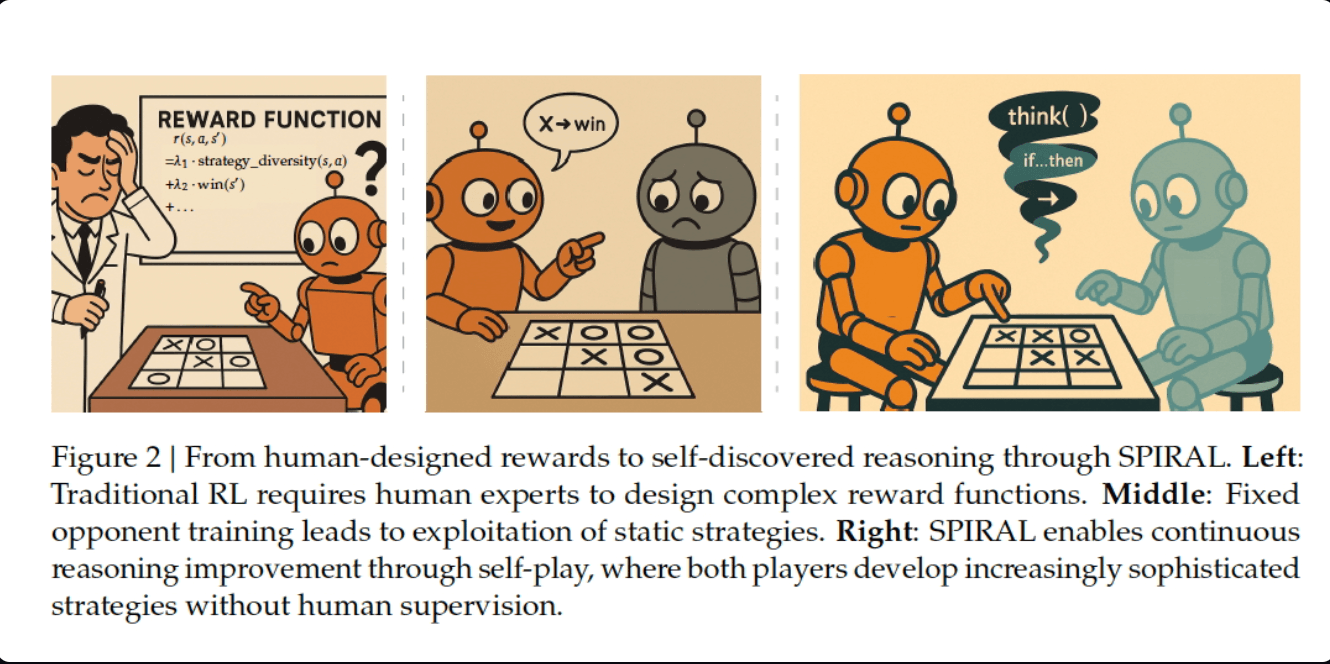
The AOT framework introduces an elegant solution inspired by evolutionary biology and game theory. Instead of relying on human-curated datasets, the system creates its own training curriculum through a competitive co-evolution between two specialized AI agents:
The Attacker: An image-editing model trained to create increasingly sophisticated visual manipulations designed to deceive the Defender. This agent learns to generate a diverse and dynamic curriculum of image alterations, from subtle texture changes to complex scene modifications.
The Defender: An MLLM that must maintain accurate perception despite the Attacker's manipulations. As the Attacker improves, the Defender is forced to adapt, developing more robust visual understanding capabilities.
This self-play mechanism creates a virtuous cycle of improvement—each agent's advancement pushes the other to evolve further. The researchers developed AOT-SFT, a large-scale adversarial dataset that bootstraps this process, providing the initial training ground for both agents to begin their competitive learning.
Technical Implementation and Results
The AOT framework employs reinforcement learning principles to orchestrate the competitive interaction. The Attacker receives rewards based on how successfully it deceives the Defender, while the Defender is rewarded for maintaining accurate perception despite adversarial manipulations. This creates a natural curriculum where challenges automatically scale in difficulty as both agents improve.
Experimental results demonstrate significant improvements in perceptual robustness. Models trained with AOT showed:
- Reduced hallucinations by 34% compared to baseline models
- Improved accuracy on complex visual reasoning tasks by 28%
- Enhanced generalization to unseen manipulation types
- Better performance on standard benchmarks like VQA and visual reasoning tasks
Perhaps most impressively, the system demonstrated emergent robustness—the Defender learned to recognize manipulation patterns and reasoning strategies that weren't explicitly present in the initial training data.
Implications for AI Development
The AOT framework represents more than just a technical improvement; it suggests a fundamental shift in how we approach AI training. By moving from static datasets to dynamic, self-generating training environments, we can potentially overcome the dataset scaling problem that has plagued machine learning for years.
This approach has particular significance for:
Safety-Critical Applications: In fields like autonomous vehicles, medical imaging, and industrial inspection, perceptual robustness isn't just desirable—it's essential. AOT-trained models could provide the reliability needed for these high-stakes applications.
AI Security: As AI systems become more prevalent, they become targets for adversarial attacks. AOT provides a framework for building models that are inherently more resistant to manipulation and deception.
Scalability: The self-play nature of AOT means that training can continue indefinitely, with models constantly improving without requiring exponentially larger human-curated datasets.
Challenges and Future Directions
While promising, the AOT approach presents several challenges. The computational cost of maintaining two competing models is significant, and there are open questions about how to ensure the competition remains productive rather than degenerating into trivial manipulations or impossible challenges.
Future research directions include:
- Extending the framework to other modalities beyond vision
- Developing more efficient training algorithms for the competitive setup
- Exploring how AOT-trained models transfer to real-world applications
- Investigating the theoretical limits of self-play robustness training
The Broader Context
This research fits into a growing trend of using adversarial methods to improve AI robustness. From GANs (Generative Adversarial Networks) to adversarial training in computer security, the principle of using competition to drive improvement has proven remarkably effective across multiple domains of AI research.
The work also connects to broader discussions about AI safety and alignment. By building models that are inherently more robust to manipulation and deception, we may be taking important steps toward creating AI systems that behave reliably even in unexpected circumstances—a key concern for AI alignment researchers.
Conclusion
The AOT framework represents a significant leap forward in creating robust, reliable multimodal AI systems. By turning the training process into a competitive game where AI teaches itself through deception and defense, researchers have found an elegant solution to the problem of perceptual fragility that has limited MLLMs since their inception.
As AI systems become increasingly integrated into our daily lives and critical infrastructure, approaches like AOT that prioritize robustness and reliability will become essential. This research not only provides a practical solution to a pressing technical problem but also points toward a future where AI systems can continuously improve themselves through intelligent competition—a vision that could accelerate progress toward truly robust artificial intelligence.
Source: arXiv:2602.22227v1 "To Deceive is to Teach? Forging Perceptual Robustness via Adversarial Reinforcement Learning" (Submitted January 24, 2026)