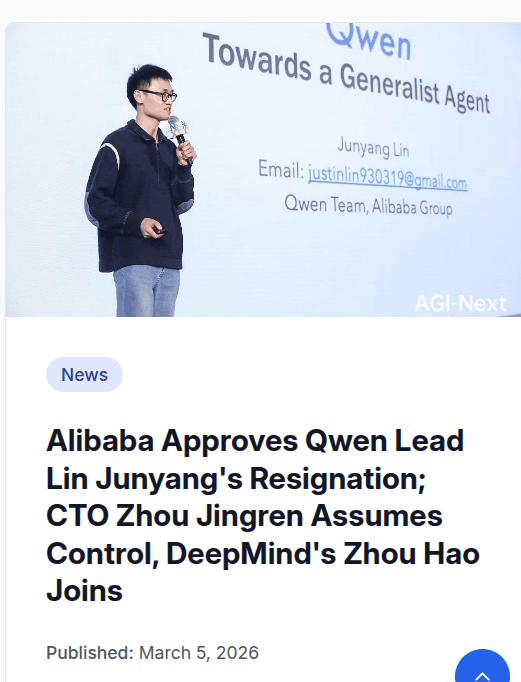
Alibaba Group has initiated a significant leadership reshuffle within its artificial intelligence division, signaling a strategic pivot as China's tech giant intensifies its competition in the global AI arena. CEO Eddie Wu has officially approved the resignation of Lin Junyang, the leader of the Qwen AI team, while simultaneously bringing in Zhou Hao, a former senior scientist from Google DeepMind who contributed to the development of Gemini 3.0.
The Departure and Arrival
Lin Junyang's departure from Alibaba's Qwen AI team represents a notable shift in the company's AI leadership structure. While specific reasons for his resignation haven't been publicly disclosed, the timing coincides with Alibaba's broader reorganization efforts under CEO Eddie Wu, who assumed leadership in September 2023 with a mandate to refocus the company on its core businesses amid increasing competitive pressures.
Zhou Hao's appointment carries particular significance given his background at Google DeepMind, where he helped build Gemini 3.0—Google's most advanced multimodal AI model to date. His expertise in post-training processes, the critical stage where models are fine-tuned using human feedback to enhance performance and alignment, suggests Alibaba is prioritizing refinement and deployment capabilities for its AI offerings.
Structural Reorganization
Concurrent with these personnel changes, Alibaba Cloud CTO Zhou Jingren is assuming more direct control over AI initiatives, overseeing a structural shift where technical experts will share their skills across multiple AI projects rather than working within isolated teams. This cross-functional approach aims to accelerate innovation and resource optimization as Alibaba competes with both domestic rivals like Baidu and Tencent and international giants including OpenAI, Google, and Microsoft.
The reorganization appears designed to break down silos that may have developed within Alibaba's extensive AI research and development operations, potentially addressing criticisms that Chinese tech companies have sometimes struggled with inefficient resource allocation across competing internal projects.
The Qwen Context
Alibaba's Qwen (通义千问) series represents the company's flagship large language model family, with Qwen 2.5 recently demonstrating competitive performance across multiple benchmarks. The models have been positioned as open-source alternatives to proprietary Western offerings, with Alibaba releasing several versions to the developer community to build ecosystem momentum.
Lin Junyang's leadership of the Qwen team coincided with significant technical advancements, including the development of multimodal capabilities and improved reasoning functions. His departure raises questions about continuity in the Qwen development roadmap, though Alibaba's appointment of Zhou Hao suggests a deliberate transition rather than an abrupt disruption.
Strategic Implications
This leadership shuffle occurs against a backdrop of intensifying AI competition between China and the United States, with both nations investing heavily in foundational AI research and application development. Alibaba's recruitment of talent with direct experience at leading Western AI labs reflects a broader trend of global talent circulation in the AI field, despite geopolitical tensions and export restrictions on advanced computing hardware.
Zhou Hao's specific expertise in post-training processes indicates Alibaba may be prioritizing the refinement stage of AI development—an area where companies like OpenAI have demonstrated significant competitive advantage through techniques like reinforcement learning from human feedback (RLHF). This focus on making existing models "smarter" through targeted fine-tuning could help Alibaba maximize returns on its substantial compute investments.
Industry Context and Competitive Landscape
Alibaba's AI ambitions face challenges on multiple fronts. Domestically, the company competes with Baidu's Ernie series and startups like Zhipu AI, while internationally it must contend with rapid advancements from American firms. The Chinese AI market also operates under distinct regulatory frameworks that influence model development and deployment strategies.
The company's cloud division, Alibaba Cloud, serves as both a development platform and deployment vehicle for its AI models, creating synergies but also requiring careful coordination between research and business units. Zhou Jingren's increased oversight likely aims to strengthen these connections as AI becomes increasingly central to Alibaba's cloud computing value proposition.
Future Trajectory
Industry observers will be watching several indicators following this leadership transition: the pace of Qwen model iterations, any shifts in Alibaba's open-source strategy, and the company's ability to attract additional international AI talent. The success of Zhou Hao's integration into Alibaba's culture and operations will be particularly telling, as Chinese tech firms have sometimes struggled to retain senior talent recruited from Western counterparts.
Alibaba's AI reorganization reflects broader trends in the technology sector, where companies are consolidating AI efforts after initial experimentation with decentralized approaches. The emphasis on cross-project expertise sharing mirrors similar initiatives at Google and Microsoft, suggesting convergence in organizational best practices for AI development at scale.
Source: Based on reporting from Pandaily and social media announcements regarding Alibaba's leadership changes.