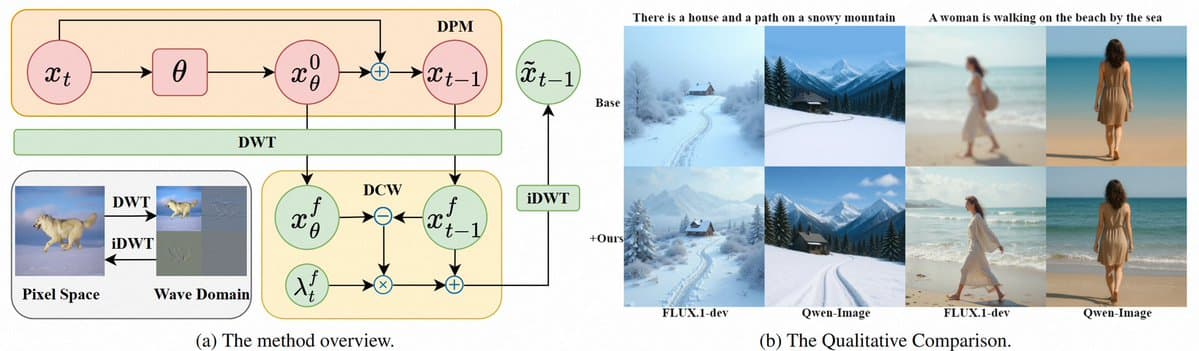
Researchers from Alibaba have identified and corrected a fundamental bias in the training of diffusion models, a core architecture behind modern image and video generation AI. The issue, termed Signal-to-Noise Ratio timestep (SNR-t) misalignment, causes models to learn from a distorted noise schedule, leading to suboptimal performance. Their solution, Diffusion Correction in Wavelet domain (DCW), applies a wavelet-based correction that realigns the training process, yielding measurable improvements in prominent models like FLUX, EDM, and ADM with minimal computational overhead.
The work, shared via a paper link on X (formerly Twitter), addresses a subtle but impactful technical flaw that has persisted in diffusion model training pipelines.
Key Takeaways
- Alibaba researchers developed DCW, a wavelet-based method to correct SNR-t misalignment in diffusion models.
- The fix improves performance for models like FLUX and EDM with minimal computational cost.
What the Researchers Fixed: SNR-t Misalignment

At the heart of diffusion models is a forward process that gradually adds noise to data (like an image) across a series of timesteps (t), and a reverse process where a neural network learns to denoise, ultimately generating new data. The relationship between the amount of noise added (quantified by the Signal-to-Noise Ratio, or SNR) and the timestep t is defined by a noise schedule.
The researchers found a critical implementation bias: the SNR calculated during training does not correctly align with the intended theoretical noise schedule for the corresponding timestep t. This "SNR-t misalignment" means the model is trained on a corrupted version of the intended noise distribution. It learns the denoising task based on an incorrect mapping, which hampers its final generative performance and efficiency.
The Solution: Diffusion Correction in Wavelet Domain (DCW)
To correct this misalignment without a costly retraining from scratch, the team developed DCW. The method operates in the wavelet domain—a mathematical space that represents data in terms of frequency components—rather than the standard pixel (spatial) domain.
Here’s the intuition: The miscalibrated SNR primarily affects different frequency components of the data (like coarse shapes vs. fine textures) in unbalanced ways. By applying the correction within the wavelet domain, DCW can precisely adjust for the misalignment per frequency band. This approach is more targeted and effective than a blunt, global correction in the pixel space.
How it works technically:
- Analysis: The forward diffusion process (adding noise) is analyzed to quantify the exact discrepancy between the actual and intended SNR for a given timestep
t. - Wavelet Decomposition: The data (or the model's features) are decomposed into wavelet coefficients, separating information into different frequency sub-bands.
- Band-Specific Correction: A correction factor, derived from the misalignment analysis, is applied to the wavelet coefficients. This factor is tailored to realign the effective SNR for each frequency band with the theoretically correct schedule.
- Reconstruction: The corrected wavelet coefficients are transformed back, yielding data that has been "adjusted" for the training bias.
The process can be applied as a preprocessing step or integrated into the model's inference pipeline, adding negligible computational overhead.
Key Results and Impact
The paper reports that applying DCW consistently improves the performance of several state-of-the-art diffusion models that were previously hampered by the undiscovered SNR-t bias. Specifically mentioned are:
- FLUX: A leading text-to-image model known for its high-quality output.
- EDM (Elucidating Diffusion Models): A popular and influential diffusion model framework.
- ADM (Ablated Diffusion Model): A class of models from Google Research that helped establish best practices in diffusion modeling.
Improvements are observed in standard quantitative metrics for image generation, such as Fréchet Inception Distance (FID) and Inception Score (IS), which measure image quality and diversity. The "minimal overhead" claim is significant; it means existing production models and research checkpoints can be enhanced without the prohibitive cost of full retraining.
What This Means in Practice

For AI engineers and researchers, this work is a crucial debugging exercise for the diffusion model stack. It suggests that some performance ceilings for existing models may not be fundamental limits but correctable implementation oversights. Integrating DCW or ensuring SNR-t alignment in future training pipelines could become a new best practice, leading to immediate gains in output quality and training efficiency for text-to-image, video generation, and other diffusion-based AI systems.
gentic.news Analysis
This correction from Alibaba's research team is a pointed example of the maturation phase in generative AI infrastructure. The field is moving past simply scaling parameters and is now diving deep into optimizing foundational training mechanics. The discovery of a systemic bias like SNR-t misalignment, affecting major open-source frameworks (EDM) and closed models (FLUX), indicates that even widely adopted, "standard" codebases can harbor significant inefficiencies.
This aligns with a broader trend we've covered, such as in our analysis of Stability AI's SD3 architecture, which also focused on refining diffusion model fundamentals rather than just increasing scale. It also connects to ongoing industry efforts to reduce the massive computational cost of training these models. A fix that boosts performance "with minimal overhead" is directly valuable in that economic context. Alibaba's push in this space follows its established investment in generative AI, competing with other cloud and tech giants to provide the most efficient and capable underlying models for developers.
The wavelet-domain approach is particularly insightful. It acknowledges that the corruption from the bias isn't uniform and applies a signal-processing lens to the problem. This interdisciplinary fix—applying classical signal processing theory to modern deep learning—is a pattern we see in other high-impact ML research, such as work improving the efficiency of attention mechanisms in transformers.
For practitioners, the immediate takeaway is to audit your own diffusion training pipelines for SNR-t alignment. In the longer term, this work may prompt a re-evaluation of other "standard" components in the generative AI stack, potentially unlocking further gains through similar rigorous corrections.
Frequently Asked Questions
What is SNR-t misalignment in diffusion models?
SNR-t misalignment is a training implementation bias where the actual Signal-to-Noise Ratio (SNR) used during the diffusion model's forward noising process does not correctly match the intended theoretical value for a given timestep (t). This means the model learns to denoise based on a corrupted version of the planned noise schedule, leading to suboptimal generative performance.
How does Alibaba's DCW method fix this bias?
DCW (Diffusion Correction in Wavelet domain) fixes the bias by applying a targeted correction in the wavelet domain, not the standard pixel domain. It analyzes the misalignment, decomposes the data into frequency bands via wavelet transform, applies a band-specific correction factor to realign the SNR, and then reconstructs the data. This precise, frequency-aware correction adds minimal computational cost.
Which AI models does the DCW correction improve?
According to the researchers, applying DCW improves the performance of several prominent diffusion models, including FLUX (a leading text-to-image model), the EDM (Elucidating Diffusion Models) framework, and ADM (Ablated Diffusion Models). Improvements are measured in standard image generation metrics like FID and Inception Score.
Can I use DCW on my already-trained diffusion model?
Yes, a key advantage of DCW highlighted by the researchers is its low overhead and applicability to existing models. It can be applied as a preprocessing correction or integrated into the inference pipeline of a pre-trained model checkpoint without requiring a full, expensive retraining from scratch.