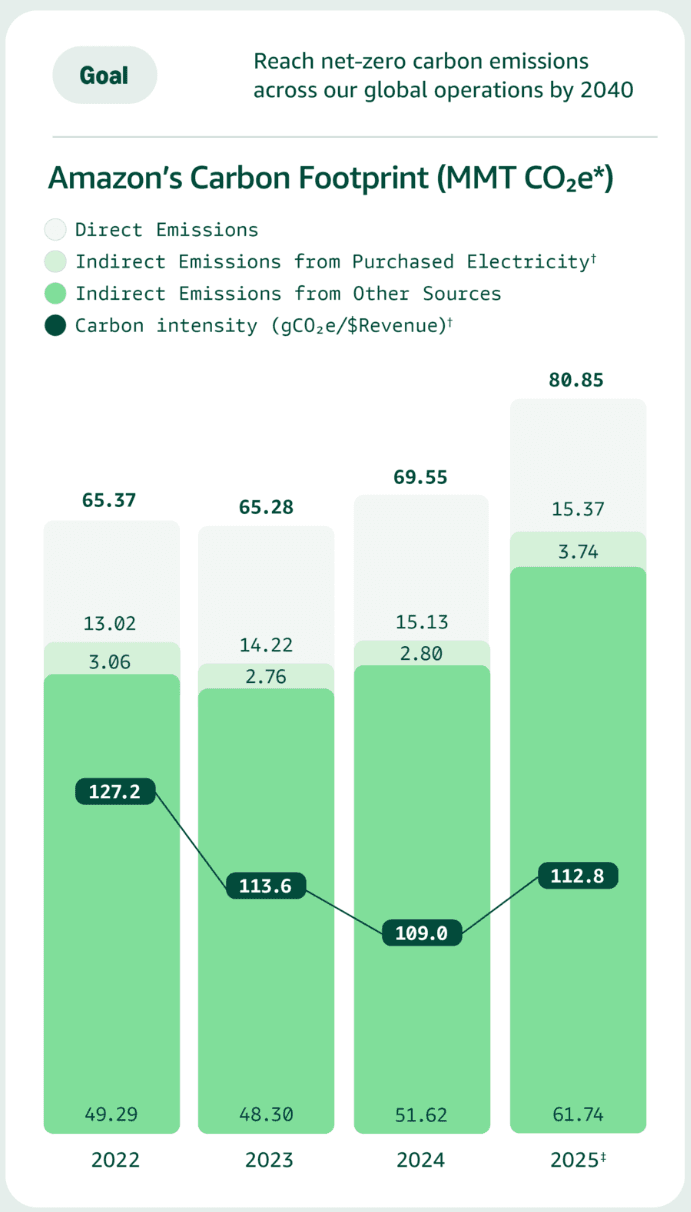
Amazon's total greenhouse gas emissions rose 16% in 2025 to 82.3 million metric tons, driven by AI data center electricity consumption. The jump is the largest single-year increase since the company began reporting in 2019, challenging its net-zero-by-2040 pledge.
Key facts
- Amazon emissions rose 16% to 82.3M metric tons in 2025
- Scope 2 electricity emissions jumped 22% to 48.1M metric tons
- Largest single-year increase since reporting began in 2019
- Amazon has invested $4B+ in Anthropic and $200B in data centers
- Company maintains net-zero by 2040 pledge despite trend
Amazon's latest sustainability report, published Tuesday, reveals that total greenhouse gas emissions reached 82.3 million metric tons of CO2 equivalent in 2025, up from 71.1 million in 2024 According to GeekWire. Scope 2 emissions, which cover purchased electricity for data centers and other operations, jumped 22% to 48.1 million metric tons — the primary driver of the overall increase.
The 16% annual increase is the largest single-year jump since Amazon began publishing emissions data in 2019. The company attributed the rise to "significant growth in our AWS infrastructure to support the increased demand for AI services," per the report. Amazon has invested heavily in AI compute capacity, including a $4B+ stake in Anthropic and a $200B data center buildout funded partly through Canadian-dollar-denominated bonds in June 2026.
Amazon maintains its net-zero by 2040 pledge, but the timeline has drawn skepticism given the steep upward trajectory. The company points to renewable energy purchases — it claims to have matched 100% of its electricity consumption with renewable energy since 2023 — but critics note that renewable energy credits (RECs) do not reduce actual grid emissions. A 2025 study from Epoch AI found that AI data center scale doubles every 7 months, suggesting the emissions pressure will intensify.
Key Takeaways
- Amazon emissions rose 16% to 82.3M metric tons in 2025, the largest jump since 2019, driven by AI data center electricity.
- The company maintains its net-zero pledge but faces skepticism.
The structural contradiction
Amazon is caught between two promises: selling AI compute to enterprises and achieving net-zero emissions. AWS's AI push, including custom Trainium chips and the Bedrock managed service, directly increases electricity demand. The company's scope 2 emissions are now 2.3x higher than in 2019, when the Climate Pledge was announced. Amazon has committed to being water-positive by 2030 and achieving net-zero carbon across its operations by 2040, but the 2025 data shows emissions moving in the wrong direction.
Amazon is not alone. Google's emissions rose 48% from 2019 to 2024, per its own reporting, driven by AI data center growth. Microsoft's emissions increased 29% over the same period. The difference is scale: Amazon's 82.3 million metric tons is roughly equivalent to the annual emissions of 18 million passenger vehicles, per EPA calculations.
The company did not disclose specific emissions from individual data center regions or break out AI workloads from general AWS compute. It said it will continue investing in carbon removal credits and grid decarbonization, but offered no interim emissions targets between now and 2040.
What to watch
Watch Amazon's Q3 2026 earnings call for any update on interim emissions targets or carbon removal procurement. Also track AWS's renewable energy matching methodology — if the company shifts from REC-based to time-matched hourly matching, the reported emissions picture could change significantly.
Source: geekwire.com