Key Takeaways
- MCP servers turn financial data sources into auditable, replaceable protocol endpoints.
- For Claude Code users building agentic BFSI systems, this means 90% fewer custom integrations and regulator-ready logging.
What Changed — MCP Is Now the Standard for Financial Agent Infrastructure
MCP hit 97 million monthly SDK downloads by late 2025. Every major AI provider — Anthropic, OpenAI, Google, Microsoft, Amazon — has adopted it. The IMF published a formal note in April 2026 citing MCP and A2A as the technical foundation for agentic payments.
For Claude Code users building financial systems, this isn't abstract. The three-layer AI protocol stack — MCP for tools, A2A for agents, WebMCP for web access — is now the consensus architecture for enterprise deployments. If you're writing agents that touch banking data, you need MCP servers.
What It Means For You — The N×M Integration Problem Solved
A typical bank with 15 AI agents and 40 financial data sources needs 600 custom integrations. Each breaks when either side updates. Each is a compliance surface that must be independently audited.
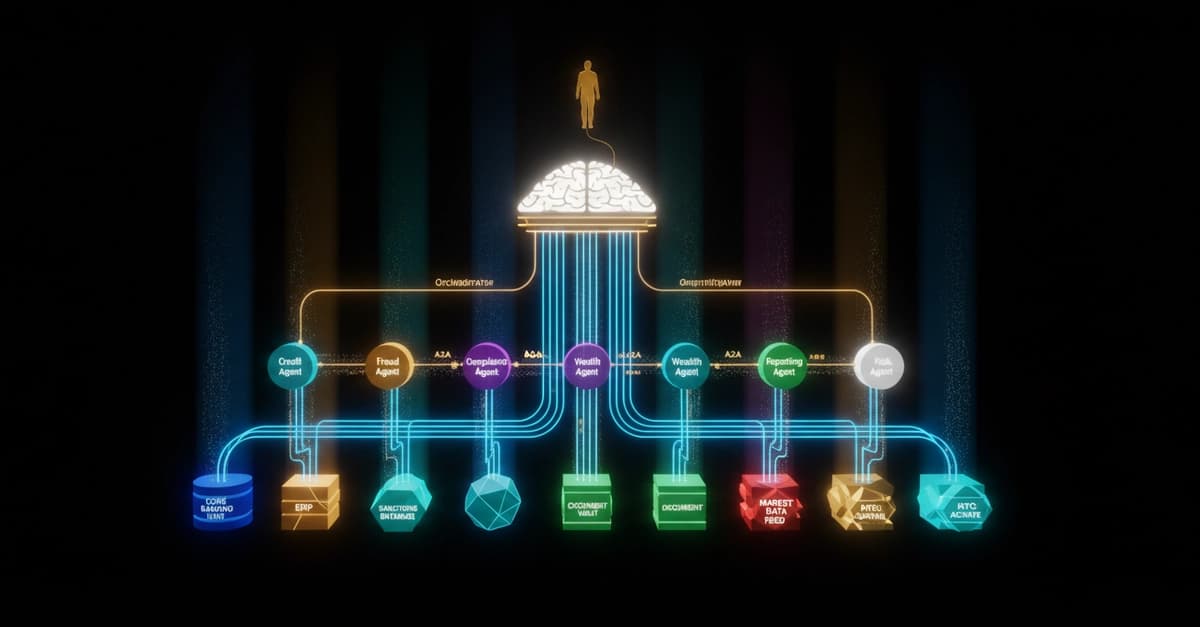
MCP reduces this to 55 connections — 15 agents plus 40 MCP servers. Each server is built and audited once. Agents connect through a standardized JSON-RPC 2.0 wire format.
For your Claude Code workflows, this means:
- Replace 40 brittle API calls with one MCP client that talks to 40 servers
- Audit at the protocol layer — every agent interaction follows a defined format
- Swap vendors without rewrites — A2A makes each agent replaceable
Try It Now — The BFSI MCP Server Taxonomy
Here's the server taxonomy a typical tier-two bank implementation uses. Each becomes a Claude Code MCP server:

Core Banking MCP Server — account balances, transaction history, product holdings. Requires row-level security so each agent only sees authorized customer records.
Credit Intelligence MCP Server — credit bureau data, internal scores, debt-to-income calculations. Flag as high-risk under EU AI Act.
Sanctions and AML MCP Server — real-time sanctions screening, PEP checks, adverse media. Every call must have immutable timestamps.
Market Data MCP Server — real-time prices, volatility surfaces, yield curves. Sub-100ms latency required.
Document Intelligence MCP Server — OCR, entity extraction, KYC document verification.
Regulatory Capital MCP Server — Basel III/IV calculations, RWA data, LCR/NSFR metrics. Read-heavy — agents query before acting.
Communication MCP Server — email, SMS, secure messaging. No agent sends customer comms without routing through this server.
Implementation Pattern: Credit Decision Automation
{
  "jsonrpc": "2.0",
  "method": "tool.call",
  "params": {
    "tool": "core_banking_api",
    "action": "get_transaction_history",
    "arguments": {
      "customer_id": "CUST-8847291",
      "period_months": 24,
      "include_categories": ["income", "regular_commitments", "irregular_debits"],
      "requesting_agent": "credit_decision_agent",
      "authorization_context": {}
    }
  }
}
Your Claude Code agent sends this to the Core Banking MCP server. The server handles auth, row-level security, and returns structured JSON. The agent then calls the Credit Intelligence server, the Sanctions server, and the Regulatory Capital server — all through the same protocol. No custom API wrappers. No brittle orchestration code.
The Compliance Layer
DORA (effective Jan 17, 2025) requires EU financial institutions to continuously monitor ICT systems. Every agent decision affecting customers or transactions must be logged, classified, and reportable.
MCP makes this tractable: when every agent interaction follows a defined wire format, audit logging happens at the protocol layer. You don't bolt compliance onto each application — it's built into the connection.
For Claude Code Users
Set up your MCP servers in CLAUDE.md:
## MCP Servers
- core-banking: http://localhost:3001
- credit-intelligence: http://localhost:3002
- sanctions-aml: http://localhost:3003
Then your Claude Code agent can call tool.call on any server without custom integration code. The protocol handles auth, logging, and error handling. You focus on the agent logic, not the plumbing.
Source: dev.to
[Updated 02 Jul via gn_mcp_protocol]
X (formerly Twitter) has released its own MCP server, enabling AI agents to directly query trending topics, user profiles, and post data via the protocol [per TechCrunch]. This marks the first major social media platform to offer a native MCP endpoint, expanding the protocol's reach beyond traditional BFSI use cases. For Claude Code users, this means a single MCP client can now bridge financial data servers with real-time social sentiment analysis from X, all under the same JSON-RPC 2.0 format.