Key Takeaways
- Bullet wraps Claude Code to auto-route models, parallelize tool calls, and use targeted search — hitting 95.8% SWE-bench in 119s.
- Try it free for faster agent loops.
What Changed — Meet Bullet, a Faster Agent Wrapper
A new coding agent called Bullet just hit Hacker News, claiming to be faster than both Codex and Claude Code. The key claim: on SWE-bench Verified, Bullet resolved 479/500 issues (95.8%) in one attempt, averaging 119 seconds per task — that's 35–67% faster than mini-SWE-agent + Fable/Sol. The founders say the models weren't the bottleneck — the agent loops around them were.
Bullet sits above the models. It's a Mac app (free, no subscription) that connects to your existing Claude Code or Codex subscription, or any OpenAI/Anthropic/xAI API key. It doesn't replace Claude Code — it wraps it with a tighter loop.
What It Means For You — The Three Core Optimizations
Bullet targets three specific inefficiencies in current agent loops:
Automatic model selection: It routes straightforward work to fast models and escalates only when the task demands a smarter one. You don't manually pick Opus vs Sonnet per prompt — Bullet decides.
Parallel tool execution: Independent searches, file reads, and commands run in parallel instead of serially. This alone can cut minutes off a long task.
Targeted code search: Instead of embedding the entire repository, Bullet uses targeted searches and file reads to find relevant code. That means a smaller context window and faster responses.
Try It Now — How to Test Bullet with Your Claude Code Setup
Bullet is free and takes under a minute to set up. Here's how to try it:
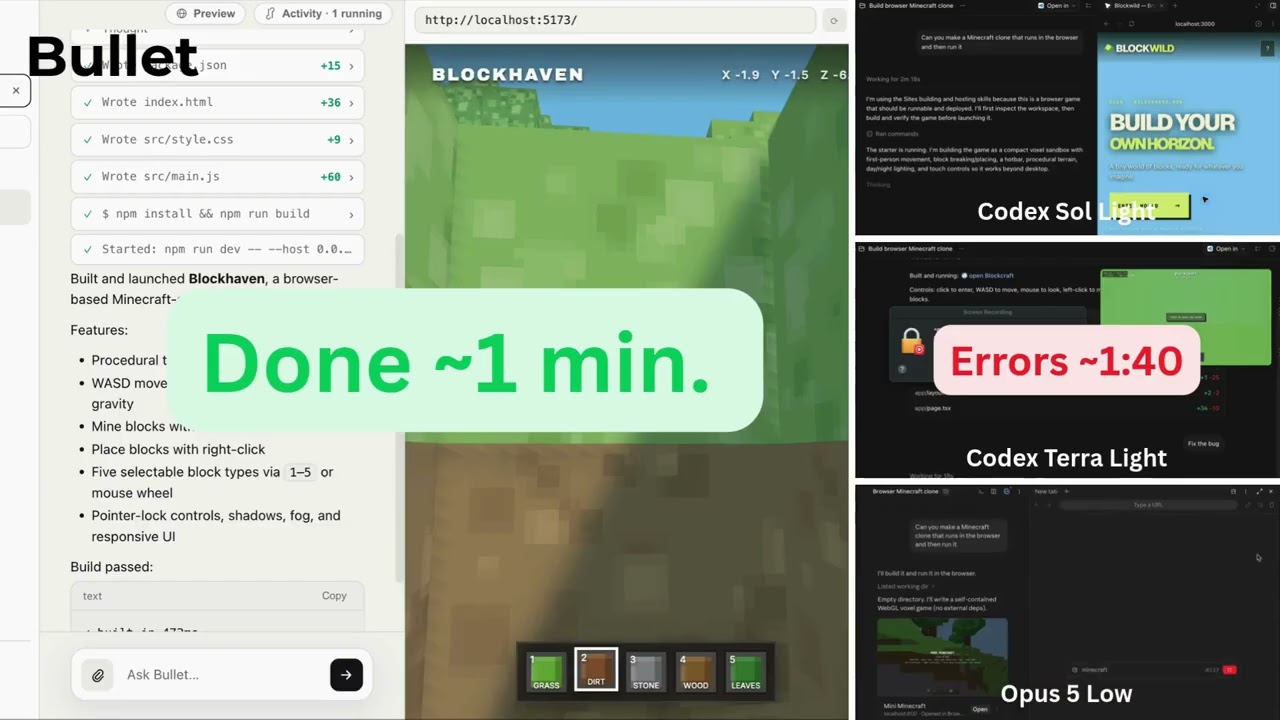
- Download the DMG from codewithbullet.com (Mac only).
- Launch the app — you'll be prompted to connect a provider: Claude Code subscription, Codex subscription, or an API key (OpenAI, Anthropic, xAI).
- Optionally, use an on-device model with no key at all.
- Open a repository and give it a task. Notice how it handles simple edits fast and only brings in heavy reasoning when needed.
Pro tip: The founders hid a code on the website that unlocks a secret page — a fun way to see what Bullet can build.
Why It Works — The Latency Problem
Most coding agents burn time on unnecessary planning, oversized context, repeated searches, and serial tool calls. Bullet's founders built it because they were "building with Claude Code every day, watching capable models move through needlessly slow machinery." The result is a system that keeps the same model→tools→results pattern but tightens the loop.
Community Feedback — What to Watch For
Early HN feedback points out a gap: Bullet lacks autocompletion for @<filename> references, making it harder to reference files by memory. If you're used to Claude Code's VSCode extension, you'll miss that. But for CLI-heavy workflows, the speed gains may outweigh it.
Bottom Line
Bullet isn't a Claude Code replacement — it's a speed layer on top. If you're tired of waiting for agent runs, try it. It's free, and you can keep using your existing Claude Code subscription.
Source: codewithbullet.com