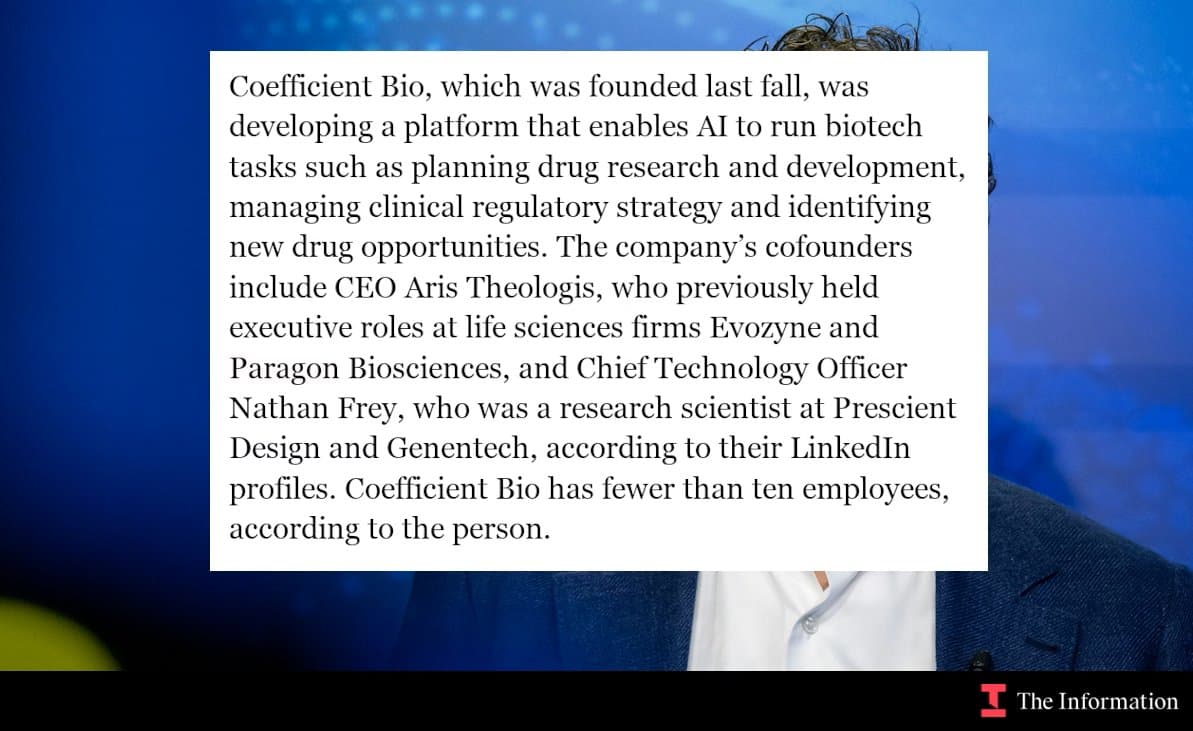
Anthropic has acquired AI biotech startup Coefficient Bio for approximately $400 million, according to a report from industry analyst @kimmonismus. The deal involves a team of fewer than 10 people who were building AI systems designed to plan drug research and development, manage clinical regulatory strategy, and identify new drug opportunities.
The startup is joining Anthropic's existing healthcare and life sciences group, which already counts pharmaceutical giants Sanofi, Novo Nordisk, and AbbVie as partners. The acquisition price, notable for such a small team, signals that Anthropic is buying specific technology and vision, not just talent.
What Coefficient Bio Was Building
According to the source, Coefficient Bio was not building another AI tool for analyzing biological data. Instead, its focus was on creating AI that could run biotech workflows end-to-end. This includes the entire pipeline from early-stage drug discovery and design through clinical trials and regulatory submissions. The goal was an AI system that could act as an autonomous agent directing the research process.
Executing Dario Amodei's 'Virtual Biologist' Vision
The acquisition is framed as a direct execution of Anthropic CEO Dario Amodei's vision outlined in his influential essay, "Machines of Loving Grace." In that essay, Amodei argued that the transformative potential of AI in biology is not as a data analysis tool, but as a "virtual biologist."
He wrote: "I’m talking about using AI to perform, direct, and improve upon nearly everything biologists do... including designing and running experiments in the real world (by controlling lab robots or simply telling humans which experiments to run – as a Principal Investigator would to their graduate students), inventing new biological methods or measurement techniques, and so on."
The source indicates that Coefficient Bio's technology aligns precisely with this vision—AI that doesn't just assist but directs the full R&D pipeline.
Anthropic's Vertical Strategy: Beyond the API
The move underscores a broader strategic shift for Anthropic. While public attention often focuses on model benchmarks and general-purpose API competition, Anthropic is building vertical-specific dominance in high-value industries like finance, cybersecurity, and now, healthcare.
Acquiring Coefficient Bio represents a push into the core operations of the pharmaceutical industry, a sector with R&D spending exceeding $1.3 trillion. The message is clear: Anthropic aims to be more than an AI model provider; it intends to be the engine for accelerated biological discovery and drug development for its enterprise partners.
gentic.news Analysis
This acquisition is a significant and expensive bet on a specific, agentic future for AI in science. It validates a thesis that has been gaining momentum: that the next frontier for large language models (LLMs) is not just answering questions or writing code, but planning and executing complex, multi-step workflows in the physical world. The ~$400M price tag for a sub-10-person team is extraordinary and reflects the perceived scarcity of teams executing on this specific vision at a high technical level.
This follows Anthropic's established pattern of forming deep, vertical partnerships with industry leaders, as seen with its cloud deals with Amazon and Google. The company is effectively using its partnerships with Sanofi, Novo Nordisk, and AbbVie as a distribution channel and validation mechanism for the integrated AI-biotech platform it is now building. This contrasts with a pure-play API strategy and suggests Anthropic believes its long-term moat will be built through deeply integrated, industry-specific deployments where its models orchestrate entire business processes.
The move also heats up the implicit competition with other AI labs moving into the life sciences space, such as Google's DeepMind (with Isomorphic Labs and AlphaFold) and Meta's ESMFold. However, Anthropic's approach, as articulated by Amodei and now backed by this acquisition, is distinct in its emphasis on AI as an autonomous director of research, not just a tool for prediction or structure analysis. The success of this bet hinges on overcoming immense technical hurdles in reasoning, planning, and reliable interaction with physical lab systems—challenges that are at the very frontier of AI research.
Frequently Asked Questions
What did Coefficient Bio do?
Coefficient Bio was an AI biotech startup building AI systems designed to autonomously plan and manage the entire drug discovery and development pipeline. This includes identifying drug candidates, designing experiments, managing clinical trial strategy, and handling regulatory submissions—acting more like a principal investigator than a data analysis tool.
Why did Anthropic pay ~$400M for such a small team?
The high acquisition price suggests Anthropic is purchasing advanced, specialized technology and a team executing on a vision that directly aligns with CEO Dario Amodei's thesis of AI as a "virtual biologist." In competitive, high-stakes fields like AI-driven drug discovery, acquiring a team that has made significant technical progress toward autonomous research agents can be worth a premium, as building such capability from scratch is difficult and time-consuming.
How does this fit with Anthropic's overall strategy?
This acquisition signals Anthropic's focus on building vertical dominance beyond offering general-purpose AI models via an API. By integrating Coefficient Bio's technology into its healthcare and life sciences group, Anthropic aims to provide a full-stack, AI-driven platform for its pharmaceutical partners (like Sanofi and Novo Nordisk), embedding itself deeply into their core R&D operations and moving up the value chain.
What is a 'virtual biologist'?
The term, coined by Anthropic CEO Dario Amodei, describes an AI system that performs the full range of tasks a human biologist or principal investigator would. This includes forming hypotheses, designing experiments, interpreting results, inventing new methods, and directing the overall research process, potentially by controlling lab robotics or instructing human researchers. It represents a shift from AI as an analytical assistant to AI as an autonomous director of scientific research.