Key Takeaways
- Anthropic officially acknowledged that Claude's performance degraded, validating user complaints of reduced intelligence.
- The admission came after widespread community feedback.
What Happened

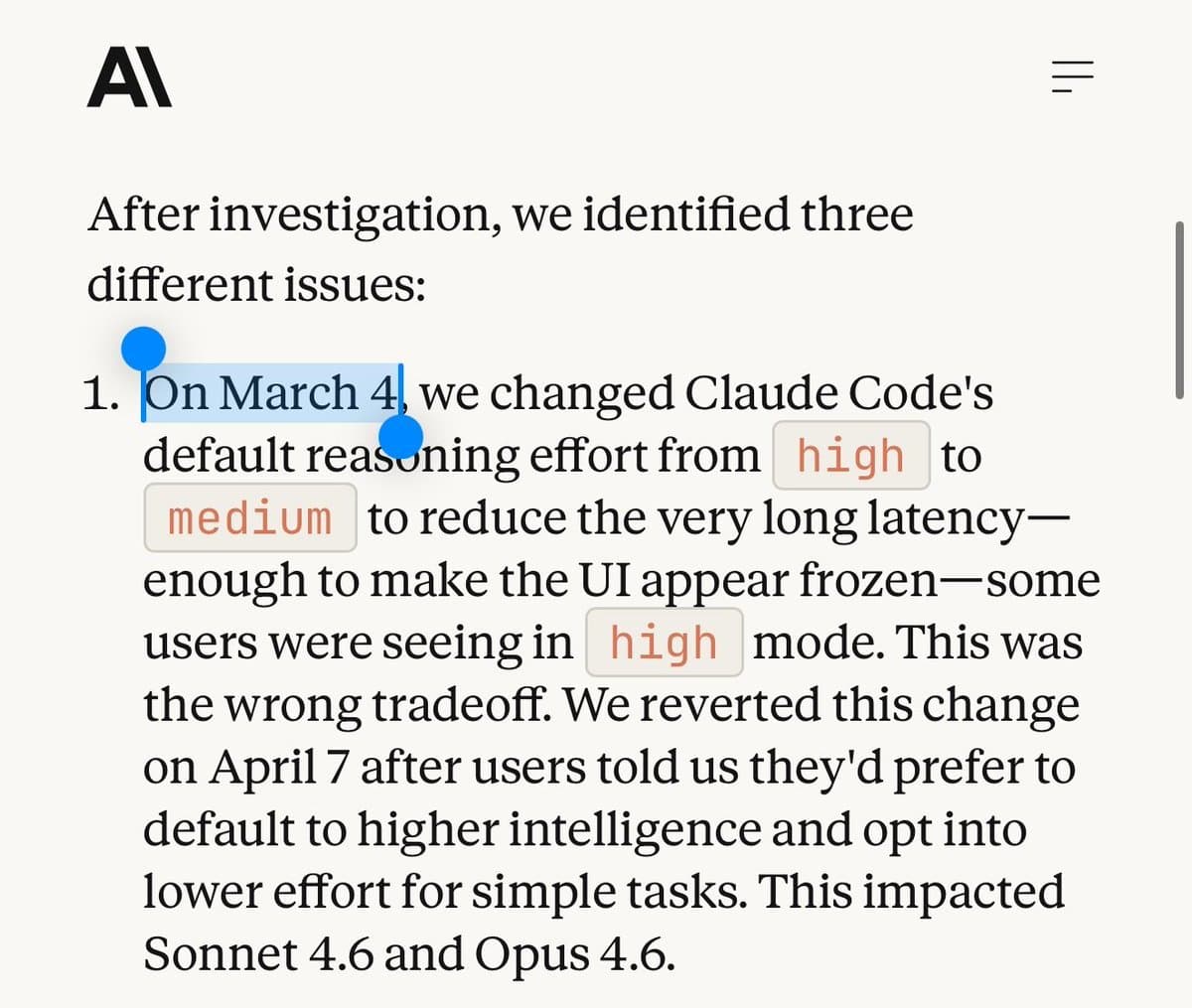
On April 12, 2026, Anthropic officially confirmed what many users had been reporting for weeks: Claude had become "dumber." The admission came via a public statement responding to mounting complaints on social media and developer forums.
The issue first gained traction when users noticed Claude's responses had become less coherent, more repetitive, and generally lower quality compared to previous versions. The sentiment was captured succinctly by user @kimmonismus, who posted:
"What's annoying is that we all felt Claude was dumber. But Anthropic only officially addressed it a short time later and said: 'Yes, you were right. We really did make it dumber.'"
Context
This incident is part of a broader pattern in the AI industry where model updates sometimes result in regressions that users detect before companies formally acknowledge. Similar situations have occurred with other large language models, including GPT-4 and Gemini, where users reported performance drops after updates.
The challenge for AI companies is that even minor changes to training pipelines, fine-tuning procedures, or safety guardrails can have unintended consequences on model behavior. In Claude's case, the regression appeared to affect reasoning quality and response coherence across multiple use cases.
Anthropic's Response
Anthropic's acknowledgment was notable for its transparency. Rather than denying the issue or attributing it to user perception, the company directly validated the feedback and committed to investigating the cause. This approach contrasts with some previous industry incidents where companies were slower to admit to regressions.
The company has not yet released detailed technical information about what caused the degradation or when a fix would be deployed.
What This Means in Practice

For developers and enterprises relying on Claude for production applications, this incident highlights the risks of depending on API-based models without version pinning or fallback strategies. It also underscores the importance of monitoring model behavior after updates and maintaining contingency plans.
gentic.news Analysis
This incident reflects a recurring tension in AI development between rapid iteration and maintaining consistent quality. As we covered previously with GPT-4's "laziness" controversy in late 2024, users are often the first to detect subtle regressions that internal testing misses. The community's ability to detect these changes quickly — often within days of deployment — demonstrates both the sophistication of AI users and the limitations of current evaluation methodologies.
Anthropic's candid admission is noteworthy in an industry where companies often downplay regressions. However, the fact that it took "a short time" — as @kimmonismus noted — for Anthropic to acknowledge the issue raises questions about their monitoring and feedback systems. If users can detect a degradation within hours, why can't the company's internal benchmarks catch it before deployment?
This event also connects to the broader trend of "AI safety vs. capability" trade-offs. Often, regressions occur when companies adjust models for safety reasons, inadvertently reducing helpfulness or reasoning ability. Without detailed technical disclosure from Anthropic, it remains unclear whether this was a safety-related change gone wrong or an unintended consequence of a different optimization.
Frequently Asked Questions
Did Anthropic really admit Claude became "dumber"?
Yes, Anthropic publicly acknowledged that Claude's performance had degraded, validating user complaints. The company stated users were correct in their assessment.
What caused Claude to become less capable?
Anthropic has not yet provided specific technical details about what caused the regression. It could be related to changes in training data, fine-tuning procedures, or safety guardrails.
How can developers protect against model regressions?
Developers should use version-pinned API endpoints when available, maintain fallback strategies, and implement monitoring to detect unexpected changes in model behavior after updates.
Is this a common problem with AI models?
Yes, similar regressions have been reported with other large language models including GPT-4 and Gemini. The phenomenon highlights the challenges of maintaining consistent quality while continuously updating models.