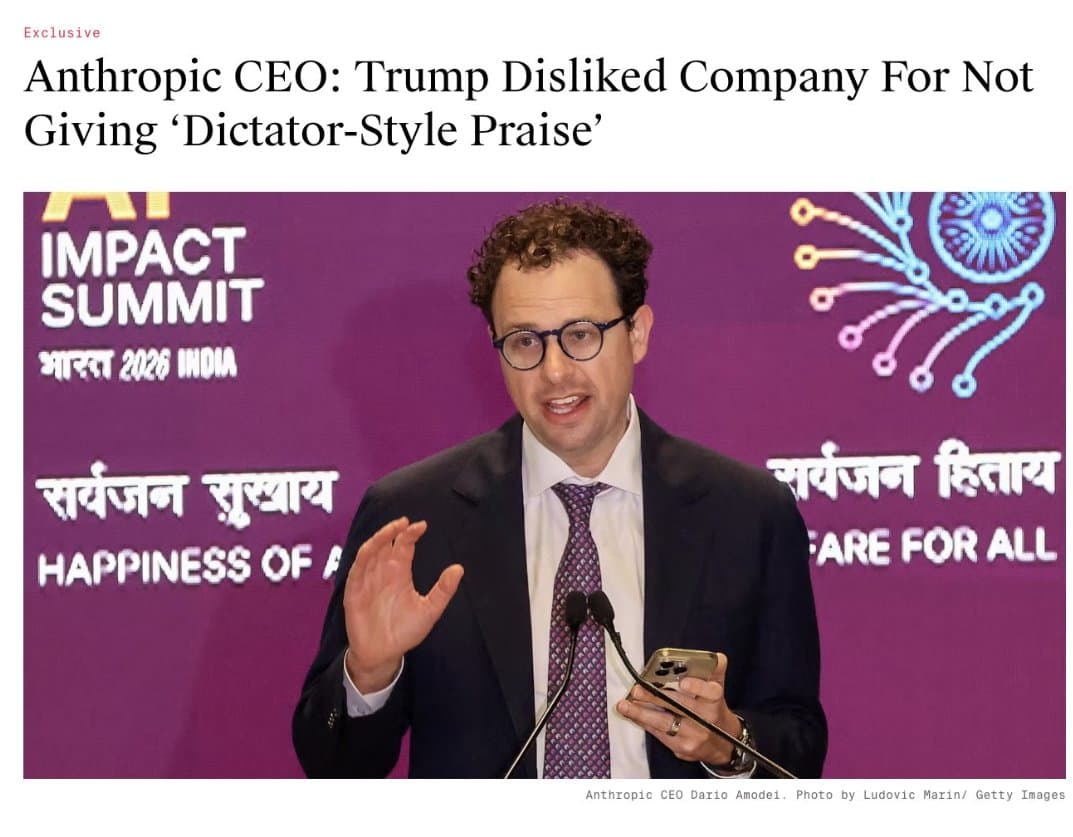
In a startling internal memo leaked this week, Anthropic CEO Dario Amodei has accused the U.S. government of rejecting his company's defense contract bid for political reasons rather than technical merit. According to the memo obtained by The Information and reported by AI commentator Rohan Paul, Amodei claims government officials expected campaign donations and "dictator-style praise" that the AI safety-focused company refused to provide.
The Explosive Allegations
According to the memo sent to Anthropic employees on Friday, Amodei stated that the real reason the government "dumped Anthropic" had nothing to do with technology or security capabilities. Instead, he alleges it was because Anthropic refused to engage in political contributions or offer the type of flattery that Amodei characterized as appropriate for authoritarian regimes rather than democratic governments.
The timing of these allegations is particularly significant as they come immediately following OpenAI's announcement of a new partnership with the Pentagon. Amodei directly referenced this development in his memo, labeling OpenAI's defense contract as "safety theater" - suggesting that OpenAI's safety commitments are more performative than substantive when compared to Anthropic's constitutional AI approach.
Context: The AI Defense Landscape
The competition for government AI contracts has intensified dramatically in recent years as defense agencies seek to integrate cutting-edge artificial intelligence into military operations, intelligence analysis, and cybersecurity. Both Anthropic and OpenAI have positioned themselves as leaders in responsible AI development, though with different philosophical approaches.
Anthropic has built its reputation around its Constitutional AI framework, which emphasizes transparency, oversight, and alignment with human values. The company has been particularly vocal about the importance of AI safety, even at the potential cost of commercial opportunities. OpenAI, while also emphasizing safety, has pursued a more aggressive expansion strategy that now includes defense applications.
This controversy emerges against a backdrop of increasing scrutiny over the relationship between tech companies and government agencies. Previous debates have focused on employee protests against defense contracts (as seen with Google's Project Maven), ethical concerns about autonomous weapons, and questions about how AI companies balance commercial interests with their stated ethical principles.
Implications for AI Governance
Amodei's allegations, if substantiated, would represent a significant breach of government procurement ethics. The federal acquisition process is designed to be merit-based, with strict regulations against political favoritism in contract awards. A proven case of contracts being awarded based on political donations rather than technical capability would undermine confidence in the entire defense procurement system.
For the AI industry specifically, these claims highlight the difficult balancing act companies face when engaging with government entities. The tension between maintaining ethical standards and securing lucrative government contracts has become increasingly pronounced as AI capabilities advance and their potential military applications expand.
The "safety theater" accusation against OpenAI raises fundamental questions about how AI companies can credibly maintain safety commitments while pursuing defense contracts. It touches on ongoing debates about whether certain AI applications should be considered off-limits regardless of potential revenue, and whether companies can adequately maintain their ethical frameworks while working within military contexts.
Broader Political Context
The reference to political donations comes during an exceptionally contentious election cycle, with technology policy and AI regulation becoming increasingly politicized. The relationship between tech leaders and political figures has been under scrutiny for years, but Amodei's memo suggests these dynamics may be influencing specific procurement decisions in ways that haven't been previously documented.
The characterization of expected praise as "dictator-style" is particularly striking, implying that government officials expected sycophantic treatment more commonly associated with authoritarian regimes. This language reflects growing concerns about the erosion of democratic norms and the potential for political considerations to override merit-based decision making in critical technology sectors.
Industry Reactions and Next Steps
While Anthropic has not made the memo public, its contents have sparked immediate discussion within AI and policy circles. The allegations come at a sensitive time for AI regulation, with multiple legislative proposals under consideration and increasing calls for transparency in how AI companies engage with government agencies.
The defense community is likely to face increased scrutiny over its AI procurement processes, particularly regarding how it evaluates competing claims about AI safety and ethics. Companies positioning themselves as more ethical alternatives may face pressure to provide clearer evidence of how their approaches translate into practical safety advantages.
For Anthropic specifically, this public airing of grievances represents a strategic gamble. While it positions the company as uncompromising on its principles, it also potentially burns bridges with government agencies that control significant AI research and development budgets. The long-term impact on Anthropic's government business prospects remains uncertain.
The Future of Ethical AI in Government
This controversy highlights fundamental questions about how democratic governments should engage with AI companies that have strong ethical frameworks. Should agencies prioritize working with companies that have the most advanced technology, or those with the strongest ethical commitments? Can these two considerations be balanced, or are they fundamentally in tension when it comes to defense applications?
The coming weeks will likely see responses from multiple stakeholders: government officials denying or explaining the procurement decision, OpenAI addressing the "safety theater" characterization, and other AI companies positioning themselves in relation to these allegations. Congressional oversight committees may also take interest, particularly given ongoing concerns about political influence in technology procurement.
What's clear is that the debate about AI ethics has moved from abstract philosophical discussions to concrete questions about procurement, politics, and power. The Anthropic allegations, whether ultimately proven or not, have pulled back the curtain on the complex interplay between AI development, government contracts, and political considerations that will shape the future of artificial intelligence.
Source: The Information via Rohan Paul on X/Twitter