OpenAI Codex Hits 2M Weekly Active Users with 3x User Growth, 5x Usage Increase in 2024
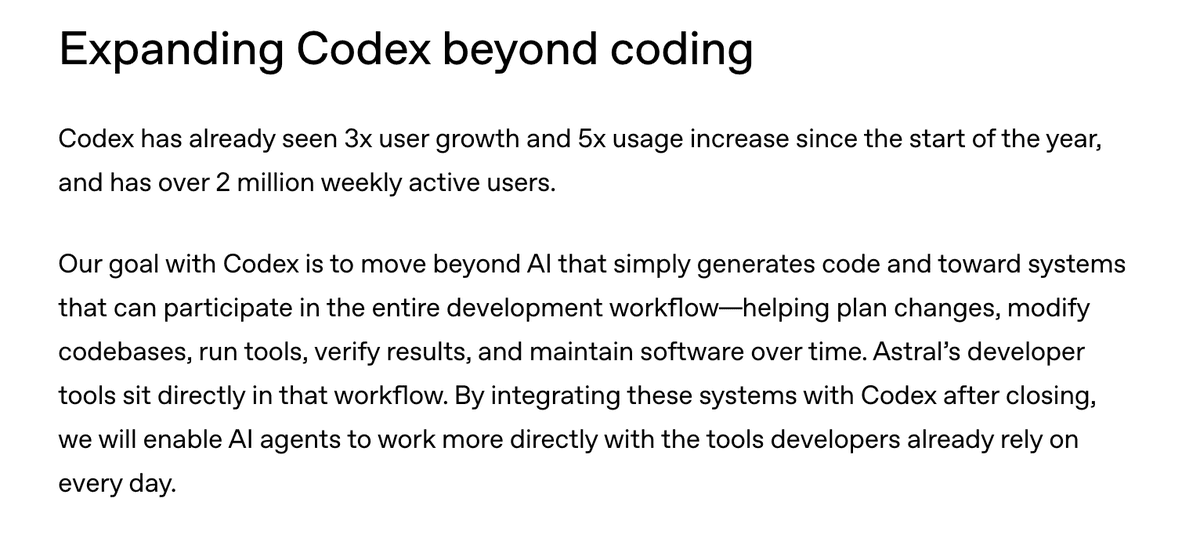
OpenAI's Codex has grown to over 2 million weekly active users, with 3x user growth and 5x usage increase since the start of 2024. This rapid adoption intensifies its competition with Anthropic's Claude for dominance in the AI coding assistant market.
According to a report shared on X (formerly Twitter), OpenAI's Codex—the AI model powering GitHub Copilot and other code generation tools—has experienced significant growth in 2024. The platform now has over 2 million weekly active users, representing a 3x increase in user count and a 5x increase in overall usage since the beginning of the year.
Context
OpenAI Codex, first introduced in 2021, is a descendant of GPT-3 specifically fine-tuned on code from public repositories. It serves as the core engine for GitHub Copilot, which launched generally in 2022. The reported metrics suggest accelerated enterprise and developer adoption of AI-powered coding assistance.
The source frames this growth within the competitive landscape with Anthropic's Claude, another leading AI model frequently used for coding tasks. The commentary references Anthropic CEO Dario Amodei's perspective that "being the best AI company with the best coding tool is the foundation for overall victory," highlighting the strategic importance of this application domain.
While the source doesn't provide specific comparative metrics for Claude's adoption, the framing indicates that both companies view AI-assisted coding as a critical battleground for developer mindshare and enterprise adoption.
AI-assisted reporting. Generated by gentic.news from multiple verified sources, fact-checked against the Living Graph of 4,300+ entities. Edited by Ala SMITH.
Following this story?
Get a weekly digest with AI predictions, trends, and analysis — free.
AI Analysis
The reported growth metrics for Codex, if accurate, indicate a transition from early adoption to mainstream developer workflow integration. A 5x increase in usage outpacing a 3x increase in users suggests that existing users are deepening their reliance on the tool, not just that new users are trying it. This is a key indicator of product-market fit and utility beyond novelty.
From a competitive standpoint, the framing of a 'battle' between Codex (via Copilot) and Claude is technically nuanced. Codex/Copilot operates primarily as an integrated development environment (IDE) autocomplete tool, while Claude is often accessed through chat interfaces (like Claude Console or third-party platforms). The competition is less about raw coding benchmark scores and more about workflow integration, latency, and the specific developer experience each tool enables. The strategic bet, as noted, is that dominance in the developer toolchain creates a powerful funnel for broader AI platform adoption.
Practitioners should watch for how this competition drives innovation in two areas: first, the emergence of more specialized 'coding-only' models versus generalist models with strong coding performance, and second, the evolution of pricing and packaging. GitHub Copilot's business model is already established, but increased competition could pressure pricing or lead to more generous free tiers as companies vie for the developer ecosystem.