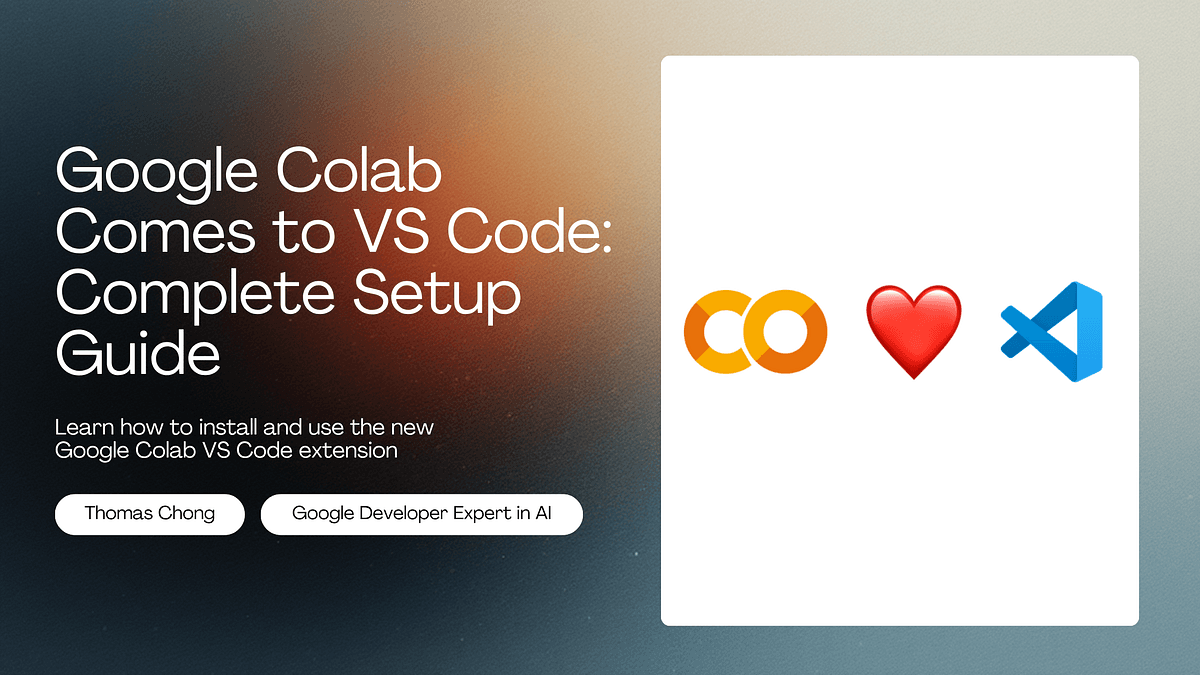
Google Colab now integrates directly with VS Code, giving users a free T4 GPU inside the editor. The move bypasses traditional cloud GPU providers like Lambda Labs, RunPod, and Vast.ai.
Key facts
- T4 GPU has 16GB VRAM and supports mixed-precision training.
- T4 can train ResNet-50 on ImageNet in roughly 8 hours.
- Cloud GPU providers charge $0.30–$2.00 per hour for T4 instances.
- Google Colab's free tier previously limited GPU access to notebooks.
- Google did not disclose usage numbers for the integration.
The integration, announced via a tweet from @HowToAI_, eliminates the need for separate cloud GPU subscriptions for many developers. Previously, VS Code users had to rely on third-party services or local hardware for GPU acceleration. Colab's free tier already offered a T4 GPU, but access was limited to a notebook environment. Now, developers can run GPU-intensive tasks — such as training small models, running inference, or prototyping — directly within their familiar VS Code workflow.
The T4 GPU, while not cutting-edge, is sufficient for many AI tasks: it offers 16GB of VRAM and supports mixed-precision training. According to public benchmarks, a T4 can train a ResNet-50 on ImageNet in roughly 8 hours, making it competitive with entry-level cloud instances costing $0.50–$1.00 per hour. Google did not disclose how many users have enabled the integration since launch.
The integration effectively turns VS Code into a zero-cost GPU workstation. For developers who already use Colab's free tier, this is a UX upgrade — not a new capability. But for those who avoided Colab due to its notebook-centric interface, the VS Code integration removes a key friction point.
Why this matters

Google's move undercuts the so-called "GPU mafia" — a loose network of cloud GPU providers that have proliferated during the AI boom. Companies like Lambda Labs, RunPod, and Vast.ai charge $0.30–$2.00 per hour for T4-equivalent instances. By offering the same GPU for free inside a popular editor, Google makes these services harder to justify for prototyping and small-scale work.
The timing is notable: Colab's free tier has seen usage caps tighten in recent months, with some users reporting session limits of 4–6 hours. The VS Code integration does not change those limits, but it does make the free GPU more accessible within a professional development environment.
What to watch
Watch for usage caps on Colab's free tier: if Google tightens session limits or introduces a paywall for the VS Code integration, the value proposition erodes. Also watch for responses from Lambda Labs and RunPod — price cuts or free tiers of their own.