When Dario Amodei, CEO of Anthropic and former OpenAI research director, speaks about artificial intelligence timelines, the industry listens. His recent warning carries particular weight: "No one is ready. Exponents kick in even faster than you think." This isn't casual speculation from an outside observer—it's a sober assessment from someone building cutting-edge AI systems while advocating for their safe development.
The Chessboard Parable: Understanding Exponential Growth
Amodei frames the challenge using the ancient parable of the second half of the chessboard. In this thought experiment, a king agrees to pay a mathematician by placing one grain of rice on the first square of a chessboard, doubling the amount on each subsequent square. The first half of the board seems manageable—by square 32, you have about 4 billion grains. But the second half produces incomprehensible numbers: by square 64, you'd need approximately 18 quintillion grains, more rice than exists on Earth.
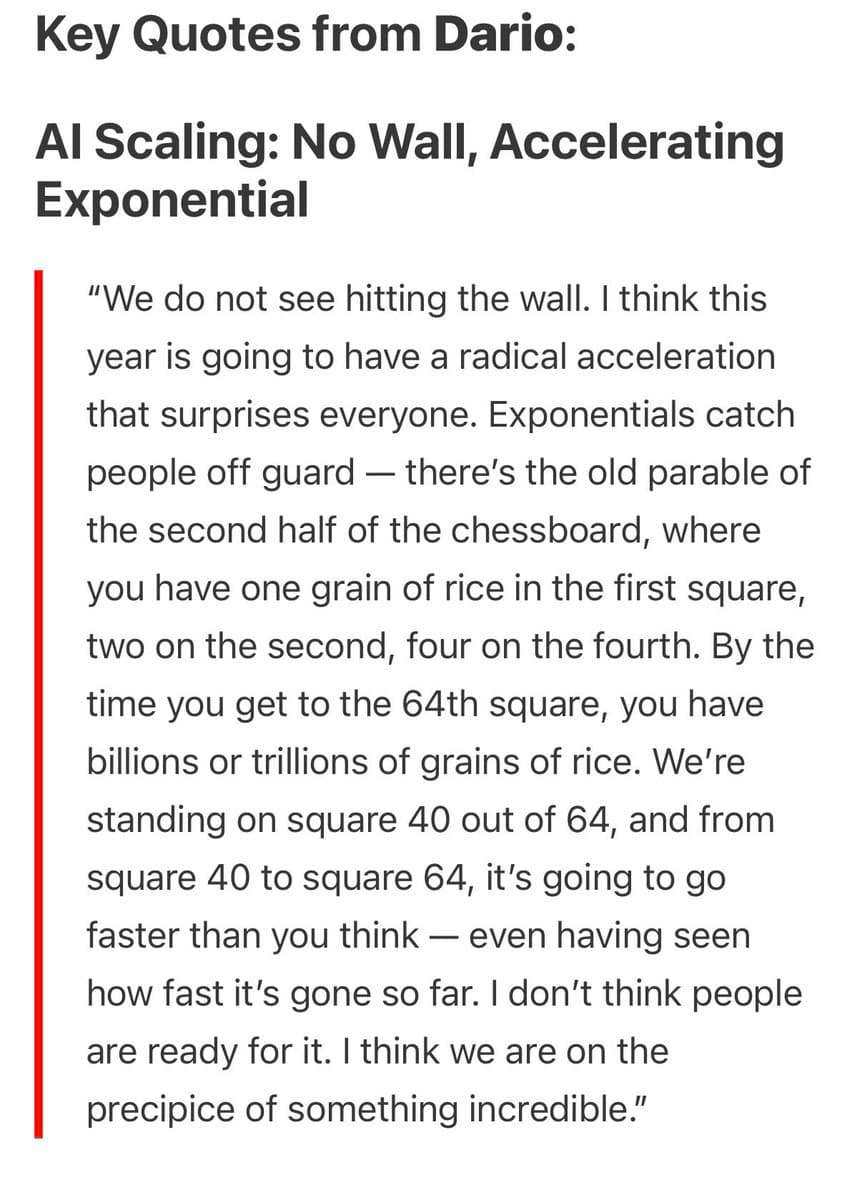
"We're standing on square 40 out of 64," Amodei explains, "and from square 40 to square 64, it's going to go faster than you think—even having seen how fast it's gone so far." This positioning is crucial. We're not at the beginning of exponential growth, nor are we at its overwhelming conclusion. We're at the precise point where the curve begins its steepest ascent, where each incremental advance produces disproportionately larger effects.
Why Square 40 Matters: The Inflection Point
The transition from linear to exponential thinking represents one of humanity's greatest cognitive challenges. Our brains evolved to recognize linear patterns—if something grows steadily, we can project that trend forward. Exponential growth defies this intuition. When Amodei says we're at square 40, he's suggesting we've already witnessed remarkable AI progress, but what comes next will dwarf it entirely.
Consider the recent trajectory: In just 18 months, we've moved from GPT-3's impressive text generation to multimodal systems that can reason across images, audio, and video. AI research cycles have compressed from years to months. Yet according to Amodei's framework, we've only experienced the relatively gentle slope of the exponential curve. The steepest part—where capabilities might multiply weekly rather than annually—lies immediately ahead.
The Preparedness Gap: Society's Lagging Response
"I don't think people are ready for it," Amodei states bluntly. This preparedness gap operates on multiple levels. Technologically, our infrastructure—from computing hardware to energy grids—isn't designed for the scaling demands of advanced AI systems. Institutionally, governments lack the regulatory frameworks and expertise to guide development responsibly. Culturally, we haven't developed the mental models to understand systems that might soon exceed human intelligence in broad domains.
This warning echoes concerns Amodei has expressed previously about AI safety. As co-founder of Anthropic, he helped create Constitutional AI—an approach that embeds ethical principles directly into model training. His dual perspective as both builder and cautionary voice gives his assessment particular credibility. He's not predicting doom but rather emphasizing that the velocity of change will outpace our adaptive capacities unless we accelerate preparation dramatically.
Implications Across Sectors: Beyond Technology
The coming exponential phase will reverberate far beyond Silicon Valley. In healthcare, AI systems might progress from diagnostic assistants to autonomous treatment designers within compressed timelines. In education, personalized AI tutors could evolve from supplemental tools to primary educational interfaces. Economic models built on gradual technological adoption will become obsolete as capabilities spread globally within weeks rather than decades.
Perhaps most significantly, the governance challenge intensifies exponentially alongside the technology itself. International coordination, ethical frameworks, and safety standards that typically require years to develop might need to be established in months. The window for proactive governance is closing rapidly as we approach the steepest part of the growth curve.
Navigating the Precipice: A Call for Accelerated Preparation
Amodei concludes with a mixture of awe and urgency: "I think we are on the precipice of something incredible." This precipice metaphor is telling—it suggests both extraordinary opportunity and significant risk. The incredible potential includes solutions to humanity's greatest challenges: disease, climate change, resource scarcity. The risk involves deploying transformative power without adequate safeguards or understanding.
The path forward requires parallel acceleration: advancing AI capabilities while simultaneously developing the safety research, governance structures, and public understanding needed to harness them beneficially. This isn't a call for slowdown but for sped-up preparation—matching the exponential growth of capabilities with exponential growth in responsibility.
As we stand on square 40, the most important realization might be this: The remaining 24 squares will pass much quicker than the first 40. The time for gradual adaptation has passed. What's needed now is exponential preparation for an exponentially changing world.
Source: Dario Amodei via @kimmonismus on X/Twitter