What Happened
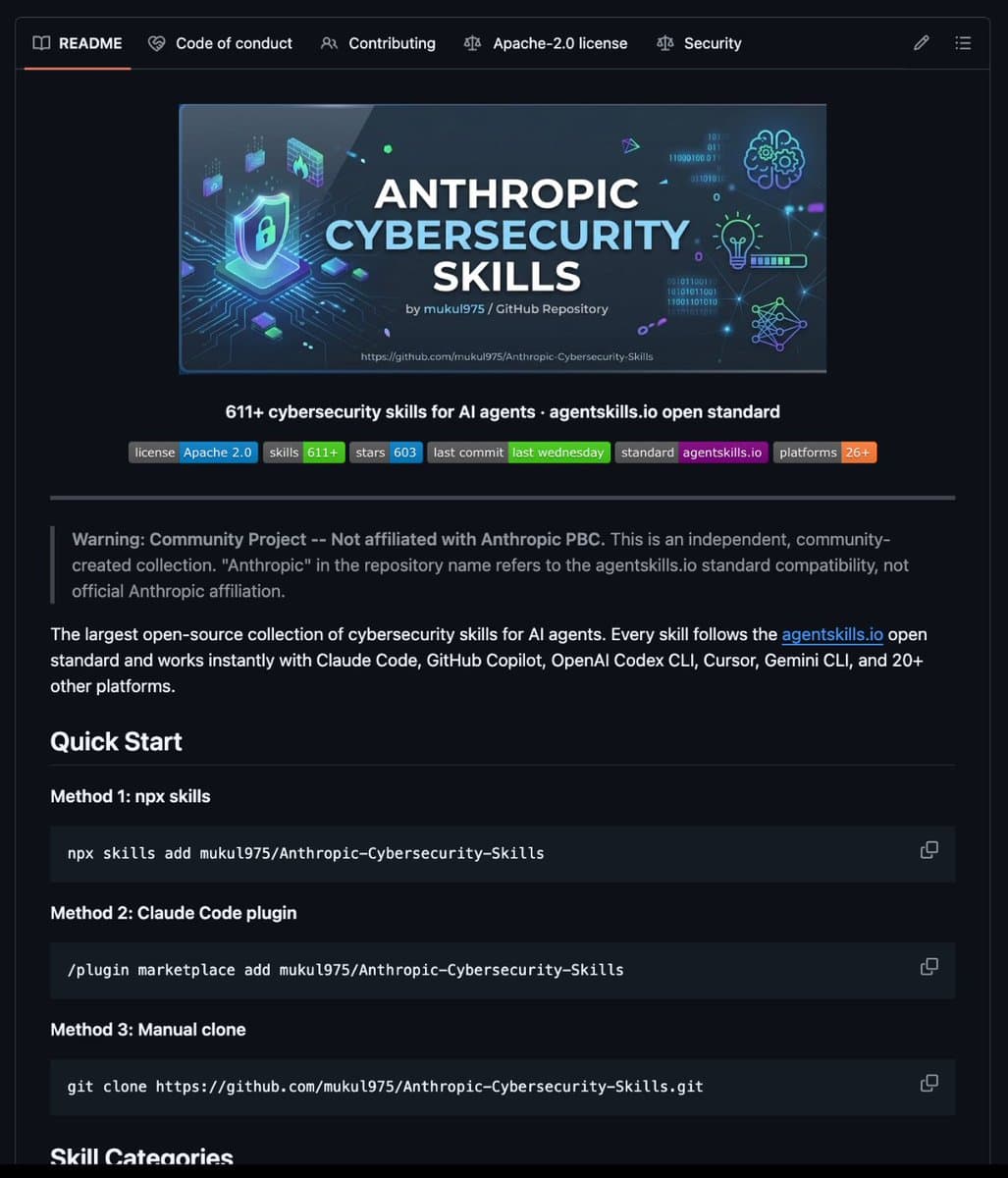
A developer has published a GitHub repository called Anthropic Cybersecurity Skills that provides 611+ structured cybersecurity skills designed specifically for AI agents. The repository is fully open-source under an MIT License and is built on the agentskills.io open standard, making it compatible with various agent frameworks.
Unlike traditional learning resources such as tutorials or blog posts, each skill in this repository is a structured file containing:
- A SKILL.md file with the complete skill definition
- A references folder with links to real standards (NIST, MITRE, CVE)
- A scripts folder with helper tools and real scripts
- An assets folder with ready-to-use checklists and report templates
The skills cover 14 major cybersecurity domains:
- Web application security
- Penetration testing
- Red teaming
- Malware analysis
- Digital forensics and incident response
- Threat intelligence
- Cloud security
- Container security
- Cryptography
- Zero trust architecture
- OT/ICS security
- DevSecOps
- Compliance and governance
- Identity and access management
How It Works
The repository functions as a structured knowledge base that AI agents can query and utilize. Each skill follows a consistent format with step-by-step procedures, reference materials, and executable components. This standardization allows AI agents to understand and execute security tasks without needing to parse unstructured documentation.
According to the source, developers can "pick a skill, hand it to your AI agent, and it knows exactly what to do." The repository appears designed to serve as a plug-and-play component for AI-powered security automation systems.
Technical Details
- Format: Structured markdown files with supporting folders
- License: MIT License (open source)
- Standard: Built on agentskills.io open standard
- Compatibility: Works with any agent framework
- Content: 611+ skills across 14 cybersecurity domains
Availability
The repository is available on GitHub, though the specific URL was not provided in the source material. Given the MIT License, developers are free to use, modify, and distribute the skills for both commercial and non-commercial purposes.