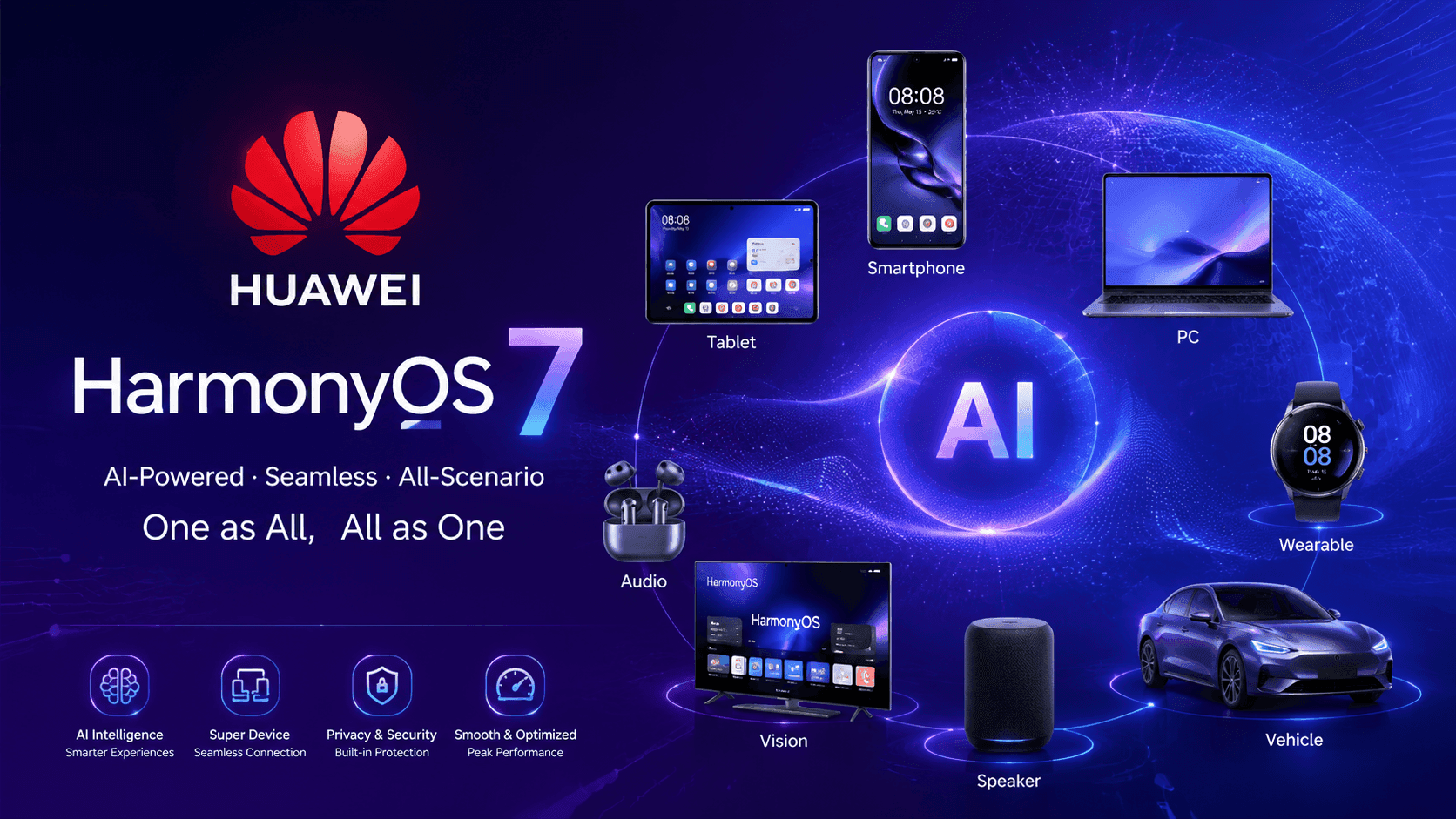
Huawei launched HarmonyOS 7 at HDC 2026, transforming its Xiaoyi assistant into a system-level AI agent. The agent exposes over 2,100 system capabilities and 2,000+ skills, per the company's announcement.
Key facts
- 2,100 system capabilities exposed by Xiaoyi agent
- 2,000+ skills integrated into HarmonyOS 7
- Launched at HDC 2026 conference
- Tau Scaling Law targets 1.4nm density by 2031
- LogicFolding Kirin chips ship fall 2026
Huawei launched HarmonyOS 7 at HDC 2026, transforming its Xiaoyi assistant into a system-level AI agent. The agent exposes over 2,100 system capabilities and 2,000+ skills, per the company's announcement. This marks a structural shift from app-centric to intent-driven interaction on Huawei devices.
Why intent-driven matters
Traditional mobile OSes require users to navigate apps to complete tasks — open a notes app to write, open a calendar to schedule. HarmonyOS 7's Xiaoyi agent intercepts user intent at the system layer, routing requests to the appropriate capability without launching a specific app. [According to Huawei's HDC 2026 presentation] (https://pandaily.com/huawei-harmonyos-7-launch-hdc-2026-ai-agent-jun2026), the agent can chain multiple capabilities — for example, booking a meeting by accessing calendar, contacts, and messaging APIs in sequence.
This architecture mirrors moves by Apple (Apple Intelligence, iOS 18) and Google (Gemini on Android), but Huawei's approach is more aggressive: Xiaoyi is not a separate app or overlay but the OS's primary interaction layer. The company claims the agent can handle tasks that previously required three to five distinct app launches.
Hardware and scaling context
Huawei's AI agent push coincides with its broader chip roadmap. At IEEE ISCAS in May 2026, the company presented the Tau (τ) Scaling Law, targeting 1.4nm-equivalent density by 2031. Huawei also announced LogicFolding architecture for Kirin chips, shipping this fall, which could provide on-device inference for Xiaoyi's agent workloads. The company did not disclose which LLM powers Xiaoyi in HarmonyOS 7.
Competitive landscape
The timing is notable: 74% of consumers are ready to delegate shopping to AI agents, per a June 2026 study. Visa recently integrated ChatGPT for agent retail purchasing. But Huawei's bet is deeper — embedding the agent at the OS level rather than as a third-party integration. The risk: if Xiaoyi's intent parsing fails, the entire interaction model breaks, unlike app-based assistants where users can fall back to manual navigation.
Huawei did not provide benchmark comparisons against Apple Intelligence or Gemini, nor disclose developer adoption metrics for the 2,100 exposed capabilities. The success of HarmonyOS 7 hinges on whether third-party developers build skills for Xiaoyi — a chicken-and-egg problem that has plagued previous platform-level AI assistants.
What to watch

Watch for third-party developer adoption of HarmonyOS 7's skill framework over the next 90 days. If fewer than 500 new skills ship by September 2026, the platform risks the same ecosystem stagnation that limited previous OS-level assistants. Also track Kirin LogicFolding chip benchmarks for on-device agent inference latency.
Source: pandaily.com