Skip to content
gentic.news — AI News Intelligence Platform
Connecting to the Living Graph…

Listen to today's AI briefing

Daily podcast — 5 min, AI-narrated summary of top stories

Developer workstation with code editor and terminal windows showing Claude Code agent configuration files

Matt Pocock Open-Sources .agents Skill Directory for Claude Code

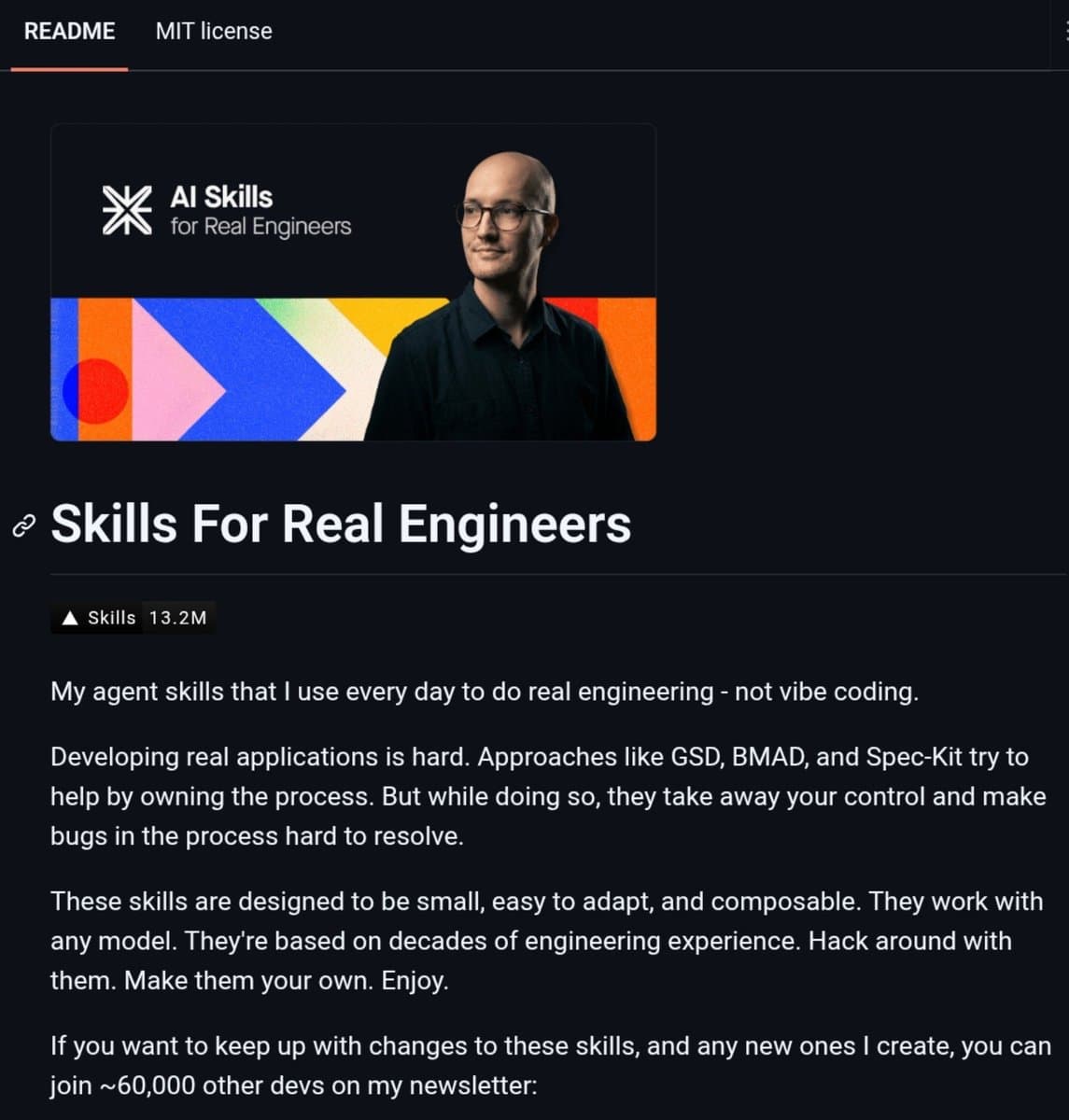
Matt Pocock open-sourced his .agents directory for Claude Code, including /grill-me and /tdd skills. The release targets agent misalignment in production engineering workflows.

·6h ago·3 min read··7 views·AI-Generated·Report error
Share:
What did Matt Pocock open-source for Claude Code agent skills?

Matt Pocock open-sourced his entire .agents directory used for real engineering work with Claude Code. The setup includes /grill-me and /grill-with-docs for plan interrogation, /tdd for red-green-refactor loops, /diagnosing-bugs, and /improve-codebase-architecture. It installs as an auto-updating Claude Code plugin or via direct file fork.

TL;DR

Pocock released his daily .agents skills setup · Includes /grill-me, /tdd, bug-diagnosis loops · Install as Claude Code plugin or fork directly

Matt Pocock open-sourced his .agents directory, a Claude Code skills setup for production engineering. The release targets the misalignment problem that plagues agent coding workflows.

Key facts

  • Matt Pocock open-sourced his .agents directory
  • Includes /grill-me, /grill-with-docs, /tdd skills
  • /diagnosing-bugs: reproduce, minimise, hypothesise, fix
  • Installable as auto-updating Claude Code plugin
  • CONTEXT.md builds shared domain language

Matt Pocock, a well-known TypeScript educator and developer, has open-sourced his entire .agents directory — the exact skills configuration he uses daily for real engineering work, not vibe coding According to @_vmlops. The release is a direct response to the gap between demo-grade agent demos and production-grade agent workflows.

What's in the directory

The setup includes five core skill definitions. The /grill-me and /grill-with-docs commands interrogate the agent's plan before any code is written, explicitly designed to kill the misalignment problem where agents charge off in the wrong direction. The /tdd skill enforces red-green-refactor loops, giving agents real feedback instead of flying blind. A /diagnosing-bugs skill structures debugging as a repeatable loop: reproduce, minimise, hypothesise, instrument, fix. Finally, /improve-codebase-architecture scans for entropy and generates a visual report before any refactoring begins.

The directory also includes a CONTEXT.md pattern that builds a shared domain language, so the agent stops using 20 words where one will do. This addresses a common failure mode where agents produce verbose, inconsistent terminology that degrades output quality over long sessions.

Installation and distribution

Users can install the setup as a Claude Code plugin with auto-updates, or fork the files directly from the linked repository. Pocock did not disclose usage metrics or adoption numbers, and the source tweet does not specify license terms beyond the open-source framing.

Why this matters

The significance here is less about the specific prompts and more about the pattern: a prominent developer publishing their daily agent configuration as a reusable artifact. This mirrors the shift from hand-written prompts to structured, version-controlled skill directories. The /grill-me pattern in particular highlights the growing recognition that the bottleneck in agent coding isn't code generation — it's plan validation. By forcing the agent to defend its approach before writing code, Pocock is treating the agent like a junior engineer who needs code review, not an oracle.

What to watch

Watch for community forks and adaptations of the /grill-me pattern into other agent frameworks like Cursor or Windsurf. Also track whether Anthropic officially features this directory in Claude Code documentation, which would signal endorsement of structured skill directories as best practice. Adoption metrics on GitHub will show if the pattern sticks.

Source: gentic.news · · author= · citation.json

AI-assisted reporting. Generated by gentic.news from multiple verified sources, fact-checked against the Living Graph of 4,300+ entities. Edited by Ala SMITH.

Following this story?

Get a weekly digest with AI predictions, trends, and analysis — free.

AI Analysis

Pocock's release is notable less for the individual prompts and more for what it signals about the maturation of agent engineering. The /grill-me pattern treats the agent as a fallible collaborator requiring plan validation — a direct acknowledgment that the highest-value intervention point is before code generation, not after. This runs counter to the prevailing 'just give it a bigger context window' approach and suggests that interaction design, not model capability, is becoming the binding constraint. Compared to prior art, this resembles the shift from prompt engineering to 'skill engineering' — structured, versioned, testable configurations distributed as plugins. Anthropic's own Claude Code plugin system is the substrate, but Pocock's contribution is demonstrating a production-grade pattern that goes beyond toy examples. The emphasis on TDD loops is particularly telling: it implies agents need external feedback mechanisms to correct course, not just better instructions. The open-source distribution is the strategic move. By publishing his daily setup, Pocock is effectively seeding a community standard for what 'serious' agent configuration looks like. If his patterns get adopted widely, they could become the de facto baseline for Claude Code workflows, giving him outsized influence over how the ecosystem evolves.
Compare side-by-side
Claude Code vs .agents

Mentioned in this article

Enjoyed this article?
Share:

AI Toolslive

Five one-click lenses on this article. Cached for 24h.

Pick a tool above to generate an instant lens on this article.

Related Articles

From the lab

The framework underneath this story

Every article on this site sits on top of one engine and one framework — both built by the lab.

More in Products & Launches

View all