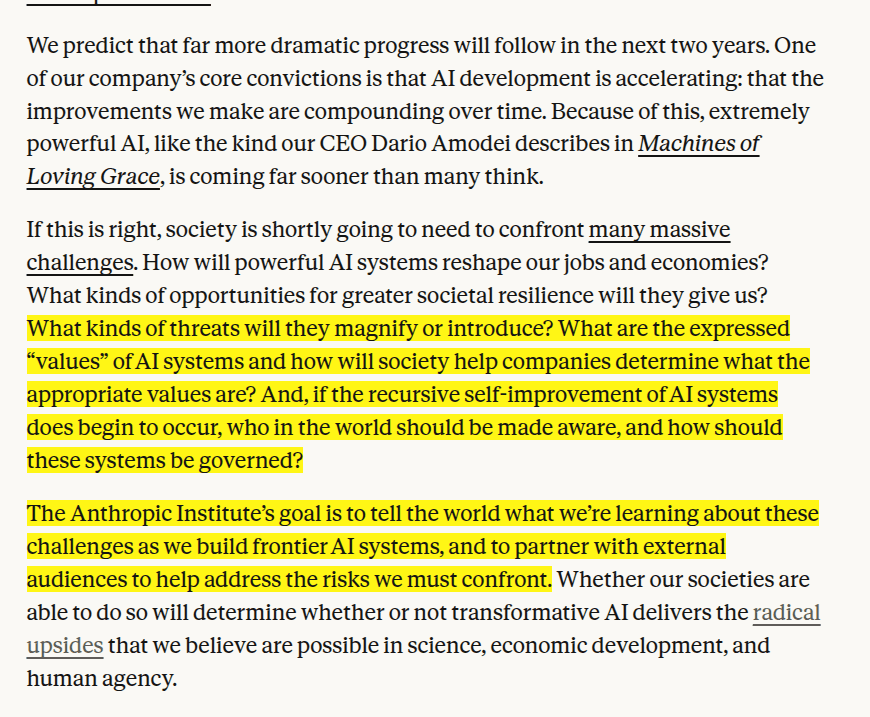
In a significant move toward greater transparency, AI safety company Anthropic has launched The Anthropic Institute, a new initiative designed to publicly share the company's internal knowledge about the rapidly advancing capabilities of its AI models. The announcement, made via social media by AI commentator Rohan Paul, reveals that Anthropic is combining its internal testing teams and economists to openly warn society about upcoming job disruptions and new legal challenges created by increasingly powerful AI systems.
Bridging the Frontier AI Divide
The institute will be led by Jack Clark, Anthropic's co-founder and head of policy, who will act as a bridge between what has traditionally been the "secret world of frontier model training" and the general public. This represents a notable departure from the typical opacity surrounding cutting-edge AI development, where capabilities research often remains confined within corporate or research lab environments until public release.
Clark's leadership suggests the institute will focus on translating technical developments into understandable societal implications. As someone who previously co-founded the AI safety organization Anthropic after working at OpenAI, Clark brings both technical understanding and policy experience to this public-facing role.
Warning of Impending Disruptions
According to the announcement, the institute will specifically address two critical areas of concern:
1. Job Market Disruption - Anthropic's economists and researchers will share findings about how their AI models might affect employment across various sectors. This suggests the company has been conducting internal analyses of economic impacts that go beyond typical capability benchmarks.
2. Legal and Regulatory Challenges - The institute will also highlight emerging legal questions created by advanced AI systems, potentially including issues of liability, intellectual property, and regulatory frameworks needed for increasingly autonomous systems.
The Self-Improvement Threshold
Perhaps most strikingly, the announcement notes that "these upcoming models might even start improving themselves automatically" and that "quite a few major labs actually see recursive self-improvement as a near-term reality." This reference to recursive self-improvement—where AI systems enhance their own capabilities without human intervention—represents a significant threshold in AI development that has long been discussed in theoretical terms but is now being treated as an imminent concern by leading labs.
The acknowledgment that multiple major AI research organizations view this capability as "near-term" suggests the field may be approaching a critical inflection point where AI systems begin to accelerate their own development in ways that could rapidly outpace human oversight capabilities.
Context and Industry Implications
Anthropic's move comes amid increasing public and regulatory scrutiny of AI development practices. The company, known for its focus on AI safety and constitutional AI approaches, appears to be positioning itself as a more transparent alternative to competitors while simultaneously preparing the public for potentially disruptive developments.
The establishment of The Anthropic Institute follows growing calls from policymakers, researchers, and the public for greater openness about AI capabilities and risks. By proactively sharing internal assessments, Anthropic may be attempting to:
- Build public trust through transparency
- Shape regulatory discussions with empirical data
- Establish norms for responsible capability disclosure
- Prepare society for transitions that their own technology may accelerate
This initiative could pressure other AI labs to follow suit with similar transparency measures, potentially leading to more informed public discourse about AI's trajectory and appropriate governance approaches.
Questions and Future Directions
While the announcement outlines the institute's general purpose, several questions remain unanswered:
- What specific format will these disclosures take? (White papers, public briefings, interactive tools)
- How frequently will updates be provided?
- Will the institute address safety concerns beyond economic and legal impacts?
- How will Anthropic balance transparency with competitive considerations?
The success of this initiative will likely depend on the depth and candor of the information shared, and whether it genuinely helps policymakers, businesses, and individuals prepare for the changes ahead.
Source: Rohan Paul via X/Twitter