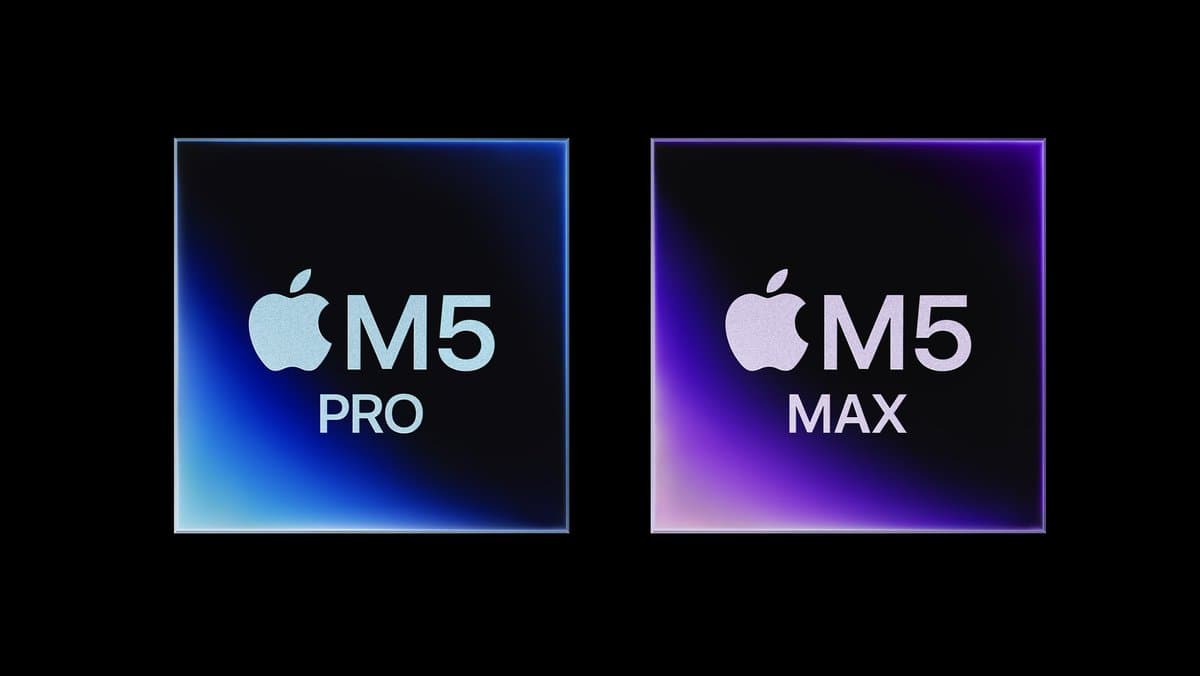
Apple has officially unveiled its next-generation M5 Pro and M5 Max processors, marking a significant evolution in the company's silicon strategy with what it calls "Fusion Architecture." According to reports from industry sources including @kimmonismus on X, these chips represent Apple's most ambitious foray yet into specialized AI computing hardware, built on an innovative approach that merges two 3nm dies into a single system-on-chip (SoC).
The Fusion Architecture Breakthrough
At the heart of Apple's M5 Pro and M5 Max lies what the company describes as "Fusion Architecture" - a novel approach to chip design that physically combines two separate 3nm dies into what appears to the system as a unified SoC. This architectural innovation represents a departure from traditional monolithic chip designs and even from chiplet approaches used by competitors like AMD and Intel.
The Fusion Architecture enables Apple to overcome the physical limitations of single-die manufacturing while maintaining the tight integration and low-latency communication that has characterized its previous M-series chips. By connecting two 3nm dies through what is likely an ultra-high-bandwidth interconnect, Apple can effectively double the available silicon real estate without sacrificing the performance-per-watt advantages that have made its chips so successful.
Performance Specifications and AI Capabilities
The M5 Pro and M5 Max deliver substantial performance improvements across multiple dimensions:
- CPU Performance: Up to 30% faster than the previous M4 generation
- GPU Compute: Over 4x peak GPU compute specifically for AI workloads
- Core Configuration: 18-core CPU with 6 "super cores" (likely high-performance cores) and up to 40-core GPU
- Memory Bandwidth: Unified memory architecture reaching 614GB/s
- Neural Accelerators: Dedicated hardware for AI and machine learning tasks
What's particularly noteworthy is the specialized focus on AI compute capabilities. The "over 4x peak GPU compute for AI" specification suggests Apple has fundamentally rearchitected its GPU components to excel at the matrix operations and tensor calculations that underpin modern AI workloads. This represents a strategic shift from general-purpose GPU compute to AI-optimized acceleration.
The Neural Accelerators: Apple's Secret Weapon
The mention of "Neural Accelerators" in the M5 Pro and M5 Max specifications points to dedicated hardware blocks specifically designed for AI inference and possibly training tasks. While Apple has included Neural Engines in its chips since the A11 Bionic in 2017, the terminology shift to "Neural Accelerators" suggests a more comprehensive and powerful approach to AI hardware.
These accelerators likely work in concert with the enhanced GPU cores to create a heterogeneous computing environment optimized for different types of AI workloads. The 614GB/s unified memory bandwidth is particularly crucial here, as AI models increasingly require rapid access to large datasets and model parameters.
Manufacturing and 3nm Advantages
The use of TSMC's 3nm process technology for both dies in the Fusion Architecture gives Apple significant advantages in power efficiency and transistor density. The 3nm process allows for more transistors in the same physical space, enabling the complex multi-die architecture while maintaining reasonable power envelopes for mobile and desktop systems.
This manufacturing advantage, combined with Apple's vertical integration from silicon design to software optimization, creates a formidable competitive position in the AI hardware space. While NVIDIA dominates the data center AI market, Apple appears to be positioning itself as the leader in edge AI computing - AI that happens on the device rather than in the cloud.
Implications for the AI Hardware Landscape
Apple's M5 Pro and M5 Max chips arrive at a critical moment in the AI hardware race. With Microsoft, Google, Amazon, and Meta all developing their own AI chips, and NVIDIA continuing to innovate with its GPU architectures, the computing landscape is becoming increasingly specialized.
Apple's approach with Fusion Architecture suggests several strategic priorities:
On-Device AI Superiority: By dramatically increasing AI compute capabilities, Apple enables more sophisticated AI features to run entirely on-device, enhancing privacy and reducing latency.
Professional Workloads: The substantial GPU improvements position these chips as serious contenders for AI-assisted creative work, scientific computing, and development tasks that increasingly rely on AI acceleration.
Ecosystem Lock-in: As Apple's silicon becomes increasingly specialized for AI, developers will have stronger incentives to optimize for Apple's hardware-software stack, strengthening the company's ecosystem.
Competitive Context and Market Position
The M5 Pro and M5 Max chips place Apple in direct competition with several segments of the computing market. For mobile and laptop AI workloads, they compete with Qualcomm's Snapdragon X Elite with its dedicated NPU. For desktop and workstation AI tasks, they challenge NVIDIA's RTX GPUs and AMD's RDNA architectures.
What sets Apple apart is the complete vertical integration - the ability to design chips specifically for its operating systems and application ecosystems. This allows for optimizations that competitors relying on more general-purpose hardware cannot match.
Looking Forward: The Future of Apple Silicon
The Fusion Architecture introduced with the M5 Pro and M5 Max likely represents just the beginning of Apple's multi-die strategy. Future iterations could incorporate even more specialized dies - perhaps dedicated AI processors, advanced media engines, or security enclaves - all connected through high-bandwidth interconnects.
This modular approach to chip design gives Apple tremendous flexibility to adapt its silicon to emerging computing paradigms, particularly as AI continues to evolve from a specialized capability to a fundamental layer of all computing tasks.
Source: Based on reporting from @kimmonismus on X and industry analysis of Apple's silicon developments.