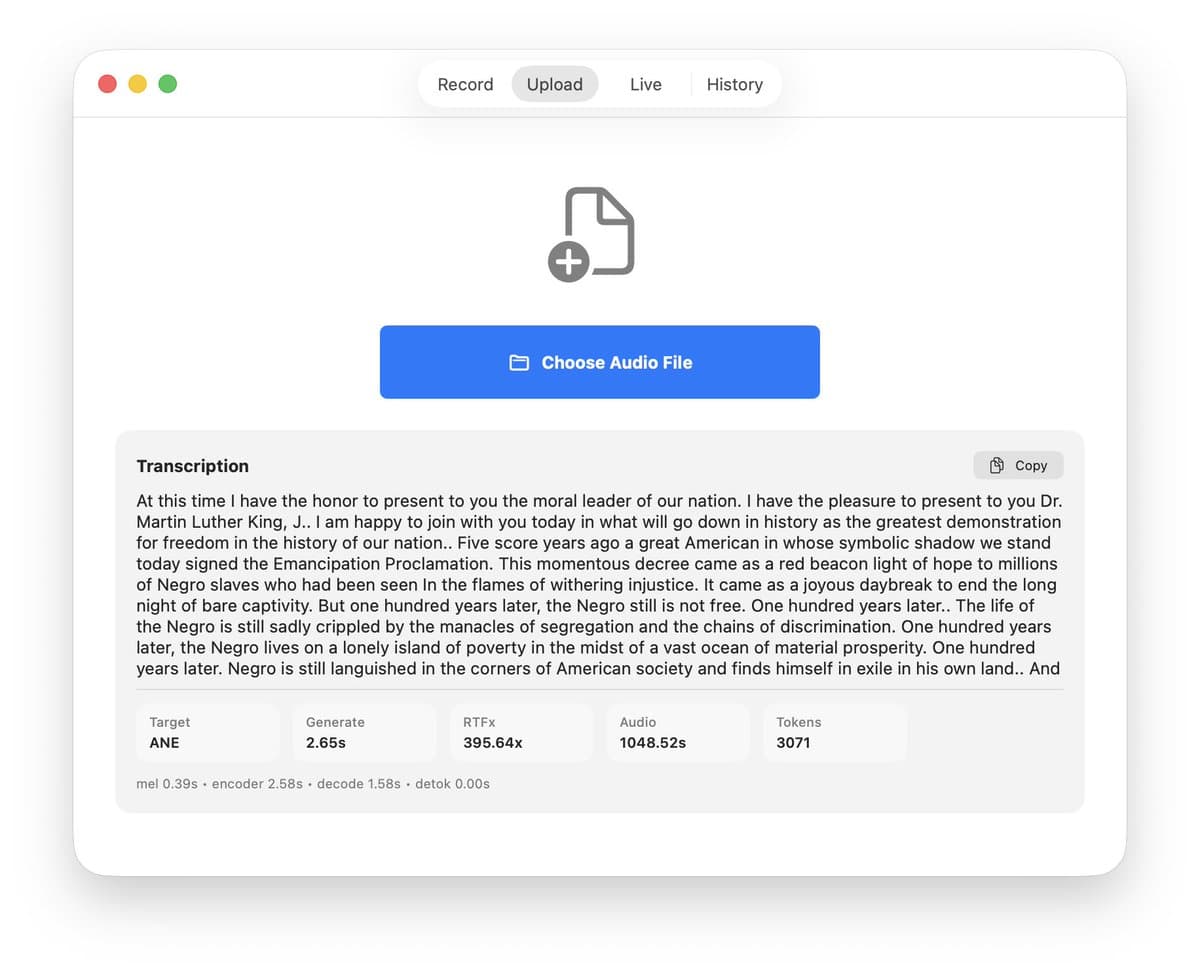
Developer and AI optimization specialist @mweinbach has announced what they believe to be the fastest implementation of the Parakeet v3 automatic speech recognition (ASR) model specifically optimized for Apple's Neural Engine (ANE). The implementation achieves a 395x real-time factor (RTFx) on an Apple M5 Max chip, with 365x RTFx on the standard M5 and 240x RTFx on the A19 Pro.
Key Takeaways
- Developer @mweinbach has optimized the Parakeet v3 speech recognition model for Apple's Neural Engine, achieving a 395x real-time factor on an M5 Max chip.
- This represents a significant performance leap for on-device AI inference on Apple Silicon.
What Happened

In a technical post on X, @mweinbach shared benchmark results for their custom implementation of Parakeet v3, a state-of-the-art speech recognition model from NVIDIA. The key metric, real-time factor (RTFx), measures how much faster than real-time the model can process audio. An RTFx of 395x means the model can process 395 seconds of audio in 1 second of compute time.
The benchmarks show performance scaling with Apple's latest silicon:
- 395x RTFx on Apple M5 Max
- 365x RTFx on Apple M5
- 240x RTFx on Apple A19 Pro (presumably in an iPhone)
These results represent a significant optimization achievement for on-device speech recognition, demonstrating that complex transformer-based ASR models can run with extreme efficiency on Apple's dedicated neural hardware.
Technical Context
Parakeet v3 is a family of automatic speech recognition models released by NVIDIA in late 2024. Built on the RNNT (Recurrent Neural Network Transducer) architecture with transformer encoders, the models are known for high accuracy across diverse accents and noisy environments. The "v3" designation refers to the third major iteration, with model sizes ranging from 0.6B to 1.1B parameters.
Apple's Neural Engine (ANE) is a dedicated neural processing unit integrated into Apple Silicon chips (A-series and M-series). It's optimized for the low-precision matrix operations fundamental to neural network inference. However, achieving peak performance requires careful optimization to match the ANE's specific memory hierarchy and execution model.
@mweinbach's achievement suggests they've successfully mapped Parakeet v3's computational graph to the ANE's architecture, minimizing data movement and maximizing utilization of the neural processing cores.
Why This Matters for On-Device AI
High-performance on-device speech recognition enables several important applications:
- Privacy-First Transcription: Audio never leaves the device, addressing privacy concerns for sensitive conversations (medical, legal, personal).
- Offline Capability: Functionality without internet connectivity for travel, remote work, or areas with poor service.
- Low-Latency Interaction: Near-instant voice commands for accessibility features, smart assistants, and real-time captioning.
- Reduced Cloud Costs: Eliminates dependency on cloud ASR services, which charge per minute of audio processed.
The 395x RTFx benchmark is particularly notable because it makes real-time transcription a trivial computational task on Apple hardware, freeing up CPU/GPU resources for other applications while maintaining extremely high accuracy.
Performance Comparison

While @mweinbach didn't provide direct comparisons to other implementations, we can contextualize the 395x RTFx figure:
- Cloud ASR Services: Typically optimized for throughput rather than latency, with RTFx in the 50-200x range on server-grade GPUs.
- Previous On-Device Models: Older on-device ASR models (like those based on Wav2Vec 2.0) might achieve 10-50x RTFx on mobile NPUs.
- Apple's Native Speech Recognition: Apple's own speech recognition system (used by Siri and system dictation) is highly optimized but not directly comparable in architecture or accuracy to Parakeet v3.
The results suggest that with sufficient optimization effort, third-party models can achieve or exceed the performance of native vendor implementations.
Implementation Challenges
Optimizing transformer-based models for the ANE presents specific challenges:
- Kernel Fusion: Combining multiple operations into single ANE kernels to reduce memory traffic
- Weight Quantization: Converting FP32/FP16 weights to INT8/INT4 without significant accuracy loss
- Attention Optimization: Efficiently implementing the attention mechanism within ANE constraints
- Memory Layout: Arranging tensors in memory to match the ANE's preferred access patterns
@mweinbach's results indicate they've successfully addressed these challenges for the Parakeet v3 architecture, though they haven't yet published implementation details or code.
gentic.news Analysis
This optimization achievement arrives at a critical inflection point for on-device AI. Apple has been aggressively promoting its Neural Engine capabilities since the M4 chip announcement in 2024, but real-world demonstrations of third-party models achieving this level of performance have been scarce. @mweinbach's work proves that the hardware capability exists—it just requires deep optimization expertise to unlock.
This development aligns with several trends we've been tracking. First, the commoditization of high-quality foundation models—Parakeet v3 is openly available from NVIDIA, not a proprietary Apple model. Second, the growing importance of inference optimization as a distinct engineering discipline, separate from model training. Third, the strategic shift toward privacy-preserving on-device AI as a market differentiator, particularly in regulated industries like healthcare and finance.
The performance gap between the M5 Max (395x) and A19 Pro (240x) is noteworthy. It reflects both the thermal/power advantages of desktop-class chips and possibly architectural improvements in the M5's Neural Engine. For developers, this means optimization work on Macs may not directly translate to identical iPhone performance, requiring platform-specific tuning.
Looking forward, the real question is whether @mweinbach will open-source their implementation or commercialize it. Given Apple's historical reluctance to expose low-level ANE programming details, community-driven optimization efforts like this could significantly accelerate adoption of complex on-device AI models across the Apple ecosystem. If this implementation becomes available, it could trigger a wave of high-performance, privacy-focused AI applications that were previously limited to cloud deployment.
Frequently Asked Questions
What is Parakeet v3?
Parakeet v3 is a family of automatic speech recognition models developed by NVIDIA, released in late 2024. Based on the RNNT architecture with transformer encoders, it achieves state-of-the-art accuracy across diverse accents and noisy environments. The models range from 0.6 to 1.1 billion parameters and are available under an open license for research and commercial use.
What does 395x RTFx mean for real-world use?
A real-time factor of 395x means the system can process audio 395 times faster than it plays. For practical applications, this extreme efficiency means speech recognition consumes minimal battery life, generates almost no heat, and runs concurrently with other applications without noticeable performance impact. It makes always-on voice interfaces technically feasible on Apple devices.
How does this compare to Apple's built-in speech recognition?
Apple's native speech recognition (used by Siri and system dictation) is highly optimized but a different architecture with different accuracy characteristics. @mweinbach's implementation demonstrates that third-party models can achieve comparable or superior efficiency through optimization, giving developers the option to use best-in-class open models rather than being limited to Apple's offerings.
Will this implementation be available to other developers?
As of this writing, @mweinbach has only shared benchmark results, not code or implementation details. The developer community will be watching to see if they open-source the work, create a commercial product, or keep it as proprietary knowledge. Widespread availability could significantly accelerate on-device AI application development for Apple platforms.