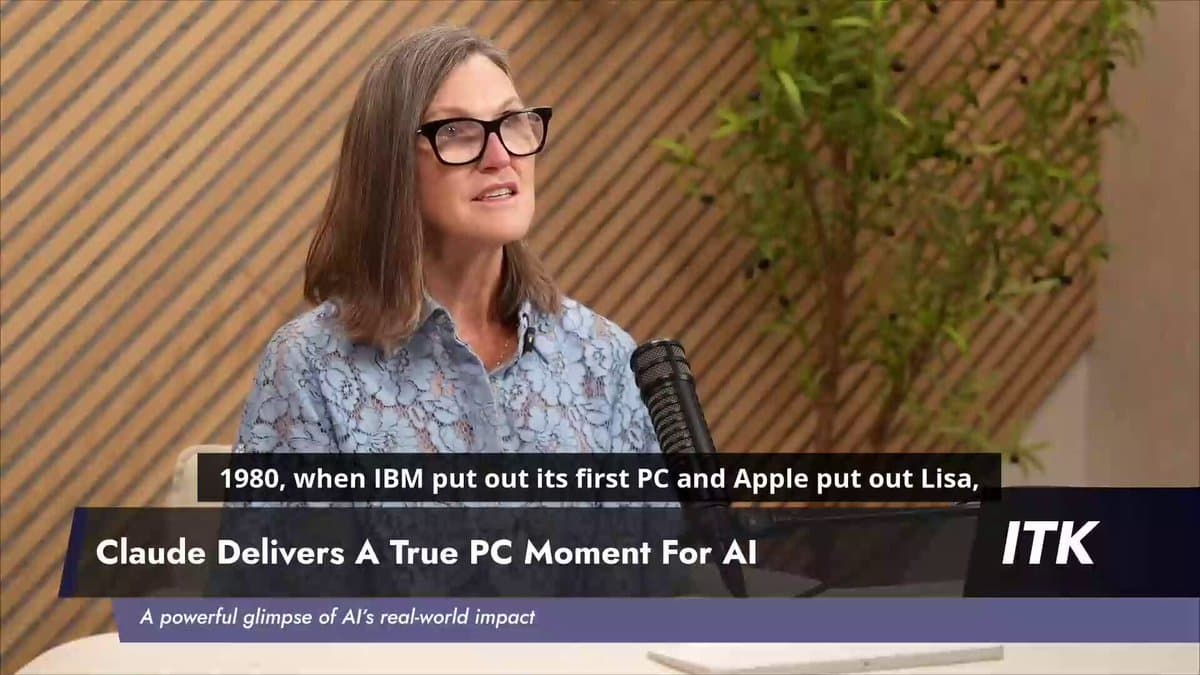
In a development that could reshape how investment firms handle operational workflows, Ark Invest has successfully deployed Anthropic's Claude Code to automate what was previously a six-month financial backlog. The announcement, made by Ark Invest founder and CEO Cathie Wood via social media, positions this achievement as a watershed moment comparable to the personal computer revolution of the 1980s.
The Breakthrough Implementation
According to the report from Rohan Paul, Ark Invest leveraged Claude Code—Anthropic's specialized coding assistant—to tackle a substantial backlog in financial operations. While specific details about the exact nature of the backlog weren't provided in the source material, financial backlogs in investment firms typically involve data processing, reconciliation, reporting, compliance documentation, or portfolio analysis tasks that accumulate due to manual processing limitations.
What makes this implementation particularly noteworthy is the timeframe: six months of accumulated work was automated through Claude Code's capabilities. This suggests the AI system was able to understand complex financial workflows, identify repetitive processes, and generate code to automate them—all while presumably maintaining the accuracy and compliance standards required in financial services.
Integration with Palantir Platform
The source indicates that Ark Invest is now taking this success a step further by integrating these newly developed AI capabilities into its Palantir platform. Palantir Technologies, known for its data integration and analytics software, serves as a central operating system for many institutional investors, particularly those dealing with complex datasets across multiple sources.
This integration represents a strategic move beyond one-off automation projects toward embedding AI capabilities directly into Ark Invest's core operational infrastructure. By bringing Claude Code's automation abilities into Palantir, the firm appears to be creating a more systematic approach to identifying and automating inefficiencies across their entire operation.
Cathie Wood's Historical Comparison
Cathie Wood's characterization of this moment as a "1980 PC MOMENT" carries significant weight given her position as both a technology-focused investor and industry veteran. The 1980s personal computer revolution fundamentally transformed business operations by bringing computing power directly to individual workers and departments, rather than keeping it centralized in data processing departments.
Wood's comparison suggests she views AI coding assistants like Claude Code as similarly transformative—tools that democratize automation capabilities that were previously the domain of specialized IT departments. Just as spreadsheets and word processors empowered financial analysts and administrators in the 1980s, AI coding tools now empower financial professionals to create their own automation solutions without extensive programming expertise.
Implications for the Investment Industry
The successful implementation at Ark Invest points toward several broader implications for the financial services sector:
Operational Efficiency at Scale: Investment firms traditionally face tension between the need for customized analysis and the efficiency demands of scale. AI coding assistants could help resolve this tension by allowing firms to maintain customization while automating the implementation of those custom analyses.
Reduced Technical Debt: Many financial institutions struggle with legacy systems and accumulated technical debt—outdated code and processes that are expensive to maintain. AI-assisted coding could accelerate the modernization of these systems by helping teams understand, document, and refactor existing codebases.
New Competitive Dynamics: Firms that successfully integrate AI coding capabilities may develop significant operational advantages over competitors still relying on manual or semi-automated processes. This could reshape competitive dynamics in asset management, where efficiency directly impacts profitability.
The Evolving AI Landscape in Finance
Ark Invest's implementation comes amid growing interest in AI applications across financial services. While much attention has focused on AI for investment analysis or algorithmic trading, this example highlights the potentially transformative impact of AI on the less-glamorous but critical back-office operations that support investment activities.
The choice of Claude Code specifically is noteworthy. Anthropic has positioned Claude as particularly strong at understanding context and following instructions carefully—attributes especially valuable in financial applications where errors can have significant consequences. The success at Ark Invest may prompt other firms to evaluate whether different AI coding assistants have particular strengths for financial workflows.
Looking Forward
As Ark Invest continues integrating these capabilities into its Palantir platform, the industry will be watching for several developments:
- Whether the automation proves sustainable and adaptable as financial regulations and reporting requirements evolve
- How the firm scales these capabilities from backlog clearance to ongoing operations
- Whether similar implementations emerge at other investment firms, potentially creating industry-wide efficiency gains
- How AI coding tools continue to evolve specifically for financial applications
Wood's comparison to the 1980s PC revolution may prove prescient if AI coding assistants become as ubiquitous in financial operations as spreadsheet software eventually became. The transition from clearing backlogs to fundamentally reimagining workflows represents the next frontier—and one that could determine which firms thrive in an increasingly AI-enabled financial landscape.
Source: Report from @rohanpaul_ai on X/Twitter regarding Ark Invest's implementation of Claude Code, including statement from Cathie Wood.