Key Takeaways
- AWS published a real-time e-commerce personalization blueprint that cuts recommendation latency to under 10 seconds using AWS Personalize, Kinesis, and Lambda.
- The architecture bridges batch and streaming modes for luxury retailers.
What Happened
Amazon Web Services published a detailed blueprint for building a scalable personalized recommendation system that transitions from batch to real-time processing. The architecture, designed for e-commerce use cases, achieves recommendation latency under 10 seconds from user click to personalized result.
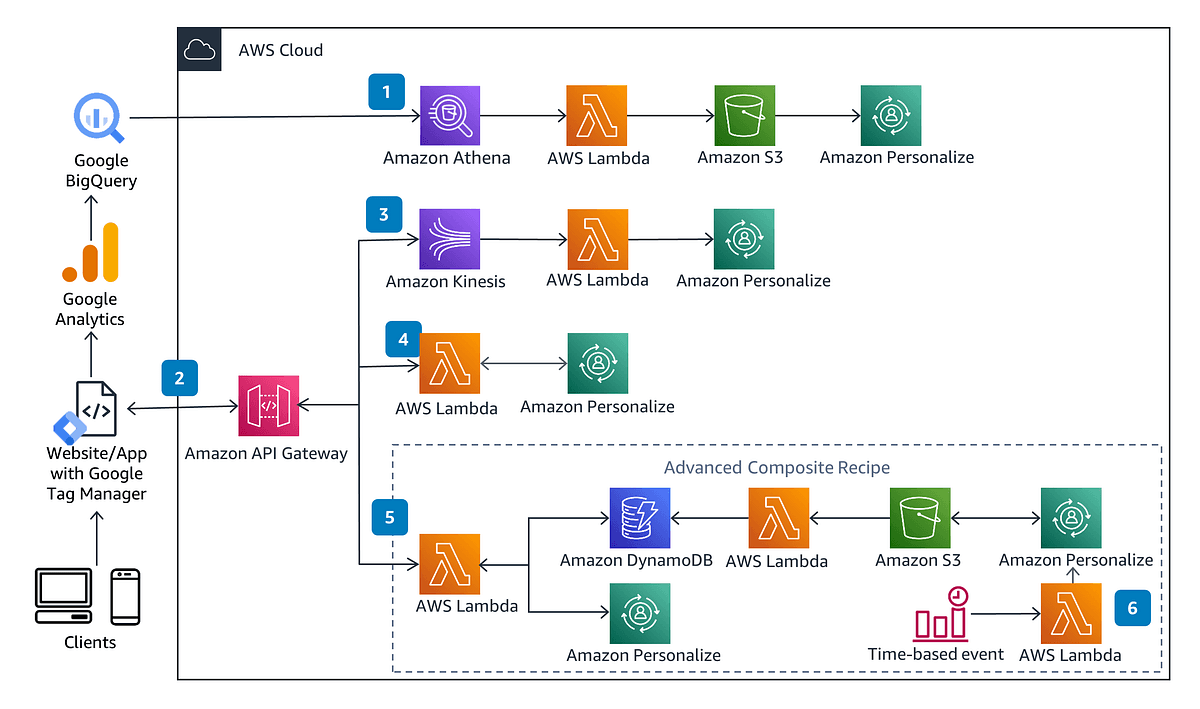
The system combines AWS Personalize for model training and inference, Amazon Kinesis for real-time event streaming, and AWS Lambda for serverless compute. It ingests user behavior events (clicks, views, purchases) in real time, updates user profiles, and serves recommendations via a REST API.
Technical Details
The blueprint separates the recommendation pipeline into three layers:
Data Ingestion Layer: Amazon Kinesis Data Streams captures user events (page views, add-to-cart, purchases) in real time. AWS Lambda functions process and transform events before passing them to Personalize.
Recommendation Engine: AWS Personalize provides pre-built recipes for user-personalization, related-items, and personalized-ranking. Models are trained in batch mode daily or weekly, but inference runs in real time using the Personalize real-time endpoint.
Serving Layer: A REST API backed by API Gateway and Lambda calls Personalize for each user request, returning top-N recommendations. The entire round-trip is designed to stay under 10 seconds.
The architecture also includes A/B testing infrastructure via Amazon CloudWatch Evidently, allowing retailers to compare recommendation strategies and continuously optimize.
Retail & Luxury Implications
For luxury retailers like Kering and Richemont, real-time personalization is critical for high-value, low-frequency purchase cycles. A customer browsing a $5,000 handbag expects immediate, contextually relevant suggestions—not a batch-processed list from yesterday.
The under-10-second latency target is achievable with AWS's managed services, but luxury brands face unique challenges:
- Data sparsity: Luxury purchases are rare events, making collaborative filtering less effective. The blueprint's support for hybrid models (content-based + collaborative) is essential.
- Cold start: New users and new products require fallback strategies. The architecture supports popularity-based and trending-item recommendations as cold-start defaults.
- Brand safety: Recommendations must align with brand identity. The A/B testing layer allows controlled rollout of personalization strategies.
Business Impact
While AWS does not provide specific ROI metrics, the blueprint targets measurable improvements:
- Conversion rate lift: Real-time personalization typically increases conversion by 5-15% in e-commerce (industry benchmarks).
- Reduced infrastructure cost: Serverless components (Lambda, Kinesis) eliminate the need for dedicated streaming clusters.
- Faster time-to-market: Managed services reduce custom ML engineering effort by an estimated 60-70%.
Implementation Approach
Event ingestion Kinesis Data Streams Low Event processing Lambda Low Model training Personalize (batch) Medium Real-time inference Personalize (real-time) Medium A/B testing CloudWatch Evidently Low API serving API Gateway + Lambda LowTotal estimated effort: 4-6 weeks for a team with AWS experience.
Governance & Risk Assessment
- Privacy: Personalize supports user-level data anonymization. GDPR compliance requires careful event filtering.
- Bias: Real-time personalization can amplify popularity bias. The blueprint recommends diversity-aware ranking as a follow-up.
- Maturity: The approach is production-ready for mid-to-large e-commerce. Luxury brands should pilot with a limited catalog first.
gentic.news Analysis
This AWS blueprint is a pragmatic, vendor-locked solution for real-time personalization. It competes directly with Google Cloud's Recommendations AI and open-source alternatives like NVIDIA Merlin.
For luxury retailers, the key takeaway is not the 10-second latency number but the architectural pattern: separating batch training from streaming inference. Most luxury brands already use batch recommendations (e.g., daily email campaigns). Adding a real-time layer on top—without replacing the batch system—is the right evolutionary step.
The blueprint's A/B testing integration is underappreciated. Luxury brands should use it not just to compare models but to measure the business impact of personalization depth. A simple "you might also like" may outperform a complex model in some contexts.
Caveat: The blueprint assumes AWS Personalize handles all ML complexity. In practice, Personalize's built-in recipes are black boxes. Luxury brands with unique merchandising rules (e.g., "never recommend a competitor brand") may need custom models using SageMaker instead.
Competitive context: Google Cloud's Recommendations AI offers similar capabilities with tighter integration to Google Analytics 360—a common tool in luxury e-commerce. AWS Personalize's advantage is its serverless event pipeline, which reduces operational overhead.
Bottom line: This is a solid reference architecture for any retailer starting real-time personalization. Luxury brands should adopt the pattern but budget for custom model tuning on top of Personalize's defaults.
Source: news.google.com