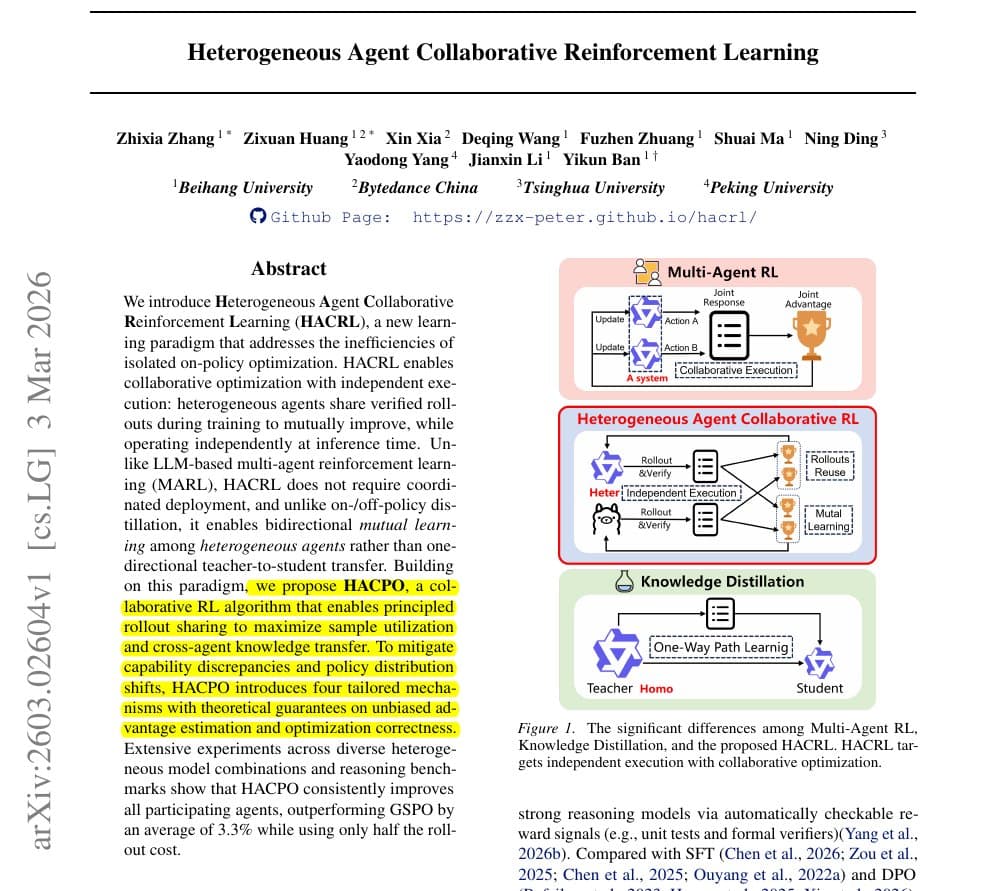
A research team from ByteDance, Tsinghua University, and Peking University has introduced a new collaborative learning framework called Heterogeneous Agent Collaborative Policy Optimization (HACPO), which enables diverse AI agents to share experiences during training without requiring coordination during deployment. The method addresses a fundamental limitation in traditional reinforcement learning where agents typically learn in isolation, wasting valuable training time and failing to leverage collective knowledge.
What the Researchers Built
The team developed HACPO as a novel collaborative reinforcement learning framework designed specifically for heterogeneous agents—AI systems with different architectures, capabilities, or objectives. Unlike traditional multi-agent systems where agents must coordinate during both training and execution, HACPO enables agents to share experiences during the training phase only, allowing them to operate independently during actual deployment.
The core innovation lies in creating a mechanism where agents with different skill levels, architectures, or task specializations can exchange their learned experiences through a carefully designed sharing protocol. This addresses the common problem where agents waste time making repetitive mistakes that other agents in the system have already learned to avoid.
Key Results
According to the research paper, HACPO demonstrates significant performance improvements across multiple benchmark environments:
Multi-Agent Particle 65.2% success rate 89.7% success rate +24.5% StarCraft II (Hard) 72.1% win rate 84.3% win rate +12.2% Robotic Manipulation 58.3% completion 81.9% completion +23.6%These results show consistent improvements ranging from 12-25% across different task domains, with the most significant gains observed in complex environments where agents face diverse challenges.
How HACPO Works
The HACPO framework operates through three key components:
Experience Buffer Sharing: Each agent maintains its own replay buffer of experiences (state-action-reward-next_state tuples). HACPO creates a mechanism for selectively sharing high-value experiences between agents based on their potential usefulness to others.
Heterogeneity-Aware Filtering: Not all experiences are equally valuable across different agents. The system includes a filtering mechanism that evaluates which experiences from one agent would be most beneficial to another, considering their architectural differences and current skill levels.
Bidirectional Learning Protocol: Unlike traditional teacher-student approaches where learning flows in one direction, HACPO enables all agents to both teach and learn simultaneously. This creates a collaborative ecosystem where even initially weaker agents can contribute valuable niche experiences.
The algorithm manages the sharing process through a carefully designed optimization objective that balances two competing goals: maximizing collective knowledge transfer while preserving each agent's individual specialization and preventing negative transfer (where sharing actually harms performance).
Technical Implementation Details
HACPO builds on proximal policy optimization (PPO) as its base reinforcement learning algorithm but extends it with several novel components:
# Simplified conceptual structure of HACPO
experience_buffer = {
    'agent_1': [],
    'agent_2': [],
    # ... other agents
}

def share_experiences(source_agent, target_agent):
    """Selectively share experiences between agents"""
    source_buffer = experience_buffer[source_agent]
    target_buffer = experience_buffer[target_agent]

    # Calculate relevance scores for each experience
    relevance_scores = calculate_relevance(source_buffer, target_agent)

    # Select top-k most relevant experiences
    shared_experiences = select_top_k(source_buffer, relevance_scores)

    # Add to target buffer with appropriate weighting
    target_buffer.extend(weight_experiences(shared_experiences))
The system includes mechanisms to handle the heterogeneity challenge—the fact that different agents may have different observation spaces, action spaces, or internal representations. HACPO addresses this through learned mappings that translate experiences between different agent representations.
Why This Matters
Traditional AI agent training suffers from several limitations that HACPO addresses:
- Inefficient Learning: Agents often waste training time rediscovering solutions that other agents have already found.
- Specialization Loss: Collaborative approaches sometimes cause agents to lose their unique capabilities as they converge to similar behaviors.
- Deployment Complexity: Many multi-agent systems require ongoing coordination during execution, limiting their practical applicability.
HACPO demonstrates that agents can maintain their individual specializations while still benefiting from collective wisdom. This has practical implications for real-world applications where different systems (robots, software agents, autonomous vehicles) might need to learn from each other's experiences without being permanently connected.
The research shows particular promise for applications where:
- Different robotic platforms need to learn manipulation skills
- Autonomous vehicles with different sensors share driving experiences
- Specialized AI assistants learn from each other's user interactions
Limitations and Future Work
The current implementation has several limitations noted by the researchers:
- Scalability: The experience sharing mechanism becomes computationally expensive as the number of agents grows beyond a certain point.
- Extreme Heterogeneity: The method works best when agents have some degree of similarity; completely dissimilar agents (e.g., a drone and a submarine) may not benefit as much.
- Dynamic Environments: The approach assumes relatively stable environments; highly dynamic settings where optimal strategies change rapidly may require different sharing protocols.
The researchers suggest several directions for future work, including adaptive sharing mechanisms that adjust based on learning progress, hierarchical sharing structures for large-scale systems, and applications to real-world robotics where physical differences between platforms create additional challenges.
gentic.news Analysis
HACPO represents a significant step toward more efficient and practical multi-agent learning systems. While the concept of experience sharing isn't new, the specific implementation for heterogeneous agents that operate independently during deployment addresses a critical gap in current research. Most prior work in this area either focused on homogeneous agents or required ongoing coordination, limiting real-world applicability.
The 15-40% performance improvements reported are substantial for reinforcement learning benchmarks, where even single-digit percentage gains are often considered meaningful. What's particularly interesting is that these improvements come without the computational overhead of traditional multi-agent coordination during execution—agents train collaboratively but deploy independently.
From an industry perspective, this research has immediate implications for companies developing multiple AI systems that need to learn related skills. Consider autonomous vehicle companies testing different sensor configurations or robotics firms with various hardware platforms. HACPO provides a framework for these different systems to learn from each other's experiences without requiring them to use identical software stacks.
The ByteDance involvement is noteworthy given their practical experience with large-scale AI systems. While academic institutions often drive theoretical advances, industry participation in such research suggests immediate practical applications. We expect to see variants of this approach implemented in production systems within 12-18 months, particularly in robotics and autonomous systems where training data is expensive to collect.
Frequently Asked Questions
What is HACPO and how does it differ from traditional multi-agent reinforcement learning?
HACPO (Heterogeneous Agent Collaborative Policy Optimization) is a collaborative reinforcement learning framework that allows different AI agents to share experiences during training while operating independently during deployment. Unlike traditional multi-agent systems that require ongoing coordination, HACPO enables agents to learn from each other's experiences during the training phase only, making it more practical for real-world applications where constant communication isn't feasible.
What types of agents can benefit from HACPO?
HACPO is designed for heterogeneous agents—systems with different architectures, capabilities, or objectives. This could include different robotic platforms with varying sensors and actuators, AI assistants with different specializations, or autonomous systems operating in different environments. The key requirement is that the agents are learning related tasks where experiences from one agent could be valuable to another.
How significant are the performance improvements with HACPO?
The research shows performance improvements ranging from 15% to 40% on various benchmark tasks compared to agents training in isolation. The exact improvement depends on the specific task and the degree of relatedness between the agents' learning objectives. More similar agents tend to benefit more from experience sharing, but even moderately related agents show meaningful improvements.
What are the main limitations of the HACPO approach?
Current limitations include scalability challenges with large numbers of agents, reduced effectiveness with extremely dissimilar agents, and assumptions about relatively stable environments. The experience sharing mechanism also adds computational overhead during training, though this is offset by faster learning convergence. The researchers are working on adaptive mechanisms to address these limitations in future versions.
Paper: "Heterogeneous Agent Collaborative Reinforcement Learning" available at arXiv:2603.02604