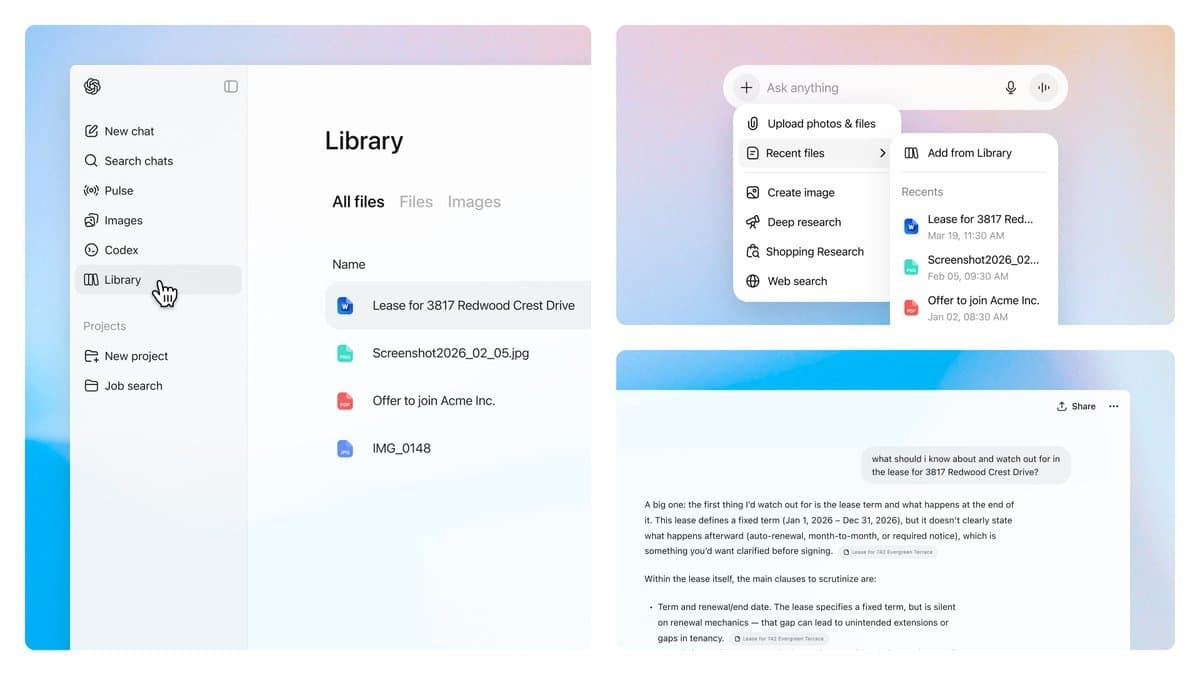
OpenAI has rolled out a significant quality-of-life update to ChatGPT: a persistent file storage system called Library. This feature transforms file uploads from temporary, conversation-specific attachments into a reusable, account-level document repository. The change fundamentally decouples file storage from individual chat threads, enabling users to access previously uploaded documents in new conversations without re-uploading.
What's New: From Ephemeral Uploads to Persistent Library
The core innovation is architectural. Previously, when a user uploaded a PDF, spreadsheet, or image to a ChatGPT conversation, that file was tethered exclusively to that chat thread. To reference the same document in a new conversation, the user had to upload it again. The new Library feature changes this by automatically saving uploaded files to a central, account-level store.
Supported file types include:
- PDFs
- Spreadsheets (e.g., .csv, .xlsx)
- Presentations
- Text documents
- Images
Once a file is in your Library, you can bring it into any new chat. On the web interface, a new Library button appears in the file upload area, allowing you to browse and select from your saved documents. ChatGPT can then answer prompts based on content you uploaded in a completely separate session earlier.
Technical Details: File Limits and Platform Availability
The update comes with clearly defined technical constraints, crucial for power users:
All Files 512 MB (hard limit per file) - Text/Documents (e.g., .txt, .pdf, .docx) - 2 million tokens per file (limit does not apply to spreadsheets) CSV/Spreadsheets ~50 MB Limit depends on row size Images 20 MB per image -Platform Rollout:
- Web: Full Library functionality with browsing and search.
- iOS & Android (Mobile Apps): Support for accessing recent files and file search.
- Availability: The feature is currently rolling out to ChatGPT Plus, Team, and Enterprise users. It is not yet available to users in the European Economic Area (EEA), Switzerland, and the UK due to unspecified regional rollout delays.
It's important to note that generated images (from DALL-E) are not stored in the Library; they remain in the separate Images tab within each chat.
How It Compares: Evolving from a Chatbot to a Workbench
This update is a strategic step in ChatGPT's evolution from a pure conversational interface toward a more integrated AI workbench. The primary comparison is to its previous self:
- Before Library: File context was siloed, leading to repetitive uploads and fragmented document history.
- After Library: Centralized document management enables continuous, cross-conversation workflows. A user can upload a research paper in one chat, ask for a summary, and then days later start a new chat to ask for critiques or comparisons based on that same paper without any extra steps.
This moves ChatGPT closer to the document-persistence model seen in some AI coding assistants (which can maintain project context) and enterprise knowledge-base tools, though it remains a user-managed file store rather than an automated corporate memory system.
What to Watch: Limitations and Future Implications
The initial rollout has clear boundaries. The 2M token limit for text files is substantial (roughly 1.5 million words) but will affect users working with very large codebases or lengthy manuscripts. The regional exclusion of the EEA and UK highlights the ongoing complexity of deploying AI features under strict data governance regulations like GDPR.
For practitioners, the key implication is workflow efficiency. This feature reduces friction for multi-step analysis, where a document must be reviewed from different angles across separate, focused conversations. It also makes ChatGPT more viable for long-term projects where reference materials are used repeatedly.
The success of Library will likely be measured by its search and organization capabilities. Can users easily find a specific chart in a 300-page PDF they uploaded two weeks ago? The effectiveness of the file search on mobile and web will be critical for real-world utility.
gentic.news Analysis
This is a foundational infrastructure update, not a flashy model breakthrough, but it's arguably more significant for daily utility. By decoupling storage from the chat thread, OpenAI is addressing a major pain point for power users and laying the groundwork for more sophisticated "memory" features. The 2M token per-document limit is a technical signal, revealing the context window constraints of the underlying models even as they scale; it's a pragmatic cap that ensures performance reliability.
Strategically, Library is a move to increase platform lock-in and session depth. When your documents live in ChatGPT, you're more likely to return to it as your primary AI interface for document-based tasks, rather than fragmenting work across different tools. This directly counters the approach of some competitors, like Claude, which have emphasized large, single-session context windows as their solution to multi-document work.
The regional rollout pause is the most telling detail. It underscores that for AI companies, the biggest challenges are increasingly regulatory and infrastructural, not purely technical. Deploying a global file storage system that complies with varying data sovereignty laws is a complex task that may dictate feature availability as much as engineering roadmaps do.
Frequently Asked Questions
What is the ChatGPT Library feature?
The ChatGPT Library is a new persistent storage system that automatically saves files you upload (like PDFs, docs, and images) to your account. Instead of being tied to a single conversation, these files are saved in a central Library that you can access from any new chat, eliminating the need to re-upload the same document multiple times.
Is the ChatGPT Library available for free users?
No. According to the current rollout, the Library feature is only available for paying subscribers on the ChatGPT Plus, ChatGPT Team, and ChatGPT Enterprise plans. It is not available to users on the free tier.
Why is the ChatGPT Library not available in Europe?
The feature is temporarily unavailable in the European Economic Area (EEA), Switzerland, and the UK. This is likely due to the complex data privacy and governance regulations in these regions, such as GDPR. OpenAI is likely completing compliance and infrastructure adjustments before launching the feature, which involves storing user-uploaded files, in these jurisdictions.
What are the file size limits for the ChatGPT Library?
There are several strict limits: a hard 512MB cap for any single file, a 2 million token limit for text-based documents (like PDFs or .docx), an approximate 50MB limit for spreadsheets, and a 20MB limit per image. These are in place to ensure system performance and reliability.