Key Takeaways
- China blocked Meta's $2 billion acquisition of agentic AI startup Manus, citing concerns over foreign investment and transfer of strategic AI technology to the US.
- The move signals Beijing's sharper stance on AI sovereignty and intensifies the US-China tech rivalry.
What Happened

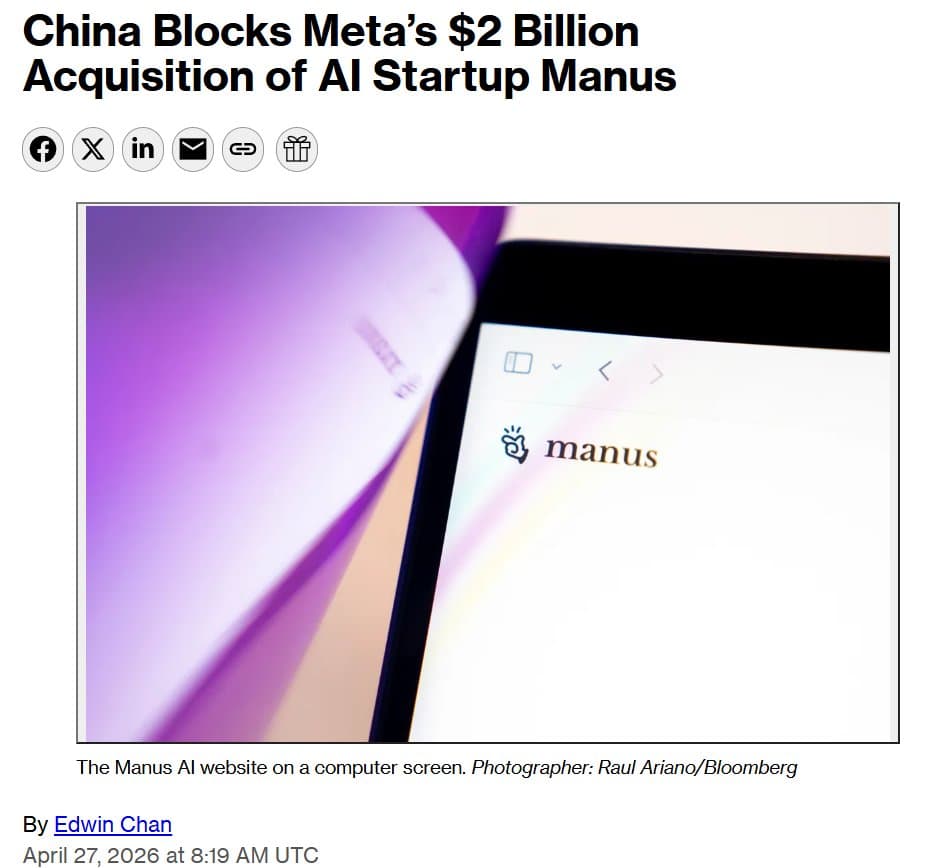
China has formally blocked Meta's proposed $2 billion acquisition of Manus, an agentic AI startup, over concerns that the deal would transfer strategic AI technology to the United States. The decision, reported by Bloomberg, marks a significant escalation in Beijing's enforcement of AI sovereignty and foreign investment restrictions.
The block turns Manus — once seen as a model for globally ambitious Chinese AI startups — into a flashpoint in the escalating US-China technology rivalry. It also signals that Beijing is willing to intervene directly in private M&A transactions when it perceives national security or technological leadership interests are at stake.
Context: Agentic AI and the Stakes
Manus specializes in agentic AI — systems that can autonomously execute multi-step tasks, interact with software tools, and make decisions without constant human oversight. This category of AI is widely viewed as the next frontier after large language models, with applications ranging from automated software development to enterprise workflow orchestration.
Meta's interest in Manus aligns with its broader push into AI agents. The company has been investing heavily in building autonomous systems that can act on behalf of users across its platforms — from ad optimization to content moderation to virtual assistants. Acquiring Manus would have given Meta immediate access to a team and technology stack already proven in the agentic AI space.
For China, the concern is that such a deal would transfer not just code and models, but also proprietary training data, engineering know-how, and — critically — insights into how agentic systems are deployed at scale in the Chinese market. That knowledge could accelerate US AI capabilities in a domain where China currently holds a competitive edge.
Regulatory Landscape
China's Foreign Investment Law, revised in 2020, gives the government broad authority to block acquisitions that threaten "national security" or involve "key technologies" deemed critical to national development. AI — particularly agentic AI — clearly falls under that umbrella.
The block on the Meta-Manus deal goes further than previous interventions. In 2022, China blocked the sale of AI chip startup UniSilicon to a US buyer. In 2023, it imposed restrictions on foreign investment in generative AI companies. But this is the first time Beijing has blocked a high-profile acquisition of an AI startup by a major US tech company, signaling a hardening of its position.
Implications for the AI Industry

The decision has immediate and downstream consequences:
- For Meta: Loses a fast path to acquiring agentic AI talent and technology. Meta will likely need to build its own agentic AI capabilities from scratch or look to other markets (Europe, Israel, India) for acquisition targets.
- For Manus: The startup now faces an uncertain future. Without the Meta deal, it must either find a domestic Chinese buyer (likely subject to government approval), continue as an independent company under tighter regulatory scrutiny, or restructure its operations to comply with new AI export controls.
- For other AI startups: The deal's block sends a chilling signal to Chinese AI founders who might have considered US acquisition as an exit strategy. It also complicates fundraising for agentic AI startups globally, as investors now face increased geopolitical risk.
- For US-China tech relations: The block is the latest in a series of escalations. It follows US export controls on AI chips to China, China's restrictions on rare earth exports, and ongoing tensions over TikTok ownership.
What This Means in Practice
For AI engineers and researchers, the practical impact is twofold. First, expect greater fragmentation in the AI ecosystem — Chinese and US agentic AI systems will likely evolve on separate tracks with different architectures, training data, and deployment patterns. Second, the talent market just got more constrained: Chinese AI researchers will face greater barriers to working with US companies, and vice versa.
Frequently Asked Questions
Why did China block Meta's acquisition of Manus?
China blocked the deal citing concerns over foreign investment and the transfer of strategic AI technology to the US. The government views agentic AI as a critical technology that could give the US a competitive advantage in the next wave of AI development.
What is agentic AI and why is it important?
Agentic AI refers to systems that can autonomously execute complex, multi-step tasks — such as writing code, managing workflows, or interacting with software tools — without constant human supervision. It's considered the next frontier after large language models because it enables AI to take real-world actions, not just generate text.
How does this affect Meta's AI strategy?
Meta loses a direct path to acquiring proven agentic AI technology and talent. The company will likely need to invest more heavily in internal R&D or look to other markets for acquisitions. This could slow Meta's timeline for deploying autonomous AI agents across its platforms.
What does this mean for other Chinese AI startups?
The block signals that the Chinese government will scrutinize — and potentially block — any acquisition that transfers AI technology to foreign buyers. Chinese AI founders may find it harder to exit via US acquisition, and may instead focus on domestic markets or partnerships within China.
gentic.news Analysis
This block is not an isolated event — it's the latest data point in a pattern we've been tracking closely at gentic.news. In February 2026, we reported on China's expanded AI export controls that specifically targeted "autonomous decision-making systems" — a category that directly covers agentic AI. The Manus block is the enforcement arm of those controls.
What's notable here is the speed and clarity of the intervention. Previous Chinese regulatory actions on AI acquisitions were slow, opaque, and often resolved through restructuring rather than outright blocks. This time, Beijing moved quickly and publicly. That suggests a strategic decision to draw a clear line: agentic AI is non-negotiable.
The timing is also significant. We've seen a surge of activity in the agentic AI space globally — from OpenAI's Agent API launch in January 2026 to Anthropic's Claude for Work platform. China's domestic agentic AI ecosystem, led by companies like Baidu and Zhipu AI, has been growing rapidly. Blocking the Meta-Manus deal protects that domestic industry while denying the US a key talent and technology pipeline.
For investors and founders, the message is clear: AI M&A is now a geopolitical chess move, not a straightforward business transaction. Any cross-border deal involving AI technology — especially agentic AI — will face heightened scrutiny from both Chinese and US regulators. The era of frictionless global AI talent and technology flow is effectively over.