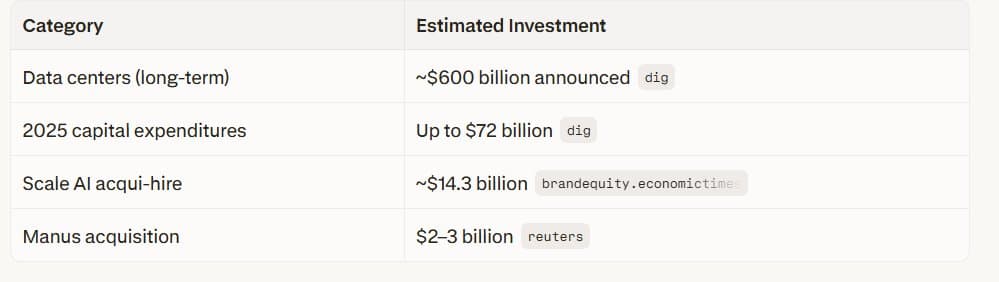
A recent analysis posted on X (formerly Twitter) by user @kimmonismus has sparked discussion by estimating that Meta has invested approximately $700 billion in AI overall, a figure that includes a recent acquihire from Scale AI, the acquisition of AI research lab Manus, and massive capital expenditure on data centers. The core critique posed is that despite this staggering financial commitment, Meta reportedly lacks an upcoming AI model that can compete with leading Chinese open-source laboratories.
The Breakdown of a $700B Estimate
The analysis provides a rough breakdown of where this colossal sum is directed:
- Scale AI Acquihire: Approximately $14.3 million. This likely refers to Meta hiring a team of AI researchers or engineers from data-labeling and evaluation platform Scale AI, a common "acquihire" strategy in the tech industry to rapidly gain talent.
- Manus Acquisition: Estimated at $2-3 billion. This is a reference to Meta's acquisition of AI research lab Manus in late 2023, a move aimed at bolstering its generative AI and reinforcement learning capabilities.
- "Several ~100m for hirings": Multiple hiring initiatives, each with budgets around $100 million, for recruiting top AI talent.
- Data Center Investment: The largest component, cited as over $600 billion. This aligns with Meta's public commitment to massive infrastructure spending. In its Q1 2024 earnings, Meta increased its 2024 capital expenditure forecast to $35-40 billion, primarily for AI infrastructure, and has signaled continued heavy investment through 2025.
The poster's fundamental question is: "What are they doing?" Given the scale of investment, the expectation is a model that leads the frontier. The claim is that Meta currently has no announced model poised to compete with state-of-the-art offerings from Chinese open-source entities like 01.AI, Qwen (Alibaba), or DeepSeek.
Context: Meta's AI Portfolio and the Competitive Landscape
Meta's public AI strategy has two prominent pillars: open-source releases and massive-scale infrastructure.
- Open-Source Leadership: Meta has been a dominant force in open-sourcing large language models (LLMs) with its Llama series. Llama 2 (July 2023) and Llama 3 (April 2024) are widely used foundational models. Llama 3 70B is a top-tier open-source model, but it generally benchmarks below the very best proprietary models from OpenAI (GPT-4, o1), Anthropic (Claude 3.5 Sonnet), and Google (Gemini 1.5 Pro).
- Infrastructure for Scale: CEO Mark Zuckerberg has repeatedly stated that building leading AI infrastructure is a primary goal. The $600B+ data center estimate, while an eye-catching aggregate, reflects a long-term bet that compute supremacy will be the key differentiator in the AI race.
The critique specifically mentions Chinese open-source labs. This is a significant and rapidly advancing segment. For example, DeepSeek's latest models have shown performance rivaling or exceeding Llama 3 70B on several benchmarks, and Qwen 2.5 has demonstrated strong coding and reasoning abilities. The implication is that despite spending orders of magnitude more, Meta's publicly visible output (Llama) is being challenged by well-funded, focused competitors abroad.
The Core Strategic Question
The analysis highlights a tension in Meta's approach: Is pouring capital into generalized AI infrastructure and talent acquisition the most effective path to producing a single, frontier-beating model? Or does it risk creating a sprawling, inefficient effort compared to more targeted research organizations?
Meta's investments are not solely about building one "GPT-4 killer." They are about:
- Powering AI recommendations across Facebook, Instagram, WhatsApp, and Threads.
- Building a full stack of AI tools (from chips to data centers to models).
- Maintaining an open-source ecosystem that attracts developers and builds industry standard.
However, for observers measuring success purely by the performance of a flagship, next-generation model, the return on a purported $700B investment appears unclear. The absence of a announced, clearly superior successor to Llama 3 fuels this perception.
gentic.news Analysis
This critique touches on a central debate in modern AI: the relationship between capital expenditure, research efficiency, and model performance. While Meta's infrastructure spend is undeniably vast, framing it as a direct $700B "investment in AI" for model development is an oversimplification. A significant portion is likely depreciating hardware for running existing services—a cost of business, not purely R&D.
However, the poster's underlying point about competitive velocity is valid and echoes concerns we've noted in prior coverage. In our analysis of Llama 3's release, we highlighted its strong performance but also its position as a top-tier open-source model, not necessarily the overall frontier leader. The AI landscape has since intensified, with Chinese labs like 01.AI (backed by Alibaba) and DeepSeek releasing highly capable models that narrow the gap. This trend of capable, well-funded open-source competitors emerging globally, often with more focused mandates than a giant like Meta, was a key prediction in our 2024 outlook.
The mention of the Manus acquisition (~$2-3B) and Scale AI acquihire fits a clear pattern for Meta: aggressive talent consolidation. Following its acquisition of AI talent from companies like Graphcore and its ongoing poaching of researchers from Google and OpenAI, Meta is betting that aggregating top minds will eventually yield breakthroughs. The success of this strategy versus more organic, focused research cultures (like Anthropic's or China's Qwen team) remains an open question.
Ultimately, this analysis confuses total aggregate spend with R&D efficiency. Meta is building a continent-sized AI factory. Whether that factory produces the most elegant and powerful single AI engine, or simply the most AI horsepower at scale, will determine if this investment is judged as astute or astoundingly wasteful. The lack of a clear, announced "next-gen" model to succeed Llama 3 is the specific data point causing observers to ask, "What are they doing?" The answer likely lies in Meta's next major model release, which will be scrutinized not just for benchmarks, but as the tangible product of this historic level of investment.
Frequently Asked Questions
How much has Meta actually invested in AI?
Meta does not disclose a single "AI investment" figure. Public data includes capital expenditure (forecast at $35-40 billion for 2024, largely for AI infrastructure), R&D costs (a portion of which is AI), and specific acquisition costs (like the Manus lab). The $700 billion estimate is an unofficial aggregate calculation that includes long-term data center build-out costs, which support all of Meta's services, not just AI model training.
What is the Scale AI acquihire mentioned?
An "acquihire" is when a company acquires another primarily to hire its employees, not for its product. While neither Meta nor Scale AI has officially announced a specific acquihire deal, the analysis suggests Meta spent approximately $14.3 million to hire a team of AI researchers or engineers from Scale AI, a company specializing in data annotation and AI evaluation. This is a common tactic in the competitive AI talent market.
Can Chinese open-source AI models really compete with Meta's Llama?
Yes, several Chinese open-source models are now highly competitive. Models like DeepSeek-V2, Qwen 2.5, and 01.AI's Yi series often match or exceed the performance of Meta's Llama 3 on standard academic benchmarks for reasoning, coding, and knowledge. This has created a vibrant, global open-source ecosystem where Meta's Llama is no longer the undisputed leader, despite the company's vastly greater resources.
Why is Meta spending so much on data centers for AI?
Meta's leadership, particularly CEO Mark Zuckerberg, believes that achieving "artificial general intelligence" (AGI) requires unprecedented scale in computing power. The massive data center investment is aimed at building a proprietary, world-leading infrastructure to train increasingly large and complex AI models, while also running AI features across its family of apps for billions of users. It's a long-term, capital-intensive bet on compute supremacy.