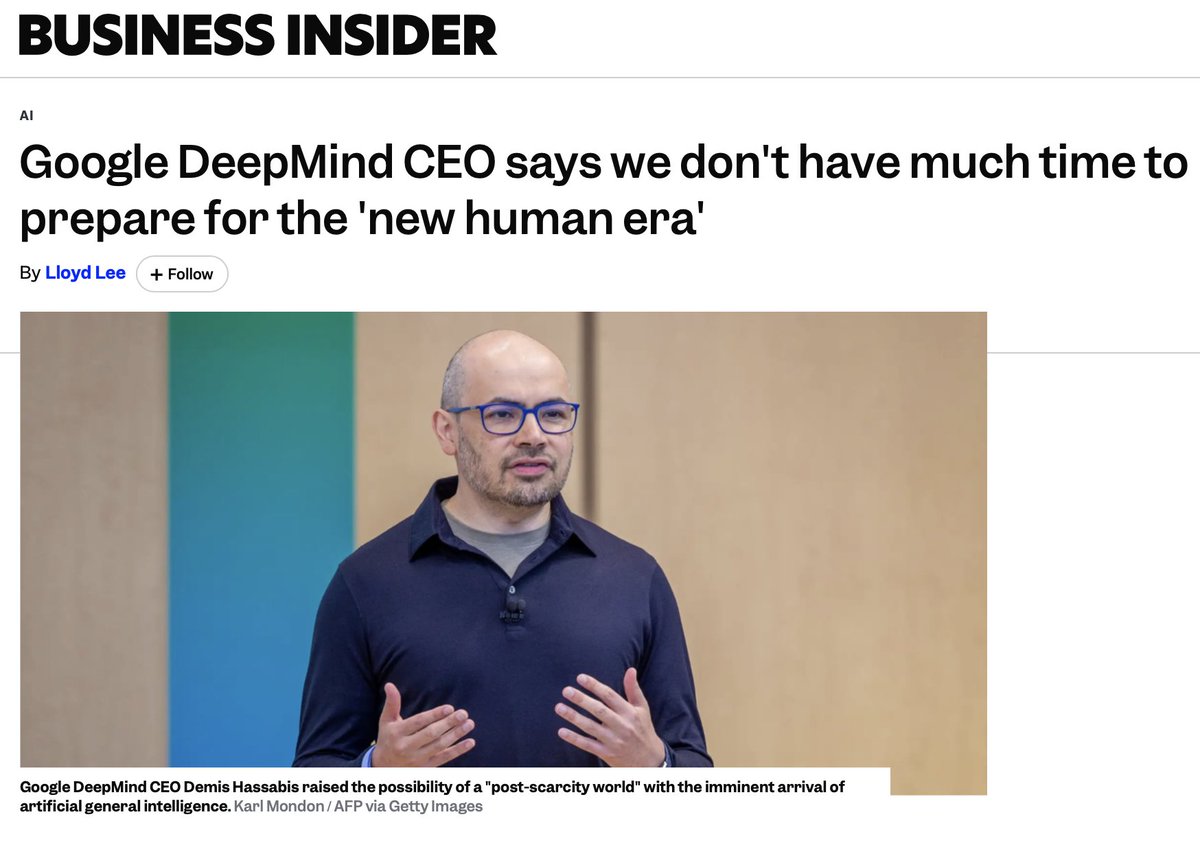
Demis Hassabis claimed we have all the components needed for AGI. The DeepMind CEO identified continual learning and memory as the remaining unsolved problems.
Key facts
- Hassabis: 'We have all the components' for AGI
- Continual learning identified as missing capability
- Memory problem remains unsolved according to DeepMind CEO
- No timeline provided for solving the two gaps
- Quote originates from @kimmonismus on X
Demis Hassabis, CEO of Google DeepMind, stated in a recent interview that the AI field has all the components necessary for artificial general intelligence. The comment, shared via @kimmonismus on X, positions DeepMind's current research as fundamentally complete except for two specific gaps: continual learning and memory systems.
Hassabis's framing is strategically significant. By declaring the components exist, he signals that the remaining work is incremental rather than foundational — a claim that diverges from more cautious voices in the field. Yann LeCun at Meta has argued we lack a sufficient understanding of how intelligence works, while Yoshua Bengio has stressed safety as the binding constraint.
The two missing capabilities — continual learning and memory — are deeply coupled. Current AI systems suffer from catastrophic forgetting when trained on new tasks, and transformer-based architectures have limited context windows that constrain long-term memory. DeepMind's own work on Neural Turing Machines (Graves et al. 2014) and Differentiable Neural Computers explored these problems but never produced production-scale solutions.
[According to @kimmonismus], Hassabis did not specify a timeline for solving these gaps. The interview clip lacks detail on whether DeepMind has internal breakthroughs or is merely stating the research agenda.
Key Takeaways
- Demis Hassabis claimed AGI components exist but continual learning and memory remain unsolved.
- The statement reframes the AGI debate from foundational to incremental.
Why this matters more than the press release suggests

Hassabis's claim is a deliberate narrative reset. For years, the AGI debate centered on whether we had the right architectures at all. By asserting the components exist, DeepMind reframes the conversation from "can we build AGI" to "when will we finish the last engineering hurdles" — a shift that benefits recruitment, investor confidence, and regulatory positioning. The missing components are precisely the areas where DeepMind has published foundational work but not deployed products, suggesting internal prioritization may be shifting toward commercialization.
What the source doesn't tell us

The single-sentence quote provides no technical specifics. Hassabis did not name which components he considers solved, what architectures he refers to, or whether the missing pieces require new research or engineering scale-up. The claim is notable primarily as a position statement from the CEO of the most prominent AGI-focused lab.
What to watch
Watch for DeepMind's next major publication or product launch. If Gemini 3 or a successor includes explicit continual learning or long-term memory modules, Hassabis's claim will have moved from aspiration to engineering reality. Any public benchmark on continual learning evaluations would signal progress.