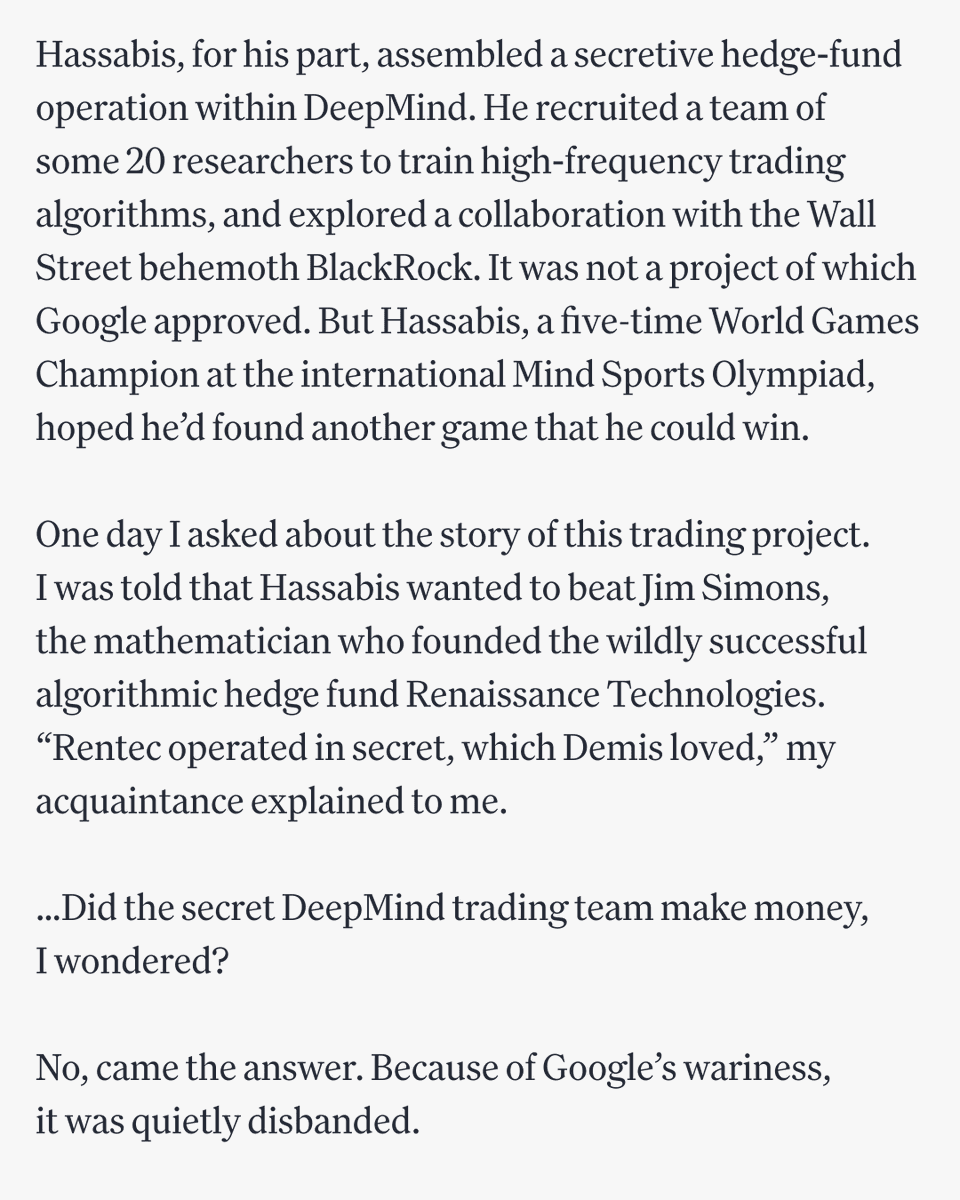
A secret internal initiative at Google's DeepMind to develop artificial intelligence for high-frequency trading (HFT) has been shut down after leadership disapproval. According to a report, DeepMind co-founder and CEO Demis Hassabis personally assembled a team of approximately 20 researchers to train AI algorithms for financial markets, with the explicit goal of competing with legendary quantitative hedge fund Renaissance Technologies.
The project operated covertly within DeepMind's London headquarters. The team's mandate was to leverage the lab's expertise in reinforcement learning and other advanced AI techniques to create predictive models and execution strategies for ultra-short-term trading. The ambition, as reported, was to directly challenge the dominance of firms like Renaissance, which has long utilized complex mathematical and computational models to achieve market-beating returns.
Google's senior leadership, upon learning of the project, reportedly intervened and ordered it to be disbanded. The initiative was terminated quietly, with no public announcement. The primary reasons for Google's disapproval were not detailed in the initial report but likely involve a combination of factors: the high-risk, speculative nature of proprietary trading conflicting with Google's core advertising business, potential regulatory and reputational complexities, and a strategic desire to keep DeepMind focused on its publicly stated missions in AI for science and general intelligence.
What Happened
Demis Hassabis, a figure known for ambitious, long-term AI bets, spearheaded the formation of a dedicated team. This move represents a significant, albeit brief, foray by one of the world's leading AI research labs into the lucrative and secretive world of quantitative finance. The project's existence highlights the perceived applicability of DeepMind's core technologies—like those used to master Go (AlphaGo) and predict protein structures (AlphaFold)—to the domain of financial market prediction and arbitrage.
The team's size (~20 researchers) suggests a project beyond a mere exploratory skunkworks. In the competitive AI talent market, dedicating two dozen top researchers indicates a serious commitment of resources and a belief in the project's potential payoff.
Context: AI's March into Finance
The use of AI and machine learning in finance is not new. Hedge funds and banks have employed increasingly sophisticated models for years. However, the entry of a pure-play, top-tier AI research lab like DeepMind signaled a potential escalation in the technological arms race. Firms like Renaissance, Two Sigma, and Citadel have built their empires on data and algorithms. A DeepMind-backed effort would have brought unprecedented firepower in deep reinforcement learning and simulation-based training—techniques that have proven extraordinarily powerful in games and scientific discovery.
Google's ultimate veto underscores the ongoing tension within Alphabet between moonshot ambitions and corporate governance. While Alphabet encourages "other bets," a clandestine trading operation with significant financial risk appears to have crossed a line for core Google leadership.
Frequently Asked Questions
What is high-frequency trading (HFT)?
High-frequency trading is a form of algorithmic trading that uses powerful computers to execute a large number of orders at extremely high speeds, often in fractions of a second. It relies on complex mathematical models to identify and exploit tiny, short-lived market inefficiencies for profit.
Why would DeepMind's AI be good for this?
DeepMind specializes in reinforcement learning (RL), where AI agents learn optimal strategies through trial and error in simulated environments. This is analogous to training an agent to trade: the market is the environment, buying/selling are the actions, and profit/loss is the reward. Techniques like those used in AlphaGo (which learned superhuman game strategies) could, in theory, be adapted to discover novel, profitable trading strategies invisible to traditional models.
Why did Google shut it down?
While not officially stated, probable reasons include: 1) Strategic Misalignment: Proprietary trading is far from Google's core business of search, advertising, and cloud computing. 2) Reputational Risk: Engaging in high-stakes financial speculation could attract regulatory scrutiny and public controversy. 3) Resource Focus: Google may have wanted DeepMind's elite researchers focused on AI advancements that benefit Google's products (e.g., Gemini) or its public-good missions in science and health, rather than a secretive financial project.
Has AI succeeded in trading before?
Yes, but with caveats. Many quantitative funds use machine learning. However, creating a consistently profitable AI-driven HFT strategy is enormously challenging due to market noise, non-stationarity (the rules change), and intense competition. Successes are closely guarded secrets. There is no publicly known AI that has achieved the long-term, legendary returns of a fund like Renaissance.
gentic.news Analysis
This report, if accurate, reveals a fascinating and previously hidden vector of ambition for Demis Hassabis and DeepMind. It follows a pattern of Hassabis exploring applied domains for DeepMind's core technology, from games to protein folding to nuclear fusion control. The financial markets represent perhaps the ultimate real-world, high-stakes reinforcement learning environment, making it a logically compelling—if ethically and strategically complex—target for the lab's capabilities.
The shutdown by Google leadership is a stark reminder of the corporate guardrails that exist even for "Other Bets." This incident aligns with the ongoing narrative of tension between Google's core business and the expansive, often expensive, ambitions of its AI research divisions. It echoes past internal debates about the commercialization paths for AI breakthroughs.
For the quantitative finance industry, this news is a shot across the bow. The mere fact that DeepMind seriously considered this arena confirms that the next frontier of competition is advanced AI, not just faster hardware or more data. While this specific project is dead, the signal it sends will likely accelerate investment in similar AI research by established hedge funds and new entrants. The technological convergence between elite AI research and finance is now undeniable. The failure of this project was not technical, but corporate-political. It demonstrates that the largest barrier to an AI lab dominating finance may not be the market's complexity, but the risk tolerance of its parent company.