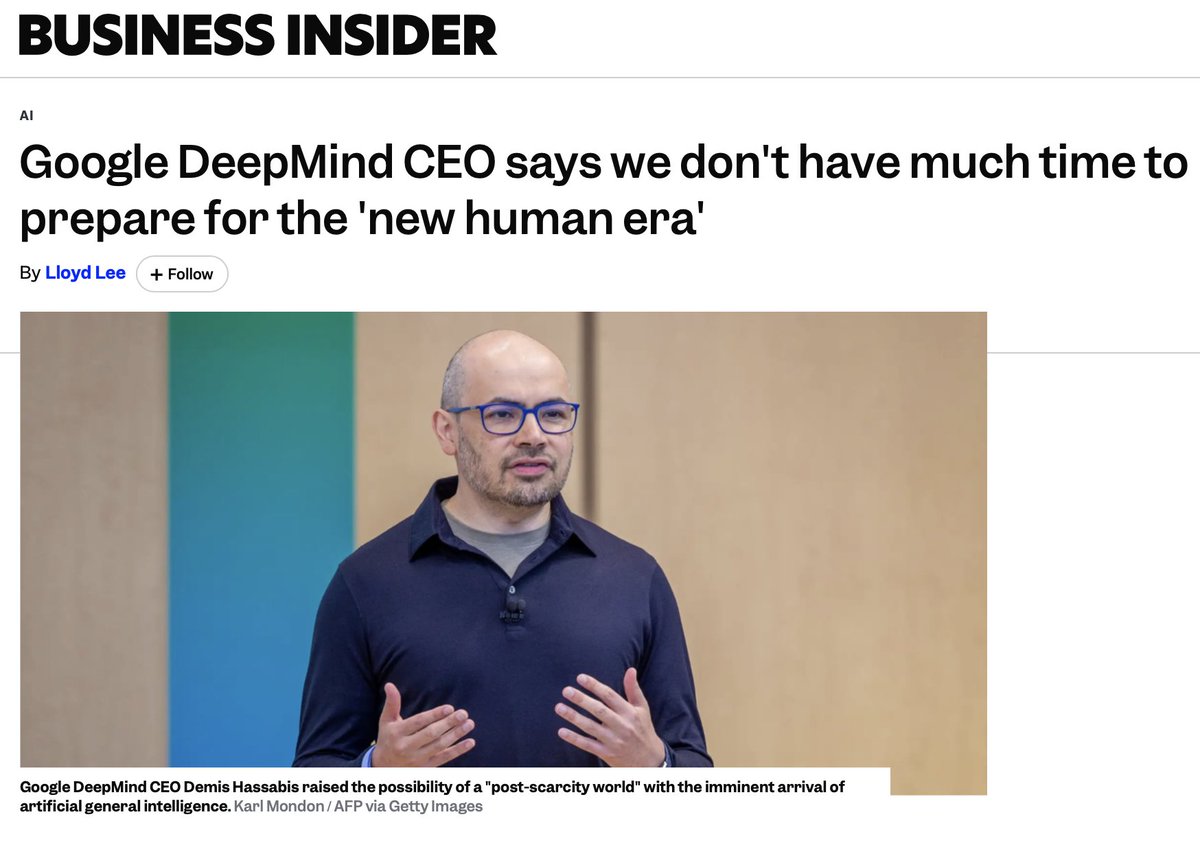
Demis Hassabis, CEO of Google's DeepMind and one of the world's foremost AI researchers, has delivered a sobering message to global leaders about the coming age of artificial general intelligence (AGI). According to recent reports from his discussions with policymakers, Hassabis warned that AGI will have "10x the impact of the industrial revolution at 10x the speed."
This stark comparison places the anticipated transformation in historical context while emphasizing its unprecedented velocity. The industrial revolution, which unfolded over approximately 80 years from the late 18th century, fundamentally reshaped economies, societies, and global power structures. If Hassabis's prediction holds true, AGI could deliver similar magnitude changes in less than a decade.
Visualizing the Economic Implications
Following Hassabis's warning, analysts have attempted to quantify what this acceleration might mean for global economic indicators. Using AI tools like Perplexity's computational capabilities, researchers have created visualizations projecting AGI's potential impact on global GDP growth.
While specific numbers from these visualizations weren't detailed in the source material, the implication is clear: we're looking at economic expansion on a scale never before witnessed in human history. The resulting conclusion from these analyses is equally concerning: "No one is ready" for the magnitude of change approaching.
Historical Context: The Industrial Revolution Benchmark
To understand Hassabis's warning, we must first appreciate what the industrial revolution achieved. Between 1760 and 1840, the world saw:
- Transition from agrarian economies to industrial manufacturing
- Development of steam power and mechanized production
- Urbanization on an unprecedented scale
- Global GDP growth that transformed living standards
- Social upheaval and new class structures
If AGI delivers ten times this impact, we could be looking at complete transformation of every economic sector, potentially including the nature of work itself, resource allocation, and global wealth distribution.
The Acceleration Factor: Why Speed Matters
The second part of Hassabis's warning—that this transformation will occur at "10x the speed"—may be even more significant than the magnitude. Historical economic transitions allowed societies decades to adapt through education reform, policy changes, and gradual workforce transitions. A tenfold acceleration would compress these adaptation periods from generations to years, potentially overwhelming existing social and governmental structures.
This rapid timeline raises critical questions about preparedness. How can educational systems redesign themselves when the skills needed might change annually? How can regulatory frameworks keep pace with technology that evolves faster than legislation can be drafted?
Global Readiness: A Concerning Assessment
The conclusion that "no one is ready" echoes concerns expressed by other AI leaders and researchers. Despite increased discussion of AI governance at forums like the UN, G7, and various AI safety summits, practical preparedness for AGI's economic impacts appears limited.
Key areas of concern include:
- Labor market disruption: Current retraining programs operate on timelines of years, not the months that might be available
- Economic inequality: Rapid value creation could exacerbate existing disparities without proactive policies
- Geopolitical stability: Nations developing AGI capabilities at different speeds could create unprecedented power imbalances
- Infrastructure adaptation: Physical and digital systems designed for gradual change may fail under rapid transformation
The Source and Its Significance
This warning comes from Demis Hassabis, whose credentials lend substantial weight to the prediction. As co-founder and CEO of DeepMind (acquired by Google in 2014), Hassabis has been at the forefront of AI development for over a decade. His company's achievements include AlphaGo (which defeated world champion Go players), AlphaFold (which revolutionized protein structure prediction), and numerous other breakthroughs in reinforcement learning and general AI capabilities.
When someone with Hassabis's technical expertise and industry position speaks to world leaders, policymakers typically pay attention. His decision to frame AGI's impact in historical terms suggests he's attempting to communicate scale in language that non-technical leaders can comprehend and act upon.
Looking Forward: What Comes Next?
Hassabis's warning represents the latest in a series of increasingly urgent messages from AI leaders about the need for preparation. The visualization work mentioned in the source material—using AI tools to model AGI's economic impact—represents an important development in itself: we're now using AI to predict AI's consequences.
As nations grapple with these predictions, several immediate questions emerge:
- How should economic models be updated to account for potential AGI-driven growth?
- What international cooperation frameworks need development to manage global impacts?
- How can societies maintain stability during potentially disruptive transitions?
- What ethical frameworks should guide AGI development and deployment?
Hassabis's message serves as both warning and call to action. The industrial revolution brought unprecedented prosperity but also created challenges that took generations to address. With AGI approaching at accelerated speed, humanity may not have the luxury of gradual adaptation.
Source: Report from Demis Hassabis's discussions with world leaders, as referenced in social media analysis.